• Fri frakt över 249 kr
  • •
  • Snabba leveranser
  • •
  • Billiga böcker
Kundservice

Du är på sajten för privatpersoner.

Företag, bibliotek eller offentlig verksamhet?

Du handlar på classic.bokus.com, där alla dina funktioner finns intakta.
Till classic.bokus.com
Bokus logotyp. Gå till startsidan.
  • Erbjudanden
  • Nyheter
  • Student
  • Topplistor
  • Barn & ungdom
  • Bokus Play
  • E-böcker
  • Pocketböcker
  • Spel & pussel

10% rabatt på allt med kod: NYSTART10 →

Sidfot

Mina sidor

    Hjälp

    • Kundservice
    • Vanliga frågor och svar
    • Frakt och leverans
    • Retur vid ångerrätt
    • Reklamera vara
    • Betalning
    • Köpvillkor
    • Allmänna villkor
    • Information om webbplatsens tillgänglighet

    Om Bokus

    • Om oss
    • Pressrum
    • För studenter
    • För företag
    • För bibliotek och offentlig verksamhet
    • För leverantörer
    • Hållbarhet

    Populärt

    • Aktuella erbjudanden
    • Presentkort
    • Studentlitteratur
    • Nya böcker
    • Topplistor
    • Signerade böcker
    • Engelska böcker

    Inspiration

    • Boktips
    • BookTok
    • Populära bokserier
    • Barnbokskaraktärer
    • Populära författare
    Logotyp för Bokus
    Följ oss på Facebook (extern länk)Följ oss på Instagram (extern länk)Följ oss på YouTube (extern länk)Följ oss på TikTok (extern länk)
    bokus @ CookiesAnpassa cookiesIntegritetspolicyKöpvillkor
    Till Citymail hemsida (extern länk)Till Budbee hemsida (extern länk)Till Postnord hemsida (extern länk)Till Schenker hemsida (extern länk)Till Early Bird hemsida (extern länk)Till Walleys hemsida (extern länk)
    1. Ekonomi och Ledarskap
    2. Ledarskapsböcker
    3. Ledarskap och motivation

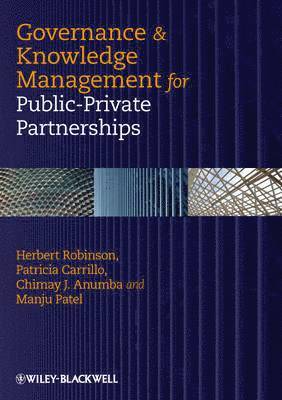
    Governance and Knowledge Management for Public-Private Partnerships

    AvHerbert Robinson,Patricia Carrillo

    Inbunden, Engelska, 2010

    1 373 kr

    Beställningsvara. Skickas inom 5-8 vardagar. Fri frakt över 249 kr.

    Beskrivning

    "The book not only gives a clear picture of the policy and strategic framework of PFI/PPP projects, the governance and knowledge management issues through different phases from planning, design development to operation and service delivery and the processes associated with each phase, but practical tools, methodologies and capabilities needed to deliver PFI/PPP projects in a range of sectors are also explained. It clearly demonstrates the key imperatives that are the hallmark of successful programmes and projects no matter what there method of funding or delivery. I have no doubt that, in undertaking the programmes and projects that I am responsible for delivering and in undertaking OGC Gateway Reviews, to support clients delivering their own programmes and projects, I will draw on the material contained in this book."—From the Foreword by Rob Smith, Director of Gateway Reviews and Estates & Facilities, Department of HealthThere is a growing demand worldwide for transport, healthcare, education, energy and water infrastructure. However, government resources are often insufficient to meet the needs of new projects and to upgrade existing infrastructure. Private participation in public infrastructure is therefore increasing but the respective roles of the public and private sectors are the subject of intense debate. This has led to renewed interest in public-private partnerships in developed and developing countries.Governance and Knowledge Management for Public-Private Partnerships shows how effective governance and knowledge management can improve the performance of PFI/PPP projects. It provides an in-depth understanding of different dimensions of governance and how they affect project management structure, processes, and decision-making ability of actors and teams involved in PFI/PPP projects. The role of knowledge management strategy, the need for benchmarking knowledge management efforts, specific tools and methodologies for capturing, sharing and applying knowledge to accelerate learning and capacity building are also examined.The book is essential reading for all those involved in PFI/PPP projects, including policy makers, industry practitioners, academics and students. The practical tools for governance and knowledge management it offers make this book particularly useful for consultants, contractors and client organisations.

    Produktinformation

    • Utgivningsdatum:2010-02-05
    • Mått:170 x 244 x 18 mm
    • Vikt:680 g
    • Format:Inbunden
    • Språk:Engelska
    • Antal sidor:264
    • Förlag:John Wiley and Sons Ltd
    • ISBN:9781405188555

    Utforska kategorier

    • Ledarskap och motivation inom Ekonomi och Ledarskap

    Mer om författaren

    Dr Herbert Robinson is Reader in Construction Economics and Project Management at London South Bank University, UK. Professor Patricia Carrillo holds a personal chair in Strategic Management in Construction, in the Department of Civil and Building Engineering at Loughborough University, UK.Professor Chimay J. Anumba is Head of the Department of Architectural Engineering at Penn State University, USA.Dr Manju Patel is Acute Sector Planning Lead at NHS Grampian in Scotland, UK and holds a council seat in the Institute of Health Engineering and Estates Management.

    Innehållsförteckning

    • Foreword About the AuthorsChapter 1 Introduction1.1 The Context1.2 Key Drivers of PPP/PFI1.3 Definitions and Key Features1.4 Types of PPP/PFI Projects1.5 Evolution and Development of PPP/PFI1.6 Need for Governance and Knowledge Management1.7 Organisation of the Chapters1.7.1 Part 11.7.2 Part 21.7.3 Part 31.7.4 Part 4ReferencesChapter 2 Policy and Strategic Framework2.1 Introduction2.2 The Policy Framework2.2.1 Policy environment2.2.2 Policy theory and objectives2.2.3 Monitoring and evaluation2.2.4 Institutions and roles2.2.5 Expertise and resources2.2.6 Processes2.2.7 Information and knowledge systems2.3 Governing Principles of PFI Projects2.3.1 Value for money and risk transfer2.3.2 Whole life cycle commitment2.3.3 Facilitating the delivery of ‘core’ public services2.3.4 Payments for services based on performance2.4 Management Strategy2.4.1 Team composition2.4.2 Contract and interface management2.4.3 Stakeholder engagement2.5 Funding Strategy2.5.1 Debt and equity component2.5.2 Project structuring, bankability and credit enhancement2.6 Sustainability Strategy2.7 European and International Perspective2.8 Concluding RemarksReferencesChapter 3 Implementation and Delivery Mechanisms3.1 Introduction3.2 Needs Assessment and Business Case Development3.2.1 The output specification3.2.2 Risk transfer3.2.3 Risk pricing3.3 Advertisement, Pre-Qualification and Bidding3.4 Competitive Negotiation and Dialogue Procedures3.5 Evaluation of Bids3.5.1 Value for money3.5.2 Affordability3.6 Preferred Bidder and Financial Close3.6.1 Whole life cost plan3.6.2 Financial modelling3.6.3 Due diligence3.7 Construction Activities3.8 Operation and Service Delivery3.8.1 Performance monitoring3.8.2 Payment mechanism3.8.3 Handing back3.9 Concluding RemarksReferencesChapter 4 Governance in Project Delivery4.1 Introduction4.2 Definitions and Principles of Governance4.3 Key Components of Governance4.3.1 Organisational structure4.3.2 Control and monitoring mechanisms4.4 Planning and Development Phase of PPP/PFI Project4.4.1 Organisational structure and accountability4.4.2 Project approval processes4.4.3 Project controls and gateways4.4.4 Post-project evaluation4.5 Construction Phase of PPP/PFI Projects4.5.1 Design controls for construction4.5.2 Project management4.5.3 Project performance4.6 Operation and Service Delivery Phase of PPP/PFI Project4.6.1 Control and monitoring of service delivery4.6.2 Organisational structure4.7 Concluding RemarksReferencesChapter 5 Case Studies on Governance in the Health Sector5.1 Introduction5.2 Overview of Health Sector and Evolution of PFI/PPP Projects5.3 Case Study Findings on Early PFI Schemes5.4 Case Study Findings on Complex PFI Schemes5.5 Analysis and Discussion of Case Studies (5.1–5.4)5.5.1 Reporting structure and levels of responsibilities5.5.2 Effective controls5.5.3 Project management5.5.4 Risk management5.5.5 Critical success factors (CSF) in projects5.5.6 Critical failure factors in projects5.5.7 Project outcome5.6 Concluding RemarksReferencesChapter 6 Knowledge Management in Collaborative Projects6.1 Introduction6.2 Knowledge and Associated Concepts6.3 Knowledge Management6.4 Theory of Knowledge Creation6.5 Types of Knowledge and Project Complexity6.6 KM Life Cycle6.7 KM Systems6.7.1 KM technologies6.7.2 KM techniques6.8 Learning in Project Organisations6.9 Developing a Business Case for KM6.10 Development of a KM Strategy6.11 KM Toolkit for PFI/PPP Projects6.12 Concluding RemarksReferencesChapter 7 Case Studies on Knowledge Transfer7.1 Introduction7.2 Key Problem Areas and Scope for Learning7.2.1 Outline business case7.2.2 PB7.2.3 FM7.3 The Need for Knowledge Transfer7.4 Improvement Capability and Organisational Readiness7.5 Concluding RemarksReferencesChapter 8 Knowledge and Capacity Building Challenges8.1 Introduction8.2 Roles and Participation8.3 Motivation and Perception8.4 Value for Money, Costs, Innovation and Risks8.5 Enablers and Barriers8.5.1 Expertise and knowledge8.5.2 Procurement periods8.5.3 Other barriers8.5.4 Unique PFI issues8.6 Scope for Learning and Developing Knowledge8.6.1 Output specification and client requirements8.6.2 Project management structure8.6.3 Risks8.6.4 Design innovation/quality8.6.5 Standardisation of documents8.6.6 Market capacity and public perception8.7 Developing Knowledge for Capacity Building8.7.1 Knowledge centres8.7.2 Dedicated PPP units8.7.3 Best practice and guidance documents8.7.4 Traditional training and CPD events8.7.5 Knowledge sharing networks and communities of practice8.7.6 Conferences, seminars and workshops8.7.7 Staff exchange and secondment8.7.8 External advisers and technical assistance8.7.9 Research and innovation capacity8.8 Concluding RemarksReferencesChapter 9 The Knowledge Transfer Framework9.1 Introduction9.2 Knowledge Transfer Issues9.2.1 Knowledge transfer needs9.2.2 Types of knowledge to transfer9.2.3 Mechanisms for knowledge transfer9.2.4 Knowledge transfer problems9.3 The Knowledge Transfer Conceptual Model9.4 Improving PFI/PPP Participation and Exploring Opportunities (Stage 1)9.5 Building a Knowledge Map and Transfer Capability (Stage 2)9.6 Creating an Action Plan for Learning and Capacity Building (Stage 3)9.7 Evaluation of Framework9.8 Industrial Application, Dissemination and Benefits9.9 Concluding RemarksReferencesChapter10 Conclusion10.1 Governance Issues10.2 Knowledge Management and Capacity Building Issues10.3 Sustainability of PFI/PPP ProjectsReferenceAppendix A An Example of Output Specification (Accommodation Standard)Appendix B1 Output Specification (Facilities Management Standard)Appendix B2 Example of Performance Parameters (Car Park)Appendix C Performance Measurement SystemIndex