• Fri frakt över 249 kr
  • •
  • Snabba leveranser
  • •
  • Billiga böcker
Kundservice

Du är på sajten för privatpersoner.

Företag, bibliotek eller offentlig verksamhet?

Du handlar på classic.bokus.com, där alla dina funktioner finns intakta.
Till classic.bokus.com
Bokus logotyp. Gå till startsidan.
  • Erbjudanden
  • Nyheter
  • Student
  • Topplistor
  • Barn & ungdom
  • Bokus Play
  • E-böcker
  • Pocketböcker
  • Spel & pussel

10% rabatt på allt med kod NYSTART10 →

Sidfot

Mina sidor

    Hjälp

    • Kundservice
    • Vanliga frågor och svar
    • Frakt och leverans
    • Retur vid ångerrätt
    • Reklamera vara
    • Betalning
    • Köpvillkor
    • Allmänna villkor
    • Information om webbplatsens tillgänglighet

    Om Bokus

    • Om oss
    • Pressrum
    • För studenter
    • För företag
    • För bibliotek och offentlig verksamhet
    • För leverantörer
    • Hållbarhet

    Populärt

    • Aktuella erbjudanden
    • Presentkort
    • Studentlitteratur
    • Nya böcker
    • Topplistor
    • Signerade böcker
    • Engelska böcker

    Inspiration

    • Boktips
    • BookTok
    • Populära bokserier
    • Barnbokskaraktärer
    • Populära författare
    Logotyp för Bokus
    Följ oss på Facebook (extern länk)Följ oss på Instagram (extern länk)Följ oss på YouTube (extern länk)Följ oss på TikTok (extern länk)
    bokus @ CookiesAnpassa cookiesIntegritetspolicyKöpvillkor
    Till Citymail hemsida (extern länk)Till Budbee hemsida (extern länk)Till Postnord hemsida (extern länk)Till Schenker hemsida (extern länk)Till Early Bird hemsida (extern länk)Till Walleys hemsida (extern länk)
    1. Naturvetenskap och teknik
    2. Geovetenskap
    3. Miljövetenskap och miljöpolitik

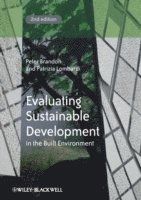
    Evaluating Sustainable Development in the Built Environment

    AvPeter S. Brandon,Patrizia Lombardi

    Inbunden, Engelska, 2010

    1 115 kr

    Beställningsvara. Skickas inom 5-8 vardagar. Fri frakt över 249 kr.

    Beskrivning

    The first edition was extremely well received, providing an introduction and insight to this important topic in a comprehensive yet easy to read form. It was chosen to be issued to the representatives of the organizations from the G8 and G20 countries attending the University Summit held in Turin in 2009 which addressed the issue of how education and research can assist sustainable development.  The second edition, completely updated to reflect the significant advances and new insights that have been made since publication of the first edition, focuses on two main issues: Facilitating a dialogue between all stakeholders so that the complexity of the problem can be exposed, structured and communicatedUnderstanding how to assess progress in sustainable developmentIt continues to provide coherent guidance on the techniques that can be used to assess sustainable development in a rigorous manner. The approach is introduced using illustrations and case studies, together with follow-up references. It remains the ideal starting point for those trying to get a handle on the subject and for those who wish to examine a structured and systematic approach to the evaluation of sustainable development in the built environment.

    Produktinformation

    • Utgivningsdatum:2010-10-28
    • Mått:178 x 254 x 20 mm
    • Vikt:763 g
    • Format:Inbunden
    • Språk:Engelska
    • Antal sidor:280
    • Upplaga:2
    • Förlag:John Wiley and Sons Ltd
    • ISBN:9781405192583

    Utforska kategorier

    • Miljövetenskap och miljöpolitik inom Naturvetenskap och teknik
    • Regional planering inom Naturvetenskap och teknik

    Mer om författaren

    Peter Brandon was Pro-Vice Chancellor for Research and Postgraduate Studies at the University of Salford and Director of the University Think Lab. He is now Director of Strategic Programmes and Professor Emeritus in the School of the Built Environment. Patrizia Lombardi is Associate Professor in the City and Housing Department at the Politecnico di Torino. She has coordinated or served as lead partner in several pan-European projects on topics related to sustainable urban development.

    Innehållsförteckning

    • About the Authors. Preface.Acknowledgements.1 Setting the Context for Evaluating Sustainable Development.The environmental perspective.The international policy debates.Extension of the debate.The impact of the built environment.The current response of the built environment community.Sustainability: a definition.Seeking a shared set of values.Striving for a common framework and classification system.The characteristics of assessment and measurement for sustainable development.Management and intervention for sustainable development.Implementing management decisions.Summary.2 Time and Sustainability.Innovation and stability.Perceptions of sustainable development.Critical failure points.Time in evaluation.Future aversion.Clever or wise?Practical assessment of 'time'.The luxury of the 'time' horizon.3 Approaches to Evaluation.The Natural Step.The concept of community capital.The ecological footprint.Monetary (capital) approach.The driving force-state-response model.Issues or theme-based frameworks.Accounting frameworks.Frameworks of assessment methods' tool kits.Summary and conclusions.4 Indicators and Measures.Why evaluate?Traditional versus sustainable development indicators.Generic and specific questions.International indicators.Aggregated indicators.Discussion.Summary.5 Assessment Methods.A directory of assessment methods.An outline summary of the main assessment methods, tools and procedures in use.Summary and conclusions.6 A Proposed Framework for Evaluating Sustainable Development.The need for a holistic and integrated framework.The theoretical underpinning of the framework.The built environment explained by the modalities.The 15 modalities for understanding sustainable development in the built environment.Development of the multi-modal framework for decision-making.Key questions for examining sustainable development within each modality.Synthesis of results.Summary.7 The Framework as a Structuring Tool: Case Studies.Case study 1: selection of a municipal waste treatment system.Case study 2: evaluation of sustainable redevelopment scenarios for an urban area.Case study 3: ‘multi-stakeholder’ urban regeneration decision-making.Case study 4: social reporting of Modena City strategic plan.Summary and conclusion.8 Towards Management Systems and Protocols.Who manages?The planning framework.Management in a learning organisation.Soft system methodology.Wicked problems.Process protocols.A possible approach.The Vancouver study.The conclusions of the Vancouver study.Follow through on the Vancouver study.Resilience.9 Education and Research.A research agenda.In conclusion.Appendix A: The Philosophy of the 'Cosmonomic Idea of Reality'.References.Websites.Bibliography.Index.