• Fri frakt över 249 kr
  • •
  • Snabba leveranser
  • •
  • Billiga böcker
Kundservice

Du är på sajten för privatpersoner.

Företag, bibliotek eller offentlig verksamhet?

Du handlar på classic.bokus.com, där alla dina funktioner finns intakta.
Till classic.bokus.com
Bokus logotyp. Gå till startsidan.
  • Erbjudanden
  • Nyheter
  • Student
  • Topplistor
  • Barn & ungdom
  • Bokus Play
  • E-böcker
  • Pocketböcker
  • Spel & pussel

10% rabatt på allt med kod: NYSTART10 →

Sidfot

Mina sidor

    Hjälp

    • Kundservice
    • Vanliga frågor och svar
    • Frakt och leverans
    • Retur vid ångerrätt
    • Reklamera vara
    • Betalning
    • Köpvillkor
    • Allmänna villkor
    • Information om webbplatsens tillgänglighet

    Om Bokus

    • Om oss
    • Pressrum
    • För studenter
    • För företag
    • För bibliotek och offentlig verksamhet
    • För leverantörer
    • Hållbarhet

    Populärt

    • Aktuella erbjudanden
    • Presentkort
    • Studentlitteratur
    • Nya böcker
    • Topplistor
    • Signerade böcker
    • Engelska böcker

    Inspiration

    • Boktips
    • BookTok
    • Populära bokserier
    • Barnbokskaraktärer
    • Populära författare
    Logotyp för Bokus
    Följ oss på Facebook (extern länk)Följ oss på Instagram (extern länk)Följ oss på YouTube (extern länk)Följ oss på TikTok (extern länk)
    bokus @ CookiesAnpassa cookiesIntegritetspolicyKöpvillkor
    Till Citymail hemsida (extern länk)Till Budbee hemsida (extern länk)Till Postnord hemsida (extern länk)Till Schenker hemsida (extern länk)Till Early Bird hemsida (extern länk)Till Walleys hemsida (extern länk)
    1. Kultur
    2. Arkitektur

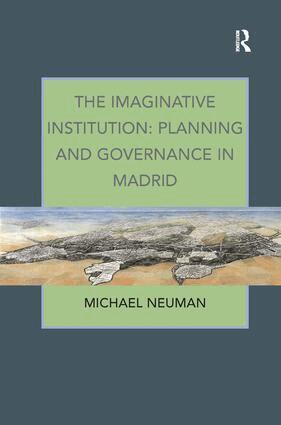
    Imaginative Institution: Planning and Governance in Madrid

    AvMichael Neuman

    Inbunden, Engelska, 2010

    2 724 kr

    Beställningsvara. Skickas inom 10-15 vardagar. Fri frakt över 249 kr.

    Fler format och utgåvor

    Häftad

    821 kr

    E-bok

    975 kr

    E-bok

    1 002 kr

    Beskrivning

    Every 20 years since 1920, Madrid has undergone an urban planning cycle in which a city plan was prepared, adopted by law, and implemented by a new institution. This preparation-adoption-institutionalization sequence, along with the institution's structures and procedures, have persisted - with some exceptions - despite frequent upheavals in society. The planning institution itself played a lead role in maintaining continuity, traumatic history notwithstanding. Why and how was this the case? Madrid's planners, who had mostly trained as architects, invented new images for the city and metro region: images of urban space that were social constructs, the products of planning processes. These images were tools that coordinated planning and urban policy. In a complex, fragmented institutional milieu in which scores of organized interests competed in overlapping policy arenas, images were a cohesive force around which plans, policies, and investments were shaped. Planners in Madrid also used their images to build new institutions. Images began as city or metropolitan designs or as a metaphor capturing a new vision. New political regimes injected their principles and beliefs into the governing institution via images and metaphors. These images went a long way in constituting the new institution, and in helping realize each regime's goals. This empirically-based life cycle theory of institutional evolution suggests that the constitutional image sustaining the institution undergoes a change or is replaced by a new image, leading to a new or reformed institution. A life cycle typology of institutional transformation is formulated with four variables: type of change, stimulus for change, type of constitutional image, and outcome of the transformation. By linking the life cycle hypothesis with cognitive theories of image formation, and then situating their synthesis within a frame of cognition as a means of structuring the institution, this book arrives at a new theory

    Produktinformation

    • Utgivningsdatum:2010-10-19
    • Mått:156 x 234 x 18 mm
    • Vikt:544 g
    • Format:Inbunden
    • Språk:Engelska
    • Antal sidor:254
    • Förlag:Taylor & Francis Ltd
    • ISBN:9781409405412

    Utforska kategorier

    • Arkitektur inom Kultur
    • Sociologi inom Samhälle och politik
    • Regional planering inom Naturvetenskap och teknik

    Mer om författaren

    Michael Neuman is at the Faculty of the Built Environment, University of New South Wales, Sydney, Australia

    Recensioner i media

    'Firstly, congratulations. It's truly a magnificent book and, I believe, extremely important from the Madrid perspective where there is a dearth of analysis and critical perspective.' Javier Ruiz, Universidad Politecnica de Madrid, Spain 'Michael Neuman has tackled and unravelled the fundamental elements that underpin successful urban governance and public administration. He has delivered a conceptual framework to guide anyone interested in designing, delivering and managing urban environments. With the pressing need to transform cities to be environmentally sustainable, I can think of no better guide for planners, urban designers, landscape architects, architects, urban managers and politicians at every level of government than this book.' Alec Tzannes, UNSW Sydney, Australia '... The Imaginative Institution is a well-written book that both urban scholars and planners, along with scholars in numerous other disciplines, will welcome. ... Neuman succeeds in the integration of multidisciplinary perspectives to inform his work on the historic and contempormy development of regional planning in Madrid.' Journal of Planning Education and Research

    Innehållsförteckning

    • Contents: Preface; Taming the metropolitan medusa; Institutional evolution and cognition: an overview; Planning institutions and images: a brief review; Planning, images, and Madrid's new regional government; The evolution of Madrid's modern planning institution; Urban planning and images; Continuity and change: the dialectic of institutional evolution; Prolegomena to a theory of institutional evolution; Appendices; References; Index