• Fri frakt över 249 kr
  • •
  • Snabba leveranser
  • •
  • Billiga böcker
Kundservice

Du är på sajten för privatpersoner.

Företag, bibliotek eller offentlig verksamhet?

Du handlar på classic.bokus.com, där alla dina funktioner finns intakta.
Till classic.bokus.com
Bokus logotyp. Gå till startsidan.
  • Erbjudanden
  • Nyheter
  • Student
  • Topplistor
  • Barn & ungdom
  • Bokus Play
  • E-böcker
  • Pocketböcker
  • Spel & pussel

10% rabatt på allt med kod: NYSTART10 →

Sidfot

Mina sidor

    Hjälp

    • Kundservice
    • Vanliga frågor och svar
    • Frakt och leverans
    • Retur vid ångerrätt
    • Reklamera vara
    • Betalning
    • Köpvillkor
    • Allmänna villkor
    • Information om webbplatsens tillgänglighet

    Om Bokus

    • Om oss
    • Pressrum
    • För studenter
    • För företag
    • För bibliotek och offentlig verksamhet
    • För leverantörer
    • Hållbarhet

    Populärt

    • Aktuella erbjudanden
    • Presentkort
    • Studentlitteratur
    • Nya böcker
    • Topplistor
    • Signerade böcker
    • Engelska böcker

    Inspiration

    • Boktips
    • BookTok
    • Populära bokserier
    • Barnbokskaraktärer
    • Populära författare
    Logotyp för Bokus
    Följ oss på Facebook (extern länk)Följ oss på Instagram (extern länk)Följ oss på YouTube (extern länk)Följ oss på TikTok (extern länk)
    bokus @ CookiesAnpassa cookiesIntegritetspolicyKöpvillkor
    Till Citymail hemsida (extern länk)Till Budbee hemsida (extern länk)Till Postnord hemsida (extern länk)Till Schenker hemsida (extern länk)Till Early Bird hemsida (extern länk)Till Walleys hemsida (extern länk)
    1. Samhälle och politik
    2. Sociologi och antropologi
    3. Sociologi

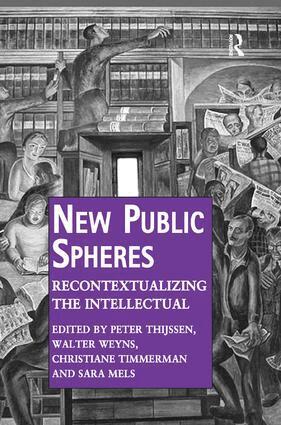
    New Public Spheres

    Recontextualizing the Intellectual

    AvPeter Thijssen,Walter Weyns

    Inbunden, Engelska, 2013

    Del i serien Public Intellectuals and the Sociology of Knowledge

    2 421 kr

    Beställningsvara. Skickas inom 10-15 vardagar. Fri frakt över 249 kr.

    Fler format och utgåvor

    Häftad

    765 kr

    Beskrivning

    The public sphere provides a domain of social life in which public opinion is expressed by means of rational discourse and debate. Habermas linked its historical development to the coffee houses and journals in England, Parisian salons and German reading clubs. He described it as a bourgeois public sphere, where private people come together and where they turn from a politically disempowered bourgeoisie into an effective political agent - the public intellectual. With communication networks being diversified and expanded over time, the worldwide web has put pressure on traditional public spheres. These new informal and horizontal networks shaped by the internet create new contexts in which an anonymous and dispersed public may gather in political e-communities to reflect critically on societal issues. These de-centered modes of communication and influence-seeking change the role of the (traditional) public intellectual and - at first sight - seem to make their contributions less influential. What processes, therefore, influence changes within public spheres and how can intellectuals assert authority within them? Should we speak of different types of intellectuals, according to the different modes of public intellectual engagement? This ground-breaking volume gives a multi-disciplinary account of the way in which public intellectuals have constructed their role and position in the public sphere in the past, and how they try to voice public concerns and achieve authority again within those fragmented public spheres today.

    Produktinformation

    • Utgivningsdatum:2013-11-21
    • Mått:156 x 234 x 20 mm
    • Vikt:544 g
    • Format:Inbunden
    • Språk:Engelska
    • Serie:Public Intellectuals and the Sociology of Knowledge
    • Antal sidor:234
    • Förlag:Taylor & Francis Ltd
    • ISBN:9781409460923

    Utforska kategorier

    • Sociologi inom Samhälle och politik

    Mer om författaren

    Peter Thijssen is Professor of Political Science at the University of Antwerp, Belgium. Walter Weyns is Professor of Sociology at the University of Antwerp, Belgium. Christiane Timmerman is Director, CeMIS (Centre for Migration and Intercultural Studies) at the University of Antwerp, Belgium. Sara Mels, University Centre Saint Ignatius Antwerp, Belgium.

    Recensioner i media

    ’In a mediated era, the public sphere is up for critical reconsideration. This book is a vital step in that direction. It also provides the materials for rethinking the contemporary role of the public intellectual in a time when the public no longer exists. I heartily recommend it.’ Willem Schinkel, Erasmus University Rotterdam, The Netherlands

    Innehållsförteckning

    • Introduction New Public Spheres: Recontextualizing the Intellectual, Peter Thijssen, Walter Weyns, Christiane Timmerman; Part I History and Contemporary Developments; Chapter 1 The Intellectual in the Public Sphere: Projections, Contradictions and Dilemmas since the Enlightenment, Harold Mah; Chapter 2 The Rise of the Embedded Intellectual: New Forms of Public Engagement and Critique, Patrick Baert, Alan Shipman; Chapter 3 From Public to Civic Intellectuals: Political Agency and Emerging Media Landscapes, Peter Dahlgren; Part II The Internet and the Public Intellectual; Chapter 4 Intellectuals, the Public Sphere and Dissemination Strategies, France Aubin; Chapter 5 How Salonfähig Are Online Political Forums? The Curious Case of Politics.be, Peter Thijssen; Chapter 6 The Creation of New Public Places: A Critique of Bruno Latour and Peter Weibel, Frank Maet; Part III Women and the Public Sphere; Chapter 7 Immigrant Intellectual: The Case of Ayaan Hirsi Ali, Odile Heynders; Chapter 8 Building Solidarity through Relationships: The Politics of Feminism as an Intellectual Project in Turkey, Nazan Haydari; Part IV Subcultures in the Public Sphere; Chapter 9 Public Intellectuals and Micro-public Spheres: A British Illustration, Richard McCallum; Chapter 10 Public Intellectuals and Public Spheres: Who Is Left to Speak to the Public? Yusuf al-Qaradawi: Shaper of an Agonistic Discourse, Zvi Bar’el; Chapter 11 Reputation among the Hungarian Intellectual Elite, Luca Kristóf;