• Fri frakt över 249 kr
  • •
  • Snabba leveranser
  • •
  • Billiga böcker
Kundservice

Du är på sajten för privatpersoner.

Företag, bibliotek eller offentlig verksamhet?

Du handlar på classic.bokus.com, där alla dina funktioner finns intakta.
Till classic.bokus.com
Bokus logotyp. Gå till startsidan.
  • Erbjudanden
  • Nyheter
  • Student
  • Topplistor
  • Barn & ungdom
  • Bokus Play
  • E-böcker
  • Pocketböcker
  • Spel & pussel

10% rabatt på allt med kod NYSTART10 →

Sidfot

Mina sidor

    Hjälp

    • Kundservice
    • Vanliga frågor och svar
    • Frakt och leverans
    • Retur vid ångerrätt
    • Reklamera vara
    • Betalning
    • Köpvillkor
    • Allmänna villkor
    • Information om webbplatsens tillgänglighet

    Om Bokus

    • Om oss
    • Pressrum
    • För studenter
    • För företag
    • För bibliotek och offentlig verksamhet
    • För leverantörer
    • Hållbarhet

    Populärt

    • Aktuella erbjudanden
    • Presentkort
    • Studentlitteratur
    • Nya böcker
    • Topplistor
    • Signerade böcker
    • Engelska böcker

    Inspiration

    • Boktips
    • BookTok
    • Populära bokserier
    • Barnbokskaraktärer
    • Populära författare
    Logotyp för Bokus
    Följ oss på Facebook (extern länk)Följ oss på Instagram (extern länk)Följ oss på YouTube (extern länk)Följ oss på TikTok (extern länk)
    bokus @ CookiesAnpassa cookiesIntegritetspolicyKöpvillkor
    Till Citymail hemsida (extern länk)Till Budbee hemsida (extern länk)Till Postnord hemsida (extern länk)Till Schenker hemsida (extern länk)Till Early Bird hemsida (extern länk)Till Walleys hemsida (extern länk)
    1. Samhälle och politik
    2. Sociologi och antropologi
    3. Sociologi

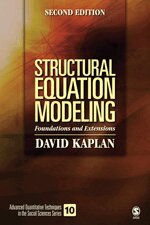
    Structural Equation Modeling

    Foundations and Extensions

    AvDavid W. Kaplan

    Inbunden, Engelska, 2008

    Del 10 i serien Advanced Quantitative Techniques in the Social Sciences

    2 712 kr

    Beställningsvara. Skickas inom 3-6 vardagar. Fri frakt över 249 kr.

    Beskrivning

    Using detailed, empirical examples, Structural Equation Modeling, Second Edition, presents a thorough and sophisticated treatment of the foundations of structural equation modeling (SEM). It also demonstrates how SEM can provide a unique lens on the problems social and behavioral scientists face.

    Intended Audience

    While the book assumes some knowledge and background in statistics, it guides readers through the foundations and critical assumptions of SEM in an easy-to-understand manner.

    Produktinformation

    • Utgivningsdatum:2008-09-04
    • Mått:152 x 228 x 18 mm
    • Vikt:480 g
    • Format:Inbunden
    • Språk:Engelska
    • Serie:Advanced Quantitative Techniques in the Social Sciences
    • Antal sidor:272
    • Upplaga:2
    • Förlag:SAGE Publications
    • ISBN:9781412916240

    Utforska kategorier

    • Sociologi inom Samhälle och politik

    Mer om författaren

    David Kaplan received his Ph.D. in Education from UCLA in 1987. He is now a Professor of Education and (by courtesy) Psychology at the University of Delaware. His research interests are in the development and application of statistical models to problems in educational evaluation and policy analysis. His current program of research concerns the development of dynamic latent continuous and categorical variable models for studying the diffusion of educational innovations.

    Recensioner i media

    The students found it difficult to understand, it is suitable for PhD research or higher

    Innehållsförteckning

    • Preface to the Second Edition1. Historical Foundations of Structural Equation Modeling for Continuous and Categorical Latent Variables2. Path Analysis: Modeling Systems of Structural Equations Among Observed Variables3. Factor Analysis4. Structural Equation Models in Single and Multiple Groups5. Statistical Assumptions Underlying Structural Equation Modeling6. Evaluating and Modifying Structural Equation Models7. Multilevel Structural Equation Modeling8. Latent Growth Curve Modeling9. Structural Models for Categorical and Continuous Latent Variables10. Epilogue: Toward a New Approach to the Practice of Structural Equation Modeling