• Fri frakt över 249 kr
  • •
  • Snabba leveranser
  • •
  • Billiga böcker
Kundservice

Du är på sajten för privatpersoner.

Företag, bibliotek eller offentlig verksamhet?

Du handlar på classic.bokus.com, där alla dina funktioner finns intakta.
Till classic.bokus.com
Bokus logotyp. Gå till startsidan.
  • Erbjudanden
  • Student
  • Topplistor
  • Barn & ungdom
  • Bokus Play
  • E-böcker
  • Ljudböcker
  • Pocketböcker
  • Spel och pussel

Pocketfynda! Hundratals böcker för 49 kr/st →

Sidfot

Mina sidor

    Hjälp

    • Kundservice
    • Vanliga frågor och svar
    • Frakt och leverans
    • Retur vid ångerrätt
    • Reklamera vara
    • Betalning
    • Köpvillkor
    • Allmänna villkor
    • Information om webbplatsens tillgänglighet

    Om Bokus

    • Om oss
    • Pressrum
    • För studenter
    • För företag
    • För bibliotek och offentlig verksamhet
    • För leverantörer
    • Hållbarhet

    Populärt

    • Aktuella erbjudanden
    • Presentkort
    • Studentlitteratur
    • Nya böcker
    • Topplistor
    • Signerade böcker
    • Engelska böcker

    Inspiration

    • Boktips
    • BookTok
    • Barnbokskaraktärer
    • Populära författare
    Logotyp för Bokus
    Följ oss på Facebook (extern länk)Följ oss på Instagram (extern länk)Följ oss på YouTube (extern länk)Följ oss på TikTok (extern länk)
    bokus @ CookiesAnpassa cookiesIntegritetspolicyKöpvillkor
    Till Citymail hemsida (extern länk)Till Budbee hemsida (extern länk)Till Postnord hemsida (extern länk)Till Schenker hemsida (extern länk)Till Early Bird hemsida (extern länk)Till Walleys hemsida (extern länk)
    1. Naturvetenskap och teknik
    2. Matematik och naturvetenskap
    3. Matematik
    4. Tillämpad matematik

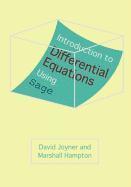
    Introduction to Differential Equations Using Sage

    AvDavid Joyner,Marshall Hampton

    Inbunden, Engelska, 2012

    626 kr

    Tillfälligt slut

    Beskrivning

    David Joyner and Marshall Hampton's lucid textbook explains differential equations using the free and open-source mathematical software Sage. Since its release in 2005, Sage has acquired a substantial following among mathematicians, but its first user was Joyner, who is credited with helping famed mathematician William Stein turn the program into a usable and popular choice. Introduction to Differential Equations Using Sage extends Stein's work by creating a classroom tool that allows both differential equations and Sage to be taught concurrently. It's a creative and forward-thinking approach to math instruction. Topics include: * First-Order Differential Equations * Incorporation of Newtonian Mechanics* Second-Order Differential Equations* The Annihilator Method* Using Linear Algebra with Differential Equations* Nonlinear Systems* Partial Differential Equations* Romeo and Juliet

    Produktinformation

    • Utgivningsdatum:2012-10-27
    • Mått:178 x 254 x 27 mm
    • Vikt:703 g
    • Format:Inbunden
    • Språk:Engelska
    • Antal sidor:280
    • Förlag:Johns Hopkins University Press
    • ISBN:9781421406374

    Utforska kategorier

    • Tillämpad matematik inom Naturvetenskap och teknik
    • Beräkning och matematisk analys inom Naturvetenskap och teknik

    Mer om författaren

    David Joyner is a professor in the Mathematics Department at the U.S. Naval Academy. He is the author of Adventures in Group Theory: Rubik's Cube, Merlin's Machine, and Other Mathematical Toys, also published by Johns Hopkins. Marshall Hampton is a professor in the Department of Mathematics and Statistics at the University of Minnesota, Duluth.

    Recensioner i media

    This book, with its many practice examples, would be ideal for those in the first year of a mathematics degree course and for those studying for working in physics or any area requiring a good knowledge of differential equations. -- Adrian Hamilton Institute of Mathematics and its Applications ... [ Introduction to Differential Equations Using Sage] provides a nice mix of theory and symbolic computation. The pedagogy is excellent and the exercises are models of their kind. Gazette of the Australian Mathematical Society

    Innehållsförteckning

    • PrefaceAcknowledgments1. First-order differential equations1.1. Introduction to DEs1.2. Initial value problems1.3. Existence of solutions to ODEs1.3.1. First-order ODEs1.3.2. Second-order homogeneous ODEs1.4. First-order ODEs: Separable and linear cases1.4.1. Separable DEs1.4.2. Autonomous ODEs1.4.3. Substitution methods1.4.4. Linear first-order ODEs1.5. Isoclines and direction fields1.6. Numerical solutions: Euler's and improved Euler's method1.6.1. Euler's method1.6.2. Improved Euler's method1.6.3. Euler's method for systems and higher-order DEs1.7. Numerical solutions II: Runge-Kutta and other methods1.7.1. Fourth-order Runge-Kutta method1.7.2. Multistep methods: Adams-Bashforth1.7.3. Adaptive step size1.8. Newtonian mechanics1.9. Application to mixing problems1.10. Application to cooling problems2. Second-order differential equations2.1. Linear differential equations2.1.1. Solving homogeneous constant-coefficient ODEs2.2. Linear differential equations, revisited2.3. Linear differential equations, continued2.4. Undetermined coefficients method2.4.1. Simple case2.4.2. Nonsimple case2.5. Annihilator method2.6. Variation of parameters2.6.1. The Leibniz rule2.6.2. The method2.7. Applications of DEs: Spring problems2.7.1. Introduction: Simple harmonic case2.7.2. Simple harmonic case2.7.3. Free damped motion2.7.4. Spring-mass systems with an external force2.8. Applications to simple LRC circuits2.9. The power of series method2.9.1. Part 12.9.2. Part 22.10. The Laplace transform method2.10.1. Part 12.10.2. Part 22.10.3. Part 33. Matrix theory and systems of DEs3.1. Quick survey of linear algebra3.1.1. Matrix arithmetic3.2. Row reduction and solving systems of equations3.2.1. The Gauss elimination game3.2.2. Solving systems using inverses3.2.3. Computing inverses using row reduction3.2.4. Solving higher-dimensional linear systems3.2.5. Determinants3.2.6. Elementary matrices and computation of determinants3.2.7. Vector spaces3.2.8. Bases, dimension, linear independence, and span3.3. Application: Solving systems of DEs3.3.1. Modeling battles using Lanchester's equations3.3.2. Romeo and Juliet3.3.3. Electrical networks using Laplace transforms3.4. Eigenvalue method for systems of DEs3.4.1. Motivation3.4.2. Computing eigenvalues3.4.3. The eigenvalue method3.4.4. Examples of the eigenvalue method3.5. Introduction to variation of parameters for systems3.5.1. Motivation3.5.2. The method3.6. Nonlinear systems3.6.1. Linearizing near equilibria3.6.2. The nonlinear pendulum3.6.3. The Lorenz equations3.6.4. Zombies attack4. Introduction to partial differential equations4.1. Introduction to separation of variables4.1.1. The transport or advection equation4.1.2. The heat equation4.2. The method of superposition4.3. Fourier, sine, and cosine series4.3.1. Brief history4.3.2. Motivation4.3.3. Definitions4.4. The heat equation4.4.1. Method for zero ends4.4.2. Method for insulated ends4.4.3. Explanation via separation of variables4.5. The wave equation in one dimension4.5.1. Methods4.6. The Schrodinger equation4.6.1. MethodBibliographyIndex

    Betyg & recensioner

    4/5