• Fri frakt över 249 kr
  • •
  • Snabba leveranser
  • •
  • Billiga böcker
Kundservice

Du är på sajten för privatpersoner.

Företag, bibliotek eller offentlig verksamhet?

Du handlar på classic.bokus.com, där alla dina funktioner finns intakta.
Till classic.bokus.com
Bokus logotyp. Gå till startsidan.
  • Erbjudanden
  • Nyheter
  • Student
  • Topplistor
  • Barn & ungdom
  • Bokus Play
  • E-böcker
  • Pocketböcker
  • Spel & pussel

10% rabatt på allt med kod: NYSTART10 →

Sidfot

Mina sidor

    Hjälp

    • Kundservice
    • Vanliga frågor och svar
    • Frakt och leverans
    • Retur vid ångerrätt
    • Reklamera vara
    • Betalning
    • Köpvillkor
    • Allmänna villkor
    • Information om webbplatsens tillgänglighet

    Om Bokus

    • Om oss
    • Pressrum
    • För studenter
    • För företag
    • För bibliotek och offentlig verksamhet
    • För leverantörer
    • Hållbarhet

    Populärt

    • Aktuella erbjudanden
    • Presentkort
    • Studentlitteratur
    • Nya böcker
    • Topplistor
    • Signerade böcker
    • Engelska böcker

    Inspiration

    • Boktips
    • BookTok
    • Populära bokserier
    • Barnbokskaraktärer
    • Populära författare
    Logotyp för Bokus
    Följ oss på Facebook (extern länk)Följ oss på Instagram (extern länk)Följ oss på YouTube (extern länk)Följ oss på TikTok (extern länk)
    bokus @ CookiesAnpassa cookiesIntegritetspolicyKöpvillkor
    Till Citymail hemsida (extern länk)Till Budbee hemsida (extern länk)Till Postnord hemsida (extern länk)Till Schenker hemsida (extern länk)Till Early Bird hemsida (extern länk)Till Walleys hemsida (extern länk)
    1. Historia och arkeologi
    2. Historia
    3. Europas historia

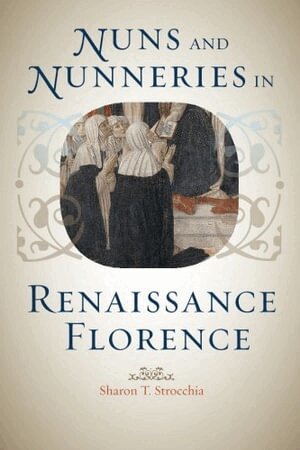
    Nuns and Nunneries in Renaissance Florence

    AvSharon T. Strocchia

    Häftad, Engelska, 2014

    512 kr

    Beställningsvara. Skickas inom 5-8 vardagar. Fri frakt över 249 kr.

    Fler format och utgåvor

    Inbunden

    638 kr

    Beskrivning

    The 15th century was a time of dramatic and decisive change for nuns and nunneries in Florence. In the course of that century, the city's convents evolved from small, semiautonomous communities to large civic institutions. By 1552, roughly one in eight Florentine women lived in a religious community. Historian Sharon T. Strocchia analyzes this stunning growth of female monasticism, revealing the important roles these women and institutions played in the social, economic, and political history of Renaissance Florence. It became common practice during this time for unmarried women in elite society to enter convents. This unprecedented concentration of highly educated and well-connected women transformed convents into sites of great patronage and social and political influence. As their economic influence also grew, convents found new ways of supporting themselves; they established schools, produced manuscripts, and manufactured textiles. Strocchia has mined previously untapped archival materials to uncover how convents shaped one of the principal cities of Renaissance Europe.She demonstrates the importance of nuns and nunneries to the booming Florentine textile industry and shows the contributions that ordinary nuns made to Florentine life in their roles as scribes, stewards, artisans, teachers, and community leaders. In doing so, Strocchia argues that the ideals and institutions that defined Florence were influenced in great part by the city's powerful female monastics. Nuns and Nunneries in Renaissance Florence shows for the first time how religious women effected broad historical change and helped write the grand narrative of medieval and Renaissance Europe. The book is a valuable text for students and scholars in early modern European history, religion, women's studies, and economic history.

    Produktinformation

    • Utgivningsdatum:2014-01-26
    • Mått:150 x 226 x 23 mm
    • Vikt:386 g
    • Format:Häftad
    • Språk:Engelska
    • Antal sidor:280
    • Förlag:Johns Hopkins University Press
    • ISBN:9781421411842
    • Utmärkelser:Winner of Helen and Howard R. Marraro Prize for Italian History 2010 (United States)

    Utforska kategorier

    • Europas historia inom Historia och arkeologi
    • Religion: allmänt inom Filosofi och religion
    • Genusvetenskap inom Samhälle och politik

    Mer om författaren

    Sharon T. Strocchia is a professor of history at Emory University and author of Death and Ritual in Renaissance Florence, also published by Johns Hopkins.

    Recensioner i media

    Strocchia examines the complex interrelationships between Florentine nuns and the laity, the secular government, and the religious hierarchy. The author skillfully analyzes extensive archival and printed sources. Choice Strocchia performs a service both to convent studies and to historians of Renaissance Florence by bringing these two fields together... Convents, long a hazy presence on the rich scholarly map of Renaissance Florence, now have their political and economic contours there clearly charted. -- P. Renee Baernstein Renaissance Quarterly An enjoyable, well-written account by a gifted historian clearly knowledgeable about her subject. -- Laura Swan Magistra Strocchia makes a significant contribution to the developing body of work on women's religious life in the Renaissance... providing a plethora of research avenues for the interested scholar and an interesting glimpse of Renaissance life for the general reader. -- Sally Mayall Brasher American Historical Review A convincing and wide-ranging analysis of a crucial facet of Renaissance Florence. -- Brian Maxson Canadian Journal of History An original and high-quality contribution to the knowledge of the monastic institute. -- Gabriella Zarri Catholic Historical Review One of the central arguments advanced in this book is that the fifteenth century was a decisive moment both for convents and for their relations with urban society. -- Karin Tilmans European Review of History This is a splendid intervention in the expanding study of religious women's communities. It is a 'must read.' -- Constance H. Berman Historian An important volume which deserves to be read and re-read not only by historians of the Renaissance church, but also by those interested in the histories of women, work and early modern urban culture. -- Roisin Cossar European History Quarterly Lucidly written and meticulously organized... The book is remarkable for both its richness and its clarity: the chapters are logically framed, the sections of broad argumentation are supported by vivid case studies, and the conclusions are both sound and thought-provoking... Strocchia's study makes a significant contribution to the study of Renaissance Florence. By weaving the convent into myriad aspects of Florentine social and political life, she offers both thought-provoking findings and a trove of new evidence that will make the book required reading for a wide range of scholars. -- Diana Bullen Presciutti Early Modern Women: An Interdisciplinary Journal Well worth your close attention whether you are interested in Renaissance religion or ruling dynasties or the textile industry of Florence. Bibliotheque d'Humanisme et Renaissance A most impressive investigation of the intricate connections that developed between convents and the Florentine state in the fifteenth and early sixteenth centuries. Journal of Social History Through scrupulous archival research, Strocchia situates her nuns in the context of late medieval spiritual, political, social, and urban developments... Strocchia convincingly moves the history of nuns and nunneries to the center of our understanding of Renaissance urban geography. -- Holly S. Hurlburt Enterprise and Society In this brilliant study, Strocchia brings us a deftly crafted analysis of Florentine convents and life within them... The combination of Strocchia's scholarship and engaging narrative sets a new standard for future studies of nunneries in other Italian cities. This is a superb book! -- Charmarie J. Blaisdell Church History This well-conceived work breaks new ground for the role of convents in society and politics in early modern Europe. -- Carol M. Bresnahan Journal of Interdisciplinary History Strocchia has written a judicious, balanced, and meticulously researched book, one that is drawn from a splendid breadth of archival sources and that makes a major contribution to our understanding of the complex and changing relationships between ecclesiastical institutions, family strategy, and civic consciousness. -- Philip Gavitt Speculum

    Innehållsförteckning

    • List of Tables, Graphs, and FiguresPreface1. The Growth of Florentine ConventsConvents in CrisisThe Midcentury ResurgenceThe Rush to the Convent2. Nuns, Neighbors, and KinsmenFrom Neighborhood Enclaves to Citywide InstitutionsProperty and the Topography of PowerDefenders of the Parish3. The Renaissance Convent EconomyThe Structure of Convent FinanceThe Paradox of ''Private'' WealthBalancing the BudgetThe Medici and the Monte4. Invisible Hands: Renaissance Nuns at WorkEconomic Strategies and OpportunitiesThe Century of Silk: Nuns and Textile ProductionThree Case Studies in Textile WorkBooks and Educational Activities5. Contesting the Boundaries of EnclosureThe Practice of Open Reclusion, 1300–1450Privatization, Enclosure, and Reform, 1430–1500The Florentine ''Night Officers''Ecclesiastical Reform Initiatives, 1500–1540ConclusionAcknowledgmentsNotesBibliographyIndex