• Fri frakt över 249 kr
  • •
  • Snabba leveranser
  • •
  • Billiga böcker
Kundservice

Du är på sajten för privatpersoner.

Företag, bibliotek eller offentlig verksamhet?

Du handlar på classic.bokus.com, där alla dina funktioner finns intakta.
Till classic.bokus.com
Bokus logotyp. Gå till startsidan.
  • Erbjudanden
  • Nyheter
  • Student
  • Topplistor
  • Barn & ungdom
  • Bokus Play
  • E-böcker
  • Pocketböcker
  • Spel & pussel

10% rabatt på allt med kod NYSTART10 →

Sidfot

Mina sidor

    Hjälp

    • Kundservice
    • Vanliga frågor och svar
    • Frakt och leverans
    • Retur vid ångerrätt
    • Reklamera vara
    • Betalning
    • Köpvillkor
    • Allmänna villkor
    • Information om webbplatsens tillgänglighet

    Om Bokus

    • Om oss
    • Pressrum
    • För studenter
    • För företag
    • För bibliotek och offentlig verksamhet
    • För leverantörer
    • Hållbarhet

    Populärt

    • Aktuella erbjudanden
    • Presentkort
    • Studentlitteratur
    • Nya böcker
    • Topplistor
    • Signerade böcker
    • Engelska böcker

    Inspiration

    • Boktips
    • BookTok
    • Populära bokserier
    • Barnbokskaraktärer
    • Populära författare
    Logotyp för Bokus
    Följ oss på Facebook (extern länk)Följ oss på Instagram (extern länk)Följ oss på YouTube (extern länk)Följ oss på TikTok (extern länk)
    bokus @ CookiesAnpassa cookiesIntegritetspolicyKöpvillkor
    Till Citymail hemsida (extern länk)Till Budbee hemsida (extern länk)Till Postnord hemsida (extern länk)Till Schenker hemsida (extern länk)Till Early Bird hemsida (extern länk)Till Walleys hemsida (extern länk)
    1. Samhälle och politik
    2. Samhälle och kultur
    3. Kultur och medier
    4. Referensverk och tvärvetenskap

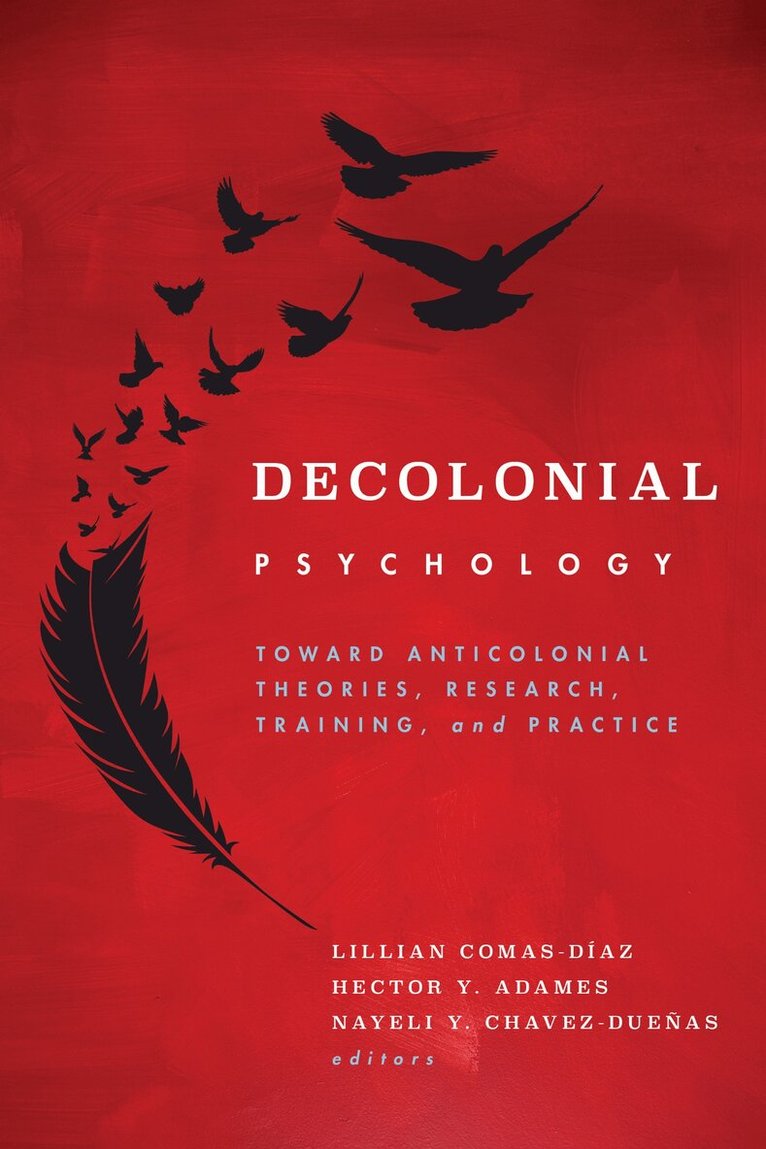
    Decolonial Psychology

    Toward Anticolonial Theories, Research, Training, and Practice

    AvLillian Comas-Díaz,Hector Y. Adames

    Häftad, Engelska, 2024

    Del i serien Cultural, Racial, and Ethnic Psychology Series

    805 kr

    Beställningsvara. Skickas inom 5-8 vardagar. Fri frakt över 249 kr.

    Beskrivning

    This book offers an expert synthesis of the scholarly literature on approaches to decolonial psychology, its historical foundations, education and training, and psychological practice. From its inception, psychological science and practice in the United States has been framed predominantly by Eurocentric epistemologies. As a result, oppressed people have internalized the belief that their culture and values are inferior to those of dominant groups. Infusing a decolonial lens into psychology is one way for the field to become more inclusive and relevant to the numerical majority worldwide. Decolonial psychology creates space and methods for oppressed and impoverished communities to radically imagine their existence outside of the superimposed borders of coloniality, neoliberalism, racism, and other systems of oppression. It emphasizes how people's subjectivity and connections to diverse social groups are influenced by history, context, and oppression how these populations actively resist and survive attacks on their humanity and how knowledge production is shaped not only by how data is interpreted but also by the questions asked.The chapters in this book provide an opportunity for readers to deepen their understanding of how colonization and coloniality impacted knowledge creation in society and the field of psychology, including thought-provoking resources that explore the subject matter. The book also underscores how coloniality continues to reverberate in many aspects of psychology today. Collectively, the authors invite readers to resist engaging in psycolonization by generating ideas and pathways to help reclaim, honor, and celebrate Indigenous ways of knowing and being. The volume offers guidance on methods to disrupt psycolonization and its epistemic violence, helping to provide a roadmap to decolonial psychology and anticolonial futures.   It is time to confront the limitations of mainstream psychology. This book will help psychologists at all levels anchor their research, teaching, and practice in decolonial methods and practices.

    Produktinformation

    • Utgivningsdatum:2024-01-23
    • Mått:152 x 229 x 23 mm
    • Vikt:616 g
    • Format:Häftad
    • Språk:Engelska
    • Serie:Cultural, Racial, and Ethnic Psychology Series
    • Antal sidor:430
    • Förlag:American Psychological Association
    • ISBN:9781433838521

    Utforska kategorier

    • Referensverk och tvärvetenskap inom Samhälle och politik
    • Socialpsykologi och gruppsykologi inom Psykologi och pedagogik
    • Etnicitet inom Samhälle och politik

    Mer om författaren

    Lillian Comas-D amp iacute az, PhD, is a psychologist in private practice in Washington, DC, the executive director of the Transcultural Mental Health Institute, and a clinical professor in the Department of Psychiatry and Behavioral Sciences at George Washington University. She is the recipient of the American Psychological Association (APA) Gold Medal Award for Life Achievement in the Practice of Psychology, and a past president of APA Division 42 (Psychologists in Independent Practice). Dr. Comas-D amp iacute az is the coeditor of Liberation Psychology: Theory, Method, Practice, and Social Justice Latina Psychologists: Thriving in the Cultural Borderlands  Womanist and Mujerista Psychologies: Voices of Fire, Acts of Courage  Multicultural Care: A Clinician's Guide to Cultural Competence  and Psychological Health of Women of Color.Hector Y. Adames, PsyD, received his doctorate in clinical psychology from Wright State University in Ohio and completed his doctoral internship at the Boston University School of Medicine's Center for Multicultural Training in Psychology. He is a licensed psychologist, professor at The Chicago School, College of Professional Psychology, and cofounder and codirector of the IC-RACE Lab (Immigration Critical Race and Cultural Equity Lab). He has earned several awards, including the 2 8 Distinguished Emerging Professional Research Award from the Society for the Psychological Study of Culture, Ethnicity, and Race, a division of APA. Dr. Adames has coauthored several books including Speaking the Unspoken: Breaking the Silence, Myths, and Taboos That Hurt Therapists and Patients  Succeeding as a Therapist: How to Create a Thriving Practice in a Changing World Ethics in Psychotherapy and Counseling: A Practical Guide  and Cultural Foundations and Interventions in Latino/a Mental Health: History, Theory and Within-Group Differences. Follow Dr. Adames on Twitter, Instagram, and Spoutible or visit the IC-RACE Lab (icrace.org).Nayeli Y. Chavez-Due amp ntilde as, PhD, received her doctorate in clinical psychology from the APA-accredited program at Southern Illinois University at Carbondale. She is a professor at The Chicago School, College of Professional Psychology, where she serves as the faculty coordinator for the concentration in Latinx mental health in the counseling psychology department. She is the codirector of the IC-RACE Lab (Immigration, Critical Race, and Cultural Equity Lab). She has earned several awards, including the 2 8 APA Distinguished Citizen Psychologist Award. Dr. Chavez-Due amp ntilde as has coauthored several books including Speaking the Unspoken: Breaking the Silence, Myths, and Taboos That Hurt Therapists and Patients  Succeeding as a Therapist: How to Create a Thriving Practice in a Changing World  Ethics in Psychotherapy and Counseling: A Practical Guide and Cultural Foundations and Interventions in Latino/a Mental Health: History, Theory and Within-Group Differences. Follow Dr. Chavez-Due amp ntilde as on Twitter, Instagram, and Spoutible or visit the IC-RACE Lab (icrace.org).

    Recensioner i media

    This book is explosive in the way that fireworks are explosive it dazzles with its fire, it illuminates dark places in psychology, it celebrates the light towards which we can all go. At a time when our discipline is teetering on the precipice where we can choose to go backwards towards the Eurocentric frameworks that have defined and restrained psychology since its inception, or allow ourselves to have the courage to join in the liberatory project of decolonizing our understanding of humans in every setting, through all possible intersectional lenses, this volume is our guidebook to the territory of this emerging, powerful paradigm. Essential reading for all of us for those, like myself, decades in the field for those who teach and train and do research for those offering healing. Brava/o to editors and authors alike. - Laura S. Brown, PhD, ABPP, independent practice; Department of Psychiatry and Behavioral Sciences, University of Washington, Seattle; and past president of APA Divisions 35, 44, 56 and Washington State Psychological Association Comas-D amp iacute az, Adames, and Chavez-Due amp ntilde as have aptly responded to an urgent call to examine past and current impacts of colonization on the discipline of psychology. The authors, in this significant volume, provide compelling information that is the basis for a sea change in how we approach theory, research, teaching, and practice. The authors amp rsquo rich examples bring to life the profound problems of colonization as well as the profound potential for decolonial psychology. - Pratyusha (Usha) Tummala-Narra, PhD, Boston University, Boston, MA Few disciplines have taken the recent challenges of decolonization and the decolonial turn more seriously than the branches of psychology in the Global South that explore the linkages between subjectivity, community, and social life. Yet, the task is barely starting. Building on the work of figures like the famed psychiatrist and revolutionary fighter, Frantz Fanon, among others, the editors and authors in this book seek to further illuminate the path of decolonization, anticolonialism, and decoloniality in the contemporary world. The anthology provides invaluable resources in the effort to infuse psychology with decolonial transdisciplinary approaches, thereby taking psychology beyond its modern-colonial horizons. An essential reference for anyone heeding the call to consider decolonization as an unfinished project and as an imperative today. - Nelson Maldonado-Torres, PhD, University of Connecticut, Storrs

    Innehållsförteckning

    • Contributors Series ForewordFrederick T. L. LeongForewordGayle Skawen:nio Morse and Marie C. WeilAcknowledgmentsIntroduction: Decoloniality as a Transformative Force in Psychology: An Orientation to This BookHector Y. Adames, Nayeli Y. Chavez-Due amp ntilde as, and Lillian Comas-D amp iacute azPart I. History and KnowledgeChapter . Colonial Mentality: Manifestations, Operations, and Psychological ImplicationsHannah L. Rebadulla, Jonathan U. Guerrero, and E. J. R. DavidChapter 2. Naming and Unlearning Psychological ColonialityCristal amp iacute s Capielo Rosario, Eduardo Lugo-Hern amp aacute ndez, and Lo amp iacute za A. DeJes amp uacute s SullivanChapter 3. Engaging With Decoloniality, Decolonization, and Histories of Psychology OtherwiseSunil Bhatia, Wahbie Long, Wade Pickren, and Alexandra RutherfordPart II. Science, Methods, and Epistemic Justice Chapter 4. Decolonizing and Building Liberatory Psychological SciencesHelen A. Neville, B. Andi Lee, and Amir H. MaghsoodiChapter 5. Beyond Decolonization: Anticolonial Methodologies for Indigenous Futurity in Psychological Research Jillian Fish and Joseph P. GoneChapter . Disciplinary Disruptions: Strategies Toward a Decolonial Community Psychology PraxisJesica Siham Fern amp aacute ndezChapter 7. Decolonizing in a Transnational Feminist Commons Perched Precariously Between the Academy and Movements for JusticeAdreanne Ormond, Puleng Segalo, Mar amp iacute a Elena Torre, and Michelle FinePart III. Education, Professional Training, and Mentoring  Chapter 8. Decolonizing the High School and Undergraduate CurriculumEdil Torres Rivera and Ivelisse Torres FernandezChapter 9. Unlearning Colonial Practices and (Re)envisioning Graduate Education in Psychology Carrie L. Casta amp ntilde eda-Sound, Miguel Gallardo, and Susana O. SalgadoChapter . The Decolonial Mentoring Framework: Advancing an Anticolonial Future in Psychology and BeyondMackenzie T. Goertz, Hector Y. Adames, Chelsea Parker, Nayeli Y. Chavez-Due amp ntilde as, Radia DeLuna​, and Jessica G. Perez-ChavezChapter . Wise Face, Firm Heart: Ethics and Decolonial PsychologyMelinda A. Garc amp iacute aPart IV. Psychotherapies  Chapter 2. Decolonial Psychotherapy: Joining the Circle, Healing the WoundLillian Comas-D amp iacute az and Frederick M. JacobsenChapter 3. Decolonizing Psychoanalysis: Anti-Blackness, Coloniality, and a New Premise for Psychoanalytic TreatmentDaniel Jose Gaztambide, Fabo Feliciano-Graniela, Jose Luiggi-Hernandez, and Edlyane Veronica Medina Escobar Chapter 4. Decolonizing Feminist TherapyThema Bryant, Carolyn Zerbe Enns, and Yuying TsongPart V. Queer Futures, Self-Care, and Community Care Chapter 5. Moving Psychology Toward Anticolonial Queer FuturesDella V. Mosley, Pearis L. Jean, Brittany Bridges, Maria Sobrino, Jeannette Mejia, Sunshine Adam, Garrett Ross, and Roberto AbreuChapter . Your Self-Care Is Made of Capitalism: A Decolonial Approach to Self and Community CareArianne E. Miller and Nellie TranIndexAbout the Editors