• Fri frakt över 249 kr
  • •
  • Snabba leveranser
  • •
  • Billiga böcker
Kundservice

Du är på sajten för privatpersoner.

Företag, bibliotek eller offentlig verksamhet?

Du handlar på classic.bokus.com, där alla dina funktioner finns intakta.
Till classic.bokus.com
Bokus logotyp. Gå till startsidan.
  • Erbjudanden
  • Nyheter
  • Student
  • Topplistor
  • Barn & ungdom
  • Bokus Play
  • E-böcker
  • Pocketböcker
  • Spel & pussel

10% rabatt på allt med kod: NYSTART10 →

Sidfot

Mina sidor

    Hjälp

    • Kundservice
    • Vanliga frågor och svar
    • Frakt och leverans
    • Retur vid ångerrätt
    • Reklamera vara
    • Betalning
    • Köpvillkor
    • Allmänna villkor
    • Information om webbplatsens tillgänglighet

    Om Bokus

    • Om oss
    • Pressrum
    • För studenter
    • För företag
    • För bibliotek och offentlig verksamhet
    • För leverantörer
    • Hållbarhet

    Populärt

    • Aktuella erbjudanden
    • Presentkort
    • Studentlitteratur
    • Nya böcker
    • Topplistor
    • Signerade böcker
    • Engelska böcker

    Inspiration

    • Boktips
    • BookTok
    • Populära bokserier
    • Barnbokskaraktärer
    • Populära författare
    Logotyp för Bokus
    Följ oss på Facebook (extern länk)Följ oss på Instagram (extern länk)Följ oss på YouTube (extern länk)Följ oss på TikTok (extern länk)
    bokus @ CookiesAnpassa cookiesIntegritetspolicyKöpvillkor
    Till Citymail hemsida (extern länk)Till Budbee hemsida (extern länk)Till Postnord hemsida (extern länk)Till Schenker hemsida (extern länk)Till Early Bird hemsida (extern länk)Till Walleys hemsida (extern länk)
    1. Historia och arkeologi
    2. Historia
    3. Asiens historia

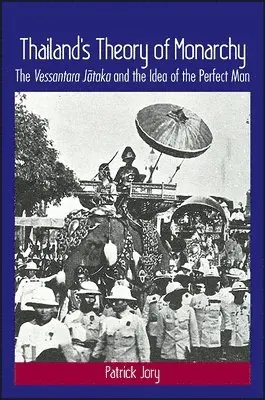
    Thailand's Theory of Monarchy

    The Vessantara Jātaka and the Idea of the Perfect Man

    AvPatrick Jory

    Häftad, Engelska, 2017

    472 kr

    Beställningsvara. Skickas inom 5-8 vardagar. Fri frakt över 249 kr.

    Fler format och utgåvor

    Inbunden

    Tillf. slut

    Beskrivning

    Discusses the origins and cultural history of the Theravada Buddhist ideals behind the Thai institution of monarchy.2016 CHOICE Outstanding Academic Title Since the 2006 coup d'état, Thailand has been riven by two opposing political visions: one which aspires to a modern democracy and the rule of law, and another which holds to the traditional conception of a kingdom ruled by an exemplary Buddhist monarch. Thailand has one of the world's largest populations of observant Buddhists and one of its last politically active monarchies. This book examines the Theravada Buddhist foundations of Thailand's longstanding institution of monarchy. Patrick Jory states that the storehouse of monarchical ideology is to be found in the popular literary genre known as the Jātakas, tales of the Buddha's past lives. The best-known of these, the Vessantara Jātaka, disseminated an ideal of an infinitely generous prince as a bodhisatta or future Buddha-an ideal which remains influential in Thailand today. Using primary and secondary source materials largely unknown in Western scholarship, Jory traces the history of the Vessantara Jātaka and its political-cultural importance from the ancient to the modern period. Although pressures from European colonial powers and Buddhist reformers led eventually to a revised political conception of the monarchy, the older Buddhist ideal of kingship has yet endured.

    Produktinformation

    • Utgivningsdatum:2017-01-02
    • Mått:152 x 229 x 16 mm
    • Vikt:417 g
    • Format:Häftad
    • Språk:Engelska
    • Antal sidor:302
    • Förlag:State University of New York Press
    • ISBN:9781438460888

    Utforska kategorier

    • Asiens historia inom Historia och arkeologi
    • Religion: allmänt inom Filosofi och religion
    • Buddhism inom Filosofi och religion

    Mer om författaren

    Patrick Jory is Senior Lecturer in Southeast Asian History at the University of Queensland and the editor of Ghosts of the Past in Southern Thailand: Essays on the History and Historiography of Patani.

    Recensioner i media

    "…the central contribution of Jory's innovative study [is] in providing invaluable historical context to the intensified absolutist royalism that has now become the official discourse of the country's national bureaucracy and authoritarian military regime." — Sojourn"Essential." — CHOICE

    Innehållsförteckning

    • List of IllustrationsAcknowledgmentsNote on TranscriptionIntroductionThe Vessantara Jātaka’s Place in Thailand’s Religious CultureThe Vessantara Jātaka as a Political TextBarami: Foundation of a Theravada Buddhist Theory of Monarchy1. The Vessantara Jātaka as a Performative TextThe Sacred TextTexts Recited in Conjunction with the Maha Chat The Aesthetics of the Recitation: thamnorng and lae RitualConclusion2. The Vessantara Jātaka and Early State Formation Dvaravati and SukhothaiScripture and Orality in SukhothaiThe Doctrine of the Perfections (barami)Than: The Power of GivingThe Vessantara Jātaka, the Family, and Thai Social RelationsThe Kingdom of AyutthayaKingdoms of Lanna and Lan ChangConclusion3. A Theravada Buddhist Theory of Monarchy: The Ruler as Bodhisatta The Vessantara Jātaka and the Chakri Monarchy in Rattanakosin PeriodThe Vessantara Jātaka beyond the Thai CourtThai Monarchs and the Ten Perfections (barami)The Genealogy of the Buddha and the Lineage of KingsConclusion4. The Colonial Challenge to Buddhist MonarchyThe Court’s Rejection of the JātakasDisplacement of the Jātakas from the Story of the BuddhaThe Decline of "Great Lineage" HistoryThe End of the Bodhisatta-KingCourt Politics, Reformist Buddhism, and the Question of CanonicityConclusion5. Thai and Western Buddhist Scholarship in the Era of ImperialismKing Chulalongkorn’s Essay on the Jātakas Western Buddhist Scholarship and the Jātakas Relations between the Thai Court and Western Pali ScholarsThe Persistence of the Jātakas beyond the Thai CourtConclusion6. From Jātakas to Thai FolktalesThe Marginalization of NithanOfficial Translations of the Nipāta Jātaka and Paññnasa JātakaThe Jātakas as "Thai Literature"Folktale Editions of the Jātakas ConclusionConclusion: The Modern VessantaraKing Bhumibol as the Modern VessantaraEpilogueAppendix: Outline of the Thirteen Chapters of the Vessantara JātakaGlossary of Thai and Pali Terminology UsedNotesBibliographyIndex