• Fri frakt över 249 kr
  • •
  • Snabba leveranser
  • •
  • Billiga böcker
Kundservice

Du är på sajten för privatpersoner.

Företag, bibliotek eller offentlig verksamhet?

Du handlar på classic.bokus.com, där alla dina funktioner finns intakta.
Till classic.bokus.com
Bokus logotyp. Gå till startsidan.
  • Erbjudanden
  • Nyheter
  • Student
  • Topplistor
  • Barn & ungdom
  • Bokus Play
  • E-böcker
  • Pocketböcker
  • Spel & pussel

10% rabatt på allt med kod NYSTART10 →

Sidfot

Mina sidor

    Hjälp

    • Kundservice
    • Vanliga frågor och svar
    • Frakt och leverans
    • Retur vid ångerrätt
    • Reklamera vara
    • Betalning
    • Köpvillkor
    • Allmänna villkor
    • Information om webbplatsens tillgänglighet

    Om Bokus

    • Om oss
    • Pressrum
    • För studenter
    • För företag
    • För bibliotek och offentlig verksamhet
    • För leverantörer
    • Hållbarhet

    Populärt

    • Aktuella erbjudanden
    • Presentkort
    • Studentlitteratur
    • Nya böcker
    • Topplistor
    • Signerade böcker
    • Engelska böcker

    Inspiration

    • Boktips
    • BookTok
    • Populära bokserier
    • Barnbokskaraktärer
    • Populära författare
    Logotyp för Bokus
    Följ oss på Facebook (extern länk)Följ oss på Instagram (extern länk)Följ oss på YouTube (extern länk)Följ oss på TikTok (extern länk)
    bokus @ CookiesAnpassa cookiesIntegritetspolicyKöpvillkor
    Till Citymail hemsida (extern länk)Till Budbee hemsida (extern länk)Till Postnord hemsida (extern länk)Till Schenker hemsida (extern länk)Till Early Bird hemsida (extern länk)Till Walleys hemsida (extern länk)
    1. Historia och arkeologi
    2. Historia
    3. Asiens historia

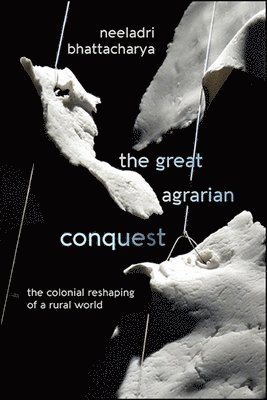
    Great Agrarian Conquest

    The Colonial Reshaping of a Rural World

    AvNeeladri Bhattacharya

    Häftad, Engelska, 2020

    455 kr

    Skickas . Fri frakt över 249 kr.

    Fler format och utgåvor

    Inbunden

    Tillf. slut

    Beskrivning

    Groundbreaking analysis of how colonialism created new conceptual categories and spatial forms that reshaped rural societies.This book examines how, over colonial times, the diverse practices and customs of an existing rural universe-with its many forms of livelihood-were reshaped to create a new agrarian world of settled farming. While focusing on Punjab, India, this pathbreaking analysis offers a broad argument about the workings of colonial power: the fantasy of imperialism, it says, is to make the universe afresh.Such radical change, Neeladri Bhattacharya shows, is as much conceptual as material. Agrarian colonization was a process of creating spaces that conformed to the demands of colonial rule. It entailed establishing a regime of categories-tenancies, tenures, properties, habitations-and a framework of laws that made the change possible. Agrarian colonization was in this sense a deep conquest.Colonialism, the book suggests, has the power to revisualize and reorder social relations and bonds of community. It alters the world radically, even when it seeks to preserve elements of the old. The changes it brings about are simultaneously cultural, discursive, legal, linguistic, spatial, social, and economic. Moving from intent to action, concepts to practices, legal enactments to court battles, official discourses to folklore, this book explores the conflicted and dialogic nature of a transformative process.By analyzing this great conquest, and the often silent ways in which it unfolds, the book asks every historian to rethink the practice of writing agrarian history and reflect on the larger issues of doing history.

    Produktinformation

    • Utgivningsdatum:2020-07-02
    • Mått:152 x 229 x 33 mm
    • Vikt:699 g
    • Format:Häftad
    • Språk:Engelska
    • Antal sidor:542
    • Förlag:State University of New York Press
    • ISBN:9781438477404

    Utforska kategorier

    • Asiens historia inom Historia och arkeologi
    • Industrier och branscher inom Ekonomi och Ledarskap
    • Allmän historia och världshistoria inom Historia och arkeologi

    Mer om författaren

    Neeladri Bhattacharya taught at Jawaharlal Nehru University in New Delhi for forty-one years, from which he retired in 2017 as Professor of History. He has been a Fellow of St. Antony's College, Oxford, and has held visiting professorships in Europe, South Africa, and the United States.

    Recensioner i media

    "Writing a nuanced and historically deep account of agrarian life while, simultaneously, never losing sight of the ideas that animate those who would shape that history, is exceptionally difficult. Neeladri Bhattacharya has done for the Punjab what Marc Bloch did for much of France, John Furnivall for Burma and Paul Gourou for Indochina, and William Cronon for colonial New England. The sweep and intellectual ambition of The Great Agrarian Conquest ensures that it will become a touchstone even for those who would nurse a divergent narrative." — Studies in History"During the British Raj (1858–1947), the spread of settled agriculture greatly transformed the Punjab region (currently divided between India and Pakistan). Bhattacharya insightfully documents and deeply examines this transformation by interweaving a range of sources, including original archival material, published government reports, and elite and popular literature by British and Indian authors … Highly recommended." — CHOICE"The Great Agrarian Conquest is a subtle and substantial work of scholarship. If there is one book Indians need to read to understand how colonialism actually worked (or did not work), this is it." — Ramachandra Guha, in The Wire, in praise of the Indian edition

    Innehållsförteckning

    • Acknowledgements Abbreviations Introduction: The Great Agrarian ConquestPart I. Governing the Rural 1. Masculine Paternalism and Colonial GovernanceColonial RidersStyles of GovernanceThe Fear of AmbiguityThe New PaternalismReason and the ImaginationThe Return of the DespotPaternal ViolencePart II. The Agrarian Imaginary 2. How Villages were FoundHow Estate becomes VillageRecording the InteriorThe Cartographic TruthBounding SovereigntyAgrarian Spaces, Village StructuresRespatialising the Rural3. In Search of TenuresMapping TenuresThe Logic of ClassificationTemporalising Space and Spatialising TimeThe Prison-house of CategoriesLandscaping Village CommunitiesThe Limits of ClassificationEmpowering the Village Brotherhood4. The Power of CategoriesEthnographic Truth and the Question of RightsTranslating CategoriesRights vs PracticeFixity, Security, and Legal OrderThe Production of Categories5. Codifying CustomFrom Text to PracticeOf Informants and SovereignsThe EnquiryThe Impossible Task of PreservationTradition, Reason, and TimeCustom and PowerThe Discourse on CustomPart III. From Code to Practice 6. Remembered PastsDabwali DhabThe Remembered PastThe Time of ReciprocityThrough the Native Voice7. Beyond the CodeThe Myth of Patrilineal DescentThe Politics of AdoptionAgainst GiftsThe Will of the DeadThe Rights of ChastityThe Community and the IndividualWho was the Outsider?The Commodity Economy and the Language of Rights8. Fear of the FragmentFear of the FragmentTimes that BindTwo Histories of PartitionModernity and the Culture of Joint HoldingsThe Market and the Ambiguities of LawWhen Negotiations FailThe Logic of ScatterPart IV. From the "Primitive" to the Modern 9. Colonising the CommonsNomads of the BãrTirni and the Politics of SettlementThe Unpublished MapsThe Fraudulent LineRegulating RightsRegenerating Grasslands: From Practice to Science10. The Promise of Modernity, Antinomies of DevelopmentCanals and the Science of EmpireA Regime of SquaresEnclosing the FieldsA New Language of ClaimsPromise and BetrayalAntinomies of DevelopmentTwo Paths of Agrarian ConquestEpilogue: The Last RideGlossary Bibliography Index Figures and MapsFig. 1 Henry Montgomery Lawrence Fig. 2 John Laird Mair LawrenceFig. 3 James Andrew Broun Ramsay DalhousieFig. 4 Revenue Per Acre of Cultivated AreaFig. 5 The Limits of the Agrarian: Distribution of Cultivated and Uncultivated Land in Punjab, 1891–3Fig. 6 Mapping Villages: Congregated Village Map of Jullunder Tahsil, 1847–8Fig. 7 Cartographic EnclosureFig. 8 Tehong Village, 1929–30Fig. 9 Bhambu Sandila Village, 1934–5Fig. 10 Spatial Structure of the Plains’ Villages of Central PunjabFig. 11 Classifying Villages, Spatialising Tenures (Punjab 1883-4)Fig. 12 Chronology of Village Settlement in SirsaFig. 13 Before and After: Visualising ConsolidationFig. 14a Inheritance, Partition and Other Transfers, Jullunder and Ludhiana, 1893Fig. 14b Inheritance, Partition and Other Transfers, Hissar and Karnal, 1893Fig. 15a How the Land was Held: Tehong VillageFig. 15b How the Land was Held: Bhambu Sandila VillageFig. 15c How the Land was Held: Bairampur VillageFig. 15d How the Land was Held: Suner VillageFig. 16 The Bãr Landscape: Montgomery District, 1870sFig. 17 Tirni Mahals in MontgomeryFig. 18 Map of the Canal ColoniesFig. 19 Vision of Order: The Plan of a Canal Colony Abadi, 1898Fig. 20 How the Farms were Cultivated: A Contrast Between Older Districts and the Canal ColoniesFig. 21 Wayside Conversation: Darling Questions VillagersFig. 22 The Hand of Friendship