• Fri frakt över 249 kr
  • •
  • Snabba leveranser
  • •
  • Billiga böcker
Kundservice

Du är på sajten för privatpersoner.

Företag, bibliotek eller offentlig verksamhet?

Du handlar på classic.bokus.com, där alla dina funktioner finns intakta.
Till classic.bokus.com
Bokus logotyp. Gå till startsidan.
  • Erbjudanden
  • Nyheter
  • Student
  • Topplistor
  • Barn & ungdom
  • Bokus Play
  • E-böcker
  • Pocketböcker
  • Spel & pussel

10% rabatt på allt med kod: NYSTART10 →

Sidfot

Mina sidor

    Hjälp

    • Kundservice
    • Vanliga frågor och svar
    • Frakt och leverans
    • Retur vid ångerrätt
    • Reklamera vara
    • Betalning
    • Köpvillkor
    • Allmänna villkor
    • Information om webbplatsens tillgänglighet

    Om Bokus

    • Om oss
    • Pressrum
    • För studenter
    • För företag
    • För bibliotek och offentlig verksamhet
    • För leverantörer
    • Hållbarhet

    Populärt

    • Aktuella erbjudanden
    • Presentkort
    • Studentlitteratur
    • Nya böcker
    • Topplistor
    • Signerade böcker
    • Engelska böcker

    Inspiration

    • Boktips
    • BookTok
    • Populära bokserier
    • Barnbokskaraktärer
    • Populära författare
    Logotyp för Bokus
    Följ oss på Facebook (extern länk)Följ oss på Instagram (extern länk)Följ oss på YouTube (extern länk)Följ oss på TikTok (extern länk)
    bokus @ CookiesAnpassa cookiesIntegritetspolicyKöpvillkor
    Till Citymail hemsida (extern länk)Till Budbee hemsida (extern länk)Till Postnord hemsida (extern länk)Till Schenker hemsida (extern länk)Till Early Bird hemsida (extern länk)Till Walleys hemsida (extern länk)
    1. Naturvetenskap och teknik
    2. Matematik och naturvetenskap
    3. Matematik
    4. Matematisk statistik

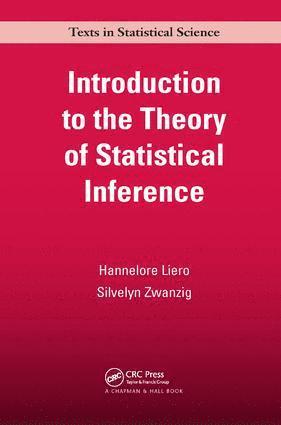
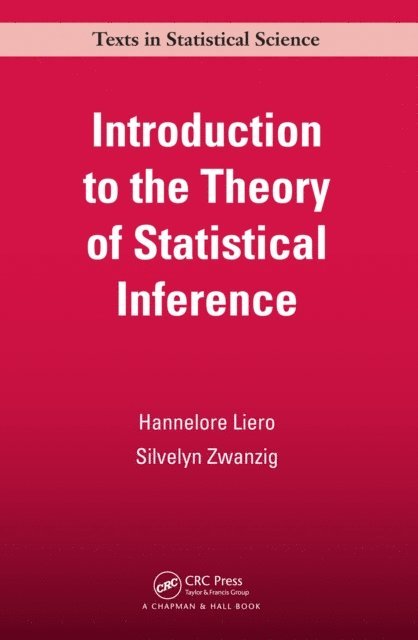
    Introduction to the Theory of Statistical Inference

    AvHannelore Liero,Silvelyn Zwanzig

    Häftad, Engelska, 2011

    Del i serien Chapman & Hall/CRC Texts in Statistical Science

    877 kr

    Beställningsvara. Skickas inom 10-15 vardagar. Fri frakt över 249 kr.

    Fler format och utgåvor

    Inbunden

    3 305 kr

    Beskrivning

    Based on the authors’ lecture notes, Introduction to the Theory of Statistical Inference presents concise yet complete coverage of statistical inference theory, focusing on the fundamental classical principles. Suitable for a second-semester undergraduate course on statistical inference, the book offers proofs to support the mathematics. It illustrates core concepts using cartoons and provides solutions to all examples and problems.Highlights Basic notations and ideas of statistical inference are explained in a mathematically rigorous, but understandable, formClassroom-tested and designed for students of mathematical statisticsExamples, applications of the general theory to special cases, exercises, and figures provide a deeper insight into the materialSolutions provided for problems formulated at the end of each chapter Combines the theoretical basis of statistical inference with a useful applied toolbox that includes linear modelsTheoretical, difficult, or frequently misunderstood problems are markedThe book is aimed at advanced undergraduate students, graduate students in mathematics and statistics, and theoretically-interested students from other disciplines. Results are presented as theorems and corollaries. All theorems are proven and important statements are formulated as guidelines in prose. With its multipronged and student-tested approach, this book is an excellent introduction to the theory of statistical inference.

    Produktinformation

    • Utgivningsdatum:2011-07-20
    • Mått:156 x 234 x 14 mm
    • Vikt:530 g
    • Format:Häftad
    • Språk:Engelska
    • Serie:Chapman & Hall/CRC Texts in Statistical Science
    • Antal sidor:284
    • Förlag:Taylor & Francis Inc
    • ISBN:9781439852927

    Utforska kategorier

    • Matematisk statistik inom Naturvetenskap och teknik

    Mer om författaren

    Hannelore Liero is an apl. Prof. for Mathematical Statistics at the University of Potsdam. She studied Mathematics at the Humboldt-University in Berlin. She earned her Ph.D. while working as a scientist at the Academy of Sciences of the GDR. Since 1992, she has taught Statistics for undergraduate and graduate students in Mathematics, Biology and Computer Science at the Faculty of Sciences at the University of Potsdam. In addition to teaching, she does basic research in Statistics and supports scientists applying statistical methods in practice. Silvelyn Zwanzig is an Associate Professor for Mathematical Statistics at Uppsala University. She studied Mathematics at the Humboldt-University in Berlin. Before coming to Sweden she was Assistant Professor at the University of Hamburg in Germany. She received her Ph.D. in Mathematics at the Academy of Sciences of the GDR. Since 1991, she has taught Statistics for undergraduate and graduate students. Her research interests have moved from theoretical statistics to computer intensive statistics. She is interested in consulting and was working in Astrometry.

    Recensioner i media

    … it provides in-depth explanations, complete with proofs, of how statistics works. … The book has several user-friendly aspects. One is the use of eight example data sets to illustrate the theory throughout the text. This repeated use of the same examples allows readers to focus their energy on applying a theoretical point under discussion to a familiar example rather than having to first become acquainted with a new example. Another big help are the detailed solutions provided for the problems that appear at the end of each chapter. … Also helpful: Theoretical or difficult material that can be skipped is marked with an asterisk. … a clear exposition of the theory of statistical inference, along with complete proofs and familiar examples. The text analyzes not just methods one learns in a first statistics course, but alternatives as well. Each chapter is capped by a further reading section that is at once comprehensive and concise.—David A. Huckaby, MAA Reviews, February 2012

    Innehållsförteckning

    • Introduction. Statistical Model. Inference principles. Estimation. Testing Hypotheses. Linear Model. Solutions. Bibliography. Index.