• Fri frakt över 249 kr
  • •
  • Snabba leveranser
  • •
  • Billiga böcker
Kundservice

Du är på sajten för privatpersoner.

Företag, bibliotek eller offentlig verksamhet?

Du handlar på classic.bokus.com, där alla dina funktioner finns intakta.
Till classic.bokus.com
Bokus logotyp. Gå till startsidan.
  • Erbjudanden
  • Student
  • Topplistor
  • Barn & ungdom
  • Bokus Play
  • E-böcker
  • Ljudböcker
  • Pocketböcker
  • Spel och pussel

Pocketfynda! Hundratals böcker för 49 kr/st →

Sidfot

Mina sidor

    Hjälp

    • Kundservice
    • Vanliga frågor och svar
    • Frakt och leverans
    • Retur vid ångerrätt
    • Reklamera vara
    • Betalning
    • Köpvillkor
    • Allmänna villkor
    • Information om webbplatsens tillgänglighet

    Om Bokus

    • Om oss
    • Pressrum
    • För studenter
    • För företag
    • För bibliotek och offentlig verksamhet
    • För leverantörer
    • Hållbarhet

    Populärt

    • Aktuella erbjudanden
    • Presentkort
    • Studentlitteratur
    • Nya böcker
    • Topplistor
    • Signerade böcker
    • Engelska böcker

    Inspiration

    • Boktips
    • BookTok
    • Barnbokskaraktärer
    • Populära författare
    Logotyp för Bokus
    Följ oss på Facebook (extern länk)Följ oss på Instagram (extern länk)Följ oss på YouTube (extern länk)Följ oss på TikTok (extern länk)
    bokus @ CookiesAnpassa cookiesIntegritetspolicyKöpvillkor
    Till Citymail hemsida (extern länk)Till Budbee hemsida (extern länk)Till Postnord hemsida (extern länk)Till Schenker hemsida (extern länk)Till Early Bird hemsida (extern länk)Till Walleys hemsida (extern länk)
    1. Samhälle och politik
    2. Samhälle och kultur
    3. Sociala och etiska frågor
    4. Migration

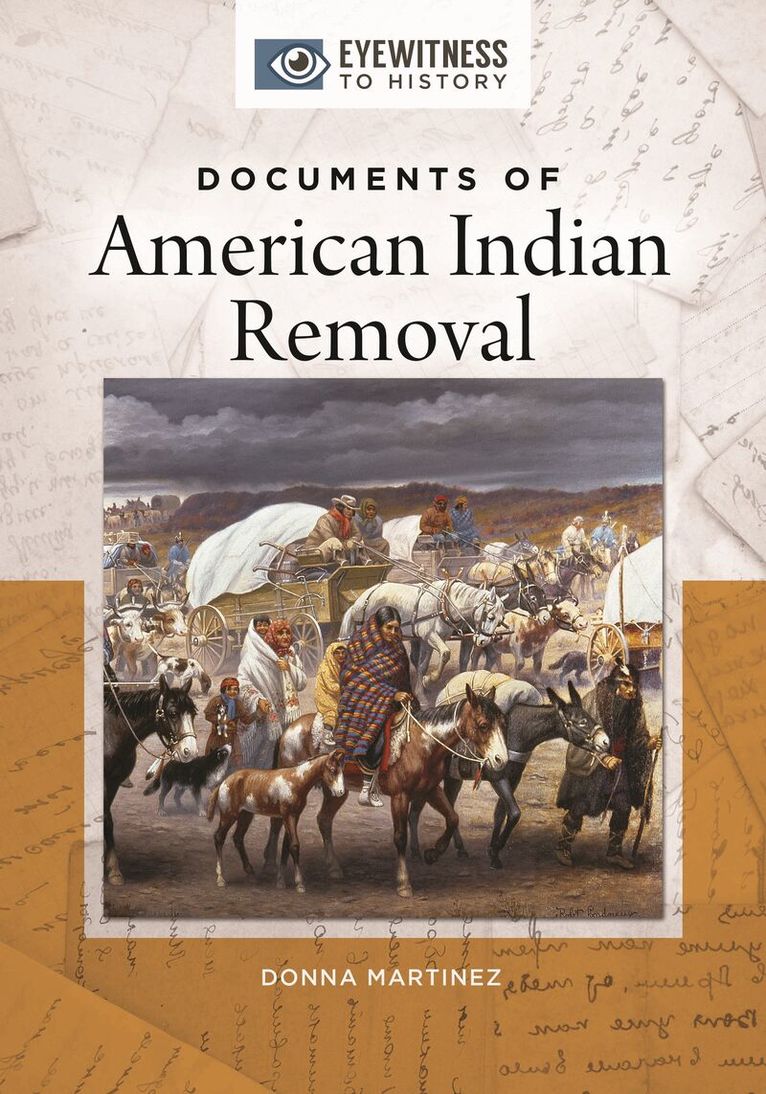
    Documents of American Indian Removal

    AvDonna Martinez

    Inbunden, Engelska, 2018

    Del i serien Eyewitness to History

    1 146 kr

    Beställningsvara. Skickas inom 10-15 vardagar. Fri frakt över 249 kr.

    Fler format och utgåvor

    E-bok

    1 243 kr

    E-bok

    1 243 kr

    Beskrivning

    This powerful collection of documents illumines the experiences of the original people of the United States during American Indian removal, offering readers a unique standpoint from which to understand American identity and the historical processes that have shaped it.The Indian Removal Act transformed the Native North American continent and precipitated the development of a national identity based on a narrative of vanishing American Indians. This volume is a probing look into a chapter in American history that, while difficult, cannot be ignored. Sweeping in its coverage of history, it includes deeply personal accounts of American Indian removal from which readers may discern the degree to which the new national identity of the United States was influenced by bigotry and dependence on the corporate economy. The book is organized into six sections that collectively provide the full scope of American Indian removal policies that began with the founding of the United States. The sections trace the evolution of federal government policies; the rhetoric of Indian removal in public debates; removal experiences; ethnic cleansing through overtly racist laws; responses to removals; and the question that reigned in the aftermath: Who owned the land? The chronological organization allows readers both to approach Indian removal through the framework of ongoing injustice in the colonial system that existed for the first 150 years of the United States, from the 1770s through the 1920s, and to draw connections from this legacy to the seizures of Indian lands and resources that continue today.

    Produktinformation

    • Utgivningsdatum:2018-12-07
    • Mått:180 x 258 x 22 mm
    • Vikt:720 g
    • Format:Inbunden
    • Språk:Engelska
    • Serie:Eyewitness to History
    • Antal sidor:296
    • Förlag:Bloomsbury Publishing Plc
    • ISBN:9781440854194

    Utforska kategorier

    • Migration inom Samhälle och politik
    • Amerikas historia inom Historia och arkeologi
    • Etnicitet inom Samhälle och politik

    Mer om författaren

    Donna Martinez (Cherokee), PhD, is professor and chair of Ethnic Studies at the University of Colorado, Denver. She is the author of five books.

    Recensioner i media

    A valuable resource for any history collection, particularly academic and research-oriented ones.

    Innehållsförteckning

    • Evaluating and Interpreting Primary DocumentsHistorical IntroductionChronologyChapter 1 Evolution of Federal Government Policies, 1778–18291. Treaty of Fort Pitt (Delaware), September 17, 17782. Secretary of War Henry Knox, Report on the Northwestern Indians, June 15, 17893. Chief Cornplanter or John Abeel, Big Tree, and Half-Town (Seneca), Letter to President Washington, December 1, 17904. President Jefferson to William Henry Harrison, February 27, 18035. Cherokee Women Petition, May 2, 18176. Treaty with the Cherokee, July 8, 18177. Statement of Menominees Concerning Treaties Ceding Lands in Wisconsin to the Indians of New York, 18248. President Monroe, Message on Indian Removal, January 27, 18259. Secretary of War John Eaton on Cherokee Removal, April 18, 182910. President Jackson on Indian Removal, April 18, 1829Chapter 2 Rhetoric of Removal, 1829–183011. President Jackson on Indian Removal, December 8, 182912. Catherine Beecher, Circular: Addressed to Benevolent Ladies of the U. States, December 25, 182913. Governor Lewis Cass of Michigan Territory, Removal of the Indians, January 183014. Senator Hugh White (Tennessee), Bill from Committee on Indian Affairs, February 22, 183015. Senator Theodore Frelinghuysen (New Jersey), against Indian Removal, April 9, 183016. Indian Removal Act, May 28, 183017. Elias Boudinot (Cherokee), Editorial, Cherokee Phoenix, June 19, 183018. President Jackson to John Pitchlynn, August 5, 1830Chapter 3 Removals, 1830–183619. Treaty of Dancing Rabbit Creek, Choctaw, September 27, 183020. President Jackson State of the Union Address, December 6, 183021. Commissioner of Indian Affairs Elbert Herring Describes Removal as Humane, November 8, 183122. Chief George Harkins (Choctaw), A Choctaw Farewell, February 183223. U.S. Supreme Court, Worcester v. Georgia, March 3, 183224. Treaty with the Seminole, 183325. David Crockett to Charles Schultz, December 25, 183426. President Jackson on Indian Removal, December 7, 183527. Chickasaw Chiefs, Letter to Andrew Jackson, December 24, 183528. Treaty of New Echota, December 29, 183529. Lieutenant J. T. Sprague, Removed Creeks Travel West, 183630. Lieutenant J. Van Horne, Journal of a Party of Seminole Indians Removal, April 11–June 6, 1836Chapter 4 Ethnic Cleansing, 1836–184431. Memorial of Protest of the Cherokee Nation, June 22, 183632. General John Wool, Cherokee Are Urged to Comply, March 22, 183733. Lieutenant Edwards Deas, Journal of Occurrences on the Route of a Party of Emigrating Creek Indians, May 25–June 5, 183734. Reverend Daniel S. Butrick, Removal Journal, May 26–July 20, 183835. Congressman Joshua Giddings, Slavery, and the Seminal War, February 9, 184136. Tonawanda Seneca Clan Mothers' Support of Chiefs' Efforts to Protest Treaty of Buffalo Creek of 1838, March 14, 184137. Coacooche (Seminole), Surrender of a Seminole Band, July 4, 184138. Tonawanda Chiefs' Advertisement Asking the Non-Indians of Western New York Not to Purchase Reservation Lands from the Ogden Land Company, Spirit of the Times, June 19, 1844Chapter 5 Responses to Removal, 1854–187939. Chief Seattle's Treaty Oration, 185440. Commissioner of Indian Affairs Ely Parker (Seneca), Letter of General Ulysses Grant, January 24, 186441. Captain Soules's Letter to Major Ned Wynkoop, December 14, 186442. Lieutenant Joseph Cramer, Letter to Major Wynkoop, December 19, 186443. Palaneapope (Yankton Sioux), How the Indians Are Victimized by Government Agents and Soldiers, August 186544. Little Hill (Winnebago), The Condition of the Winnebago Indians of Nebraska, October 3, 186545. Blackfoot (Crow), Testimony about the White Man's Promises and Intentions, August 11, 187346. Chief Joseph or Hinmahtooyahlatkekt (Nez Perce), The Fate of the Nez Perces Tribe, April 187947. Hairy Bear (Ponca), The Killing of Big Snake, a Ponca Chief, October 31, 1879Chapter 6 Who Owns the Land? 1891–193248. Sitting Bull (Hunkpapa Sioux), Keeping Treaties, Life of Sitting Bull, 189149. D.W.C. Duncan (Cherokee), How Allotment Impoverishes the Indians: Testimony before a Senate Committee, November 190650. Geronimo (Apache), A Prisoner of War, His Own Story, 190651. Cherokee Freedmen, We Can Establish Our Rights, 191352. WPA Interview of Kate Rackleff, Daughter of Cherokee Trail of Tears Survivor Rebecca Neugin (Cherokee), Recollections of Removal, 1937BibliographyIndex