• Fri frakt över 249 kr
  • •
  • Snabba leveranser
  • •
  • Billiga böcker
Kundservice

Du är på sajten för privatpersoner.

Företag, bibliotek eller offentlig verksamhet?

Du handlar på classic.bokus.com, där alla dina funktioner finns intakta.
Till classic.bokus.com
Bokus logotyp. Gå till startsidan.
  • Erbjudanden
  • Nyheter
  • Student
  • Topplistor
  • Barn & ungdom
  • Bokus Play
  • E-böcker
  • Pocketböcker
  • Spel & pussel

10% rabatt på allt med kod: NYSTART10 →

Sidfot

Mina sidor

    Hjälp

    • Kundservice
    • Vanliga frågor och svar
    • Frakt och leverans
    • Retur vid ångerrätt
    • Reklamera vara
    • Betalning
    • Köpvillkor
    • Allmänna villkor
    • Information om webbplatsens tillgänglighet

    Om Bokus

    • Om oss
    • Pressrum
    • För studenter
    • För företag
    • För bibliotek och offentlig verksamhet
    • För leverantörer
    • Hållbarhet

    Populärt

    • Aktuella erbjudanden
    • Presentkort
    • Studentlitteratur
    • Nya böcker
    • Topplistor
    • Signerade böcker
    • Engelska böcker

    Inspiration

    • Boktips
    • BookTok
    • Populära bokserier
    • Barnbokskaraktärer
    • Populära författare
    Logotyp för Bokus
    Följ oss på Facebook (extern länk)Följ oss på Instagram (extern länk)Följ oss på YouTube (extern länk)Följ oss på TikTok (extern länk)
    bokus @ CookiesAnpassa cookiesIntegritetspolicyKöpvillkor
    Till Citymail hemsida (extern länk)Till Budbee hemsida (extern länk)Till Postnord hemsida (extern länk)Till Schenker hemsida (extern länk)Till Early Bird hemsida (extern länk)Till Walleys hemsida (extern länk)
    1. Kultur
    2. Scenkonst och film
    3. Film

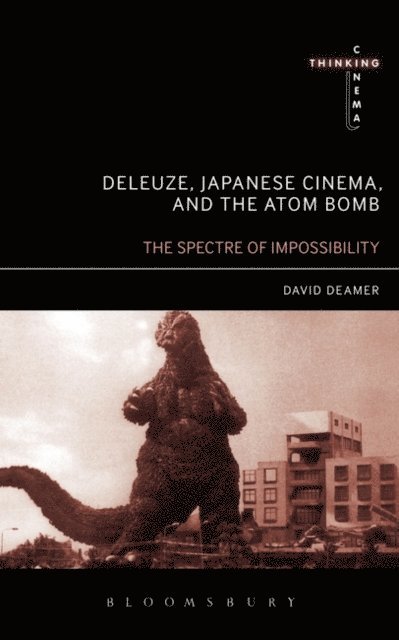
    Deleuze, Japanese Cinema, and the Atom Bomb

    The Spectre of Impossibility

    AvDavid Deamer

    E-bok
    Engelska, 2014

    Del i serien Thinking Cinema

    589 kr

    Läs direkt i Bokus Reader – eller ladda ned till din enhet

    Fler format och utgåvor

    E-bok

    625 kr

    Inbunden

    1 950 kr

    Häftad

    582 kr

    Beskrivning

    David Deamer establishes the first ever sustained encounter between Gilles Deleuze's Cinema books and post-war Japanese cinema, exploring how Japanese films responded to the atomic bombings of Hiroshima and Nagasaki. From the early days of occupation political censorship to the social and cultural freedoms of the 1960s and beyond, the book examines how images of the nuclear event appear in post-war Japanese cinema. Each chapter begins by focusing upon one or more of three key Deleuzian themes – image, history and thought – before going on to look at a selection of films from 1945 to the present day. These include movies by well-known directors Kurosawa Akira, Shindo Kaneto, Oshima Nagisa and Imamura Shohei; popular and cult classics – Godzilla (1954), Akira (1988) and Tetsuo (1989); contemporary genre flicks – Ring (1998), Dead or Alive (1999) and Casshern (2004); the avant-garde and rarely seen documentaries. The author provides a series of tables to clarify the conceptual components deployed within the text, establishing a unique addition to Deleuze and cinema studies.

    Produktinformation

    • Utgivningsdatum:2014-07-31
    • Språk:Engelska
    • Antal sidor:344
    • Filformat:EPUB
    • Kopieringsskydd:LCP
    • ISBN:9781441145895
    • Förlag:Bloomsbury Publishing PLC (Digital)
    • Serie:Thinking Cinema

    Utforska kategorier

    • Film inom Kultur
    • Filosofiska discipliner inom Filosofi och religion

    Mer om författaren

    David Deamer is Associate Lecturer in film at Manchester Metropolitan University, UK. He has published in Martin-Jones and Brown's Deleuze and Film; Bell and Colebrook's Deleuze and History; Deleuze Studies; and the online A/V Journal, of which he was co-founder. He blogs on Deleuze and cinema at www.daviddeamer.com.

    Recensioner i media

    This ambitious book brings together three different constellations: the national cinema of Japan; the atom bombs thrown on Hiroshima and Nagasaki; and Deleuze. Surprising though this may sound, the book patiently and expertly weaves these three strands together to the point of making us feel that the Deleuzian cineosis was conceived to address precisely this kind of historico-cinematic encounter. Moving away from reductive ideas of genre, Deamer tackles the complexity of a wide and extremely varied body of films united by the catastrophe of the atom bomb, allowing for a re-evaluation of forgotten gems as well as celebrated masterpieces. Unveiling not one but many Japans, this book testifies to the enduring power and infinite uses of Deleuze's vision of cinema.

    Innehållsförteckning

    • List of tablesList of imagesAcknowledgementsIntroduction: event, cinema, cineosis1. Special images, contingent centresMovement-images: Bergson, sensory-motor processThe Effects of the Atomic Bomb on Hiroshima and Nagasaki (Ito Sueo, 1946)Children of the Atom Bomb (Shindo Kaneto, 1952)Godzilla (Honda Ishiro, 1954) 2. Horizons of historyAction-images: Nietzsche, history Terror of Mechagodzilla (Honda Ishiro, 1975)Lucky Dragon No. 5 (Shindo Kaneto, 1959) Barefoot Gen (Masaki Mori, 1983)Nausicaa of the Valley of the Wind (Hayao Miyazaki, 1984)Akira (Katsuhiro Otomo, 1988)3. Traces: symptoms and figuresImpulse-images; reflection-images: Peirce, semiosisThe Naked Island (Shindo Kaneto, 1960)Dead or Alive (Takashi Miike, 1999)Ring (Nakata Hideo, 1998)Kwaidan (Kobayashi Masaki, 1964)The Face of Another (Teshigahara Hiroshi, 1966)Navel and A-bomb (Eikoh Hosoe, 1960)Tetsuo (Shinya Tsukamoto, 1989) Face of Jizo (Kuroki Kazuo, 2004)4. Consummation (and crisis)Mental-images: Bergson, memoryI Live in Fear (Kurosawa Akira, 1955)Rashomon (Kurosawa Akira, 1950)Dreams (Kurosawa Akira, 1990)Rhapsody in August (Kurosawa Akira, 1991)5. Impure anarchic multiplicitiesTime-images: Deleuze, syntheses of timeCasshern (Kiriya Kazuaki, 2004)The Pacific War (Nagisa Oshima, 1968)A History of Postwar Japan as Told by a Bar Hostess (Imamura Shohei, 1970)Black Rain (Imamura Shohei, 1989)Hiroshima (Sekigawa Hideo, 1953)Conclusion: spectres of impossibilityNotesIndexSelect bibliographySelect filmography