• Fri frakt över 249 kr
  • •
  • Snabba leveranser
  • •
  • Billiga böcker
Kundservice

Du är på sajten för privatpersoner.

Företag, bibliotek eller offentlig verksamhet?

Du handlar på classic.bokus.com, där alla dina funktioner finns intakta.
Till classic.bokus.com
Bokus logotyp. Gå till startsidan.
  • Erbjudanden
  • Nyheter
  • Student
  • Topplistor
  • Barn & ungdom
  • Bokus Play
  • E-böcker
  • Pocketböcker
  • Spel & pussel

10% rabatt på allt med kod NYSTART10 →

Sidfot

Mina sidor

    Hjälp

    • Kundservice
    • Vanliga frågor och svar
    • Frakt och leverans
    • Retur vid ångerrätt
    • Reklamera vara
    • Betalning
    • Köpvillkor
    • Allmänna villkor
    • Information om webbplatsens tillgänglighet

    Om Bokus

    • Om oss
    • Pressrum
    • För studenter
    • För företag
    • För bibliotek och offentlig verksamhet
    • För leverantörer
    • Hållbarhet

    Populärt

    • Aktuella erbjudanden
    • Presentkort
    • Studentlitteratur
    • Nya böcker
    • Topplistor
    • Signerade böcker
    • Engelska böcker

    Inspiration

    • Boktips
    • BookTok
    • Populära bokserier
    • Barnbokskaraktärer
    • Populära författare
    Logotyp för Bokus
    Följ oss på Facebook (extern länk)Följ oss på Instagram (extern länk)Följ oss på YouTube (extern länk)Följ oss på TikTok (extern länk)
    bokus @ CookiesAnpassa cookiesIntegritetspolicyKöpvillkor
    Till Citymail hemsida (extern länk)Till Budbee hemsida (extern länk)Till Postnord hemsida (extern länk)Till Schenker hemsida (extern länk)Till Early Bird hemsida (extern länk)Till Walleys hemsida (extern länk)
    1. Psykologi och pedagogik
    2. Pedagogik
    3. Pedagogisk psykologi

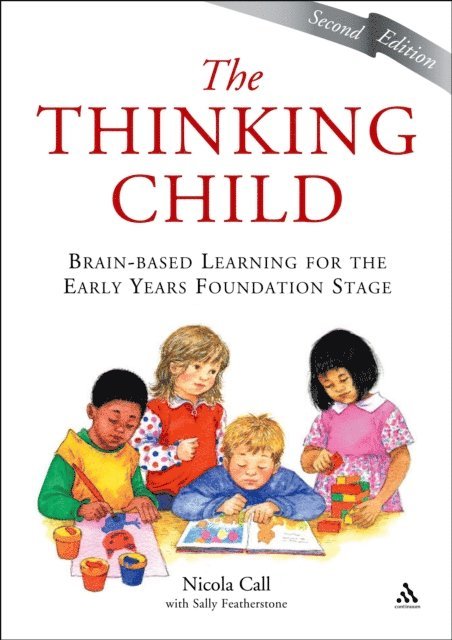
    Thinking Child

    Brain-Based Learning for the Early Years Foundation Stage

    AvNicola Call

    E-bok
    PDF, Engelska, 2010

    367 kr

    Läs direkt i Bokus Reader – eller ladda ned till din enhet (PDF kräver ofta zoom och scroll på små skärmar).

    Beskrivning

    This new edition of The Thinking Child is fully-updated with reference to the new Early Years Foundation Stage (EYFS) and Every Child Matters. The book considers the most recent research into the brain and learning, and offers practical advice on how to reflect these findings in the classroom. There is new guidance on current challenges facing practitioners, such as dealing with stressed and over-scheduled children, the philosophy and benefits of including every child and how to address practical issues that might arise in different settings. Other new material includes: - Collaborative working, - Foreign language learning and English as an additional language (EAL), - Outdoor learning and healthy settings, - Extended provision and the key person approach, and - Managing ICT and the dangers of information overload. The authors offer practical advice on implementing statutory requirements, maintaining a balance between child-initiated and adult-led activities and making the most of existing resources.

    Produktinformation

    • Utgivningsdatum:2010-04-08
    • Språk:Engelska
    • Antal sidor:160
    • Filformat:PDF
    • Kopieringsskydd:LCP
    • ISBN:9781441158727
    • Förlag:Continuum Publishing Corporation
    • Upplaga:2

    Utforska kategorier

    • Pedagogisk psykologi inom Psykologi och pedagogik
    • Skolan och förskolan inom Psykologi och pedagogik
    • Pedagogisk metodik inom Psykologi och pedagogik

    Mer om författaren

    Nicola Call started her teaching career in Inner London, rising rapidly to become Deputy Head of three primary schools. Nicola now lives in California where she combines writing with research into Accelerated Learning work in schools.Sally Featherstone is a trainer, writer and consultant for the early years and primary stages of education, both in the UK and Internationally.

    Recensioner i media

    Full of life and humour [..] I wholeheartedly recommend this book for any early years practitioner or parent of a pre-school child who wants to know more about how children learn.

    Innehållsförteckning

    • Preface \ Acknowledgements \ Introduction: Understanding the child's brain \ Step 1: Answering some frequently asked questions \ Step 2: Let's meet a brain \ Step 3: Meeting the children in their settings \ Part One: Preparing the climate and context for learning \ Step 1: Addressing children's physical needs \ Step 2: Inclusion \ Step 3: Developing emotional intelligence \ Step 4: Providing children with the tools for learning \ Step 5: Managing behaviour positively \ Step 6: Fostering partnerships with parents and carers \ Part Two: Supporting independent learning \ Step 1: Making maximum use of the environment \ Step 2: Helping children to develop good attention skills \ Step 3: Helping children to stay on task \ Step 4: Talking the language of learning \ Part Three: Developing brain-based techniques \ Step 1: Teaching children to mind map \ Step 2: Adventures in play \ Step 3: Maximising learning through music \ Step 4: Teaching and learning through movement \ Step 5: The place for technology \ Part Four: Teaching for intelligence \ Step 1: Creative teaching for better learning \ Step 2: Fostering the beginnings of group work \ Step 3: Teaching through VAK \ Step 4: Engaging the multiple intelligences \ Step 5: Taking the time for learning \ Some Useful Websites \ Bibliography \ References \ Index