• Fri frakt över 249 kr
  • •
  • Snabba leveranser
  • •
  • Billiga böcker
Kundservice

Du är på sajten för privatpersoner.

Företag, bibliotek eller offentlig verksamhet?

Du handlar på classic.bokus.com, där alla dina funktioner finns intakta.
Till classic.bokus.com
Bokus logotyp. Gå till startsidan.
  • Erbjudanden
  • Nyheter
  • Student
  • Topplistor
  • Barn & ungdom
  • Bokus Play
  • E-böcker
  • Pocketböcker
  • Spel & pussel

10% rabatt på allt med kod: NYSTART10 →

Sidfot

Mina sidor

    Hjälp

    • Kundservice
    • Vanliga frågor och svar
    • Frakt och leverans
    • Retur vid ångerrätt
    • Reklamera vara
    • Betalning
    • Köpvillkor
    • Allmänna villkor
    • Information om webbplatsens tillgänglighet

    Om Bokus

    • Om oss
    • Pressrum
    • För studenter
    • För företag
    • För bibliotek och offentlig verksamhet
    • För leverantörer
    • Hållbarhet

    Populärt

    • Aktuella erbjudanden
    • Presentkort
    • Studentlitteratur
    • Nya böcker
    • Topplistor
    • Signerade böcker
    • Engelska böcker

    Inspiration

    • Boktips
    • BookTok
    • Populära bokserier
    • Barnbokskaraktärer
    • Populära författare
    Logotyp för Bokus
    Följ oss på Facebook (extern länk)Följ oss på Instagram (extern länk)Följ oss på YouTube (extern länk)Följ oss på TikTok (extern länk)
    bokus @ CookiesAnpassa cookiesIntegritetspolicyKöpvillkor
    Till Citymail hemsida (extern länk)Till Budbee hemsida (extern länk)Till Postnord hemsida (extern länk)Till Schenker hemsida (extern länk)Till Early Bird hemsida (extern länk)Till Walleys hemsida (extern länk)
    1. Medicin
    2. Andra medicinska specialiteter
    3. Klinisk psykologi

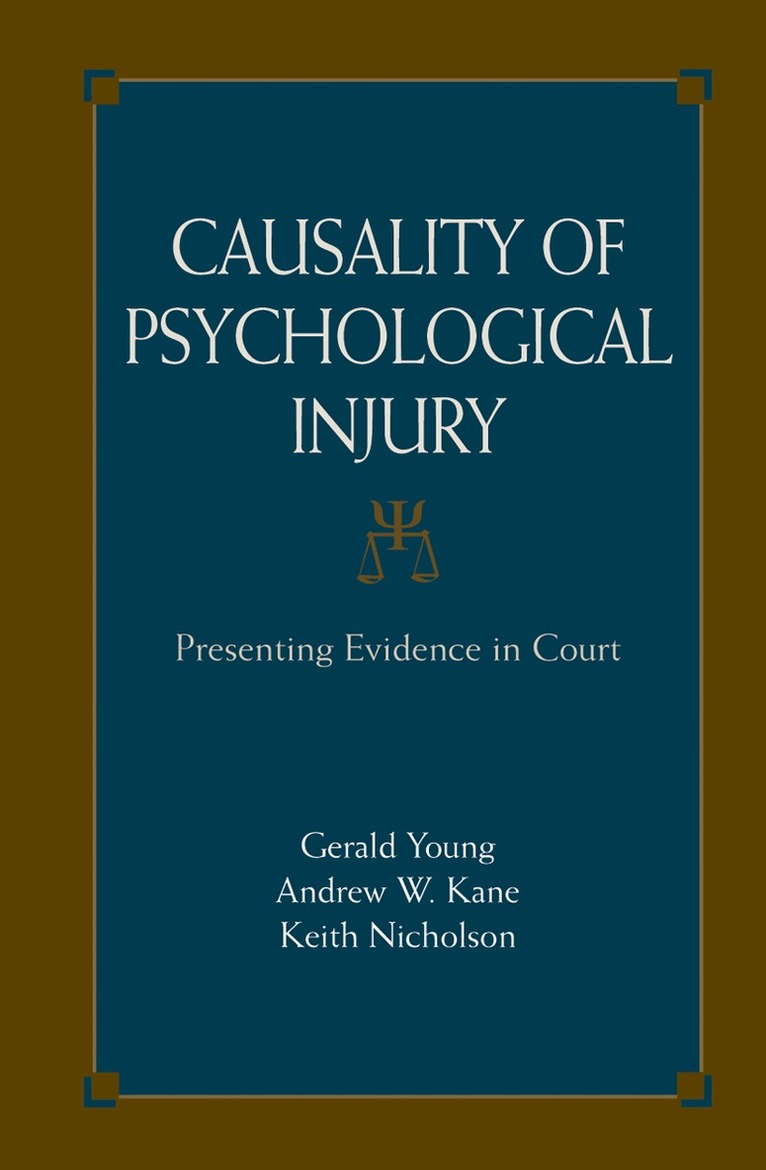
    Causality of Psychological Injury

    Presenting Evidence in Court

    AvGerald Young,Andrew W. Kane

    Häftad, Engelska, 2010

    1 099 kr

    Beställningsvara. Skickas inom 10-15 vardagar. Fri frakt över 249 kr.

    Fler format och utgåvor

    Inbunden

    999 kr

    Beskrivning

    This sequel to the authors’ Psychological Knowledge in Court offers a welcome expansion on key concepts, terms, and issues in causality, bringing much needed clarity to psychological injury assessments and the legal contexts that employ them.Focusing on PTSD, traumatic brain injury, and chronic pain (and grounding readers in salient U.S. and Canadian case law), Causality sets out a multifactorial causality framework to facilitate admissibility of psychological evidence in court. Issues concerning malingering are examined in depth, as are clinical gray areas that can jeopardize validity. At the same time, the book clearly explains what lawyers and clinicians need to understand about each other’s work—of crucial importance since the two sides often seem to speak at cross-purposes.The authors and six guest contributorsIllustrate the roles of preexisting vulnerabilities, traumatic events, and post-event occurrences in psychological impairment and disabilityReview the literature on PTSD, TBI, and chronic pain for legal relevanceIdentify current challenges and controversies in the field, as well as emerging areas for researchRecommend methods and instruments for conducting more courtworthy assessmentsProvide a detailed critical review of malingering and related phenomenaPropose a more accurate, shared terminology of causalityValid causality judgments are based on sound knowledge of research on large populations and careful testing of individuals; at the same time they must conform to stringent legal standards of relevance and reliability to be accepted for testimony. Forensic practitioners and attorneys will turn to Causality of Psychological Injury as their professional paths increasingly cross in seeking comprehensive and state of the art information.

    Produktinformation

    • Utgivningsdatum:2010-10-29
    • Mått:155 x 235 x 35 mm
    • Vikt:930 g
    • Format:Häftad
    • Språk:Engelska
    • Antal sidor:648
    • Förlag:Springer-Verlag New York Inc.
    • ISBN:9781441942142

    Utforska kategorier

    • Klinisk psykologi inom Medicin
    • Psykologi inom Psykologi och pedagogik
    • Rättsvetenskap inom Juridik

    Mer om författaren

    Gerald Young, Ph.D., C. Psych., is an Associate Professor in the Department of Psychology at Glendon College, York University, Toronto, Canada. He teaches Rehabilitation Psychology to senior undergraduates. In addition, he is a licensed psychologist in Ontario and Quebec, practicing in rehabilitation, in particular. He is the author or co-author of four books, and multiple chapters and articles. He is a member of Canadian registers in clinical practice and disability assessment. He has undertaken over 1,000 assessments related to rehabilitation and disability claims for psychological injury, including after referral for medicolegal purposes from attorneys, insurance companies, and assessment companies. He is a member of the college policy and planning committee, having served in this function at the university level, as well. For the field of psychological injury and law, he is organizing the first (a) professional association, (b) the first academic journal, (c) the first graduate-level textbook related to the field, and (d) the first book series. Springer is considering supporting these publishing initiatives. Andrew Kane, Ph.D., ABAP, is a licensed psychologist in private practice in Milwaukee. He is a diplomat of the American Board of Assessment Psychologists, is listed in the National Register of Health Service Providers in Psychology, and is a recipient of the Certificate of Professional Qualification in Psychology of the Association of State and Provincial Psychology Boards. He is a Professor at Wisconsin School of Professional Psychology, an Adjunct Clinical Professor in the department of Psychology at University of Wisconsin-Milwaukee, and an Associate Clinical Professor, Department of Psychiatry and Behavioral Medicine, Medical College of Wisconsin. He is the author or co-author of eight books and some five dozen professional papers and chapters. He served as a member of the Expert Panel on Psychiatric and Psychological Evidence of the Commission on Mental and Physical Disability Law of the American Bar Association, which helped produce the National Benchbook on Psychiatric and Psychological Evidence and Testimony, published by the ABA. He is a former president of the Wisconsin Psychological Association and of its Division of Forensic and Correctional Psychologists. Dr. Kane also served as a member of the board of the Wisconsin Psychological Association's forensic division. He served for ten years as a member of the Ethics Committee of the Wisconsin Psychological Association. Dr. Kane founded the Wisconsin Coalition on Sexual Misconduct by Psychotherapists and Counselors, a national model program. Dr. Kane has served as an expert in more than 3,000 civil cases involving a variety of issues. Keith Nicholson, Ph.D., C. Psych, has had extensive clinical experience working with many different patient populations. He obtained his Ph.D. in Clinical Neuropsychology from the University of Victoria and, since then, has worked at the Toronto Western Hospital, now part of the University Health Network in Toronto, in addition to working at several community clinics and maintaining a private practice. Dr. Nicholson is now affiliated with the Comprehensive Pain Program at the Toronto Western Hospital. He has a particular interest in the psychology of chronic pain and clinical neuropsychology and has many publications in these and other areas of interest.

    Recensioner i media

    From the reviews: "Causality of Psychological Injury: Presenting Evidence in Court is an edited volume with chapters that are not only informative but also well written. The references that I sampled are relevant, useful, and probably as current as any could be in a nonelectronic book ... . surely heightens its educational value to clinical and forensic practitioners and should shape corresponding professional thinking and praxis." (Richard W. Bloom, PsycCritiques, Vol. 52 (37), 2007) "I was delighted to find a concise summary of why third party observers should not be allowed during the course of a forensic neuropsychological examination, touching on such seminal issues as proper test administration, norms, ethical issues as well as legal precedents prohibiting this practice. The summary was so well done. ... This information was also quite helpful in formulating the expert affidavit ... . I found this volume to be responsive to some very different dilemmas I encountered in my civil practice." (Jerid M. Fisher, Archives of Clinical Neuropsychology, December, 2007) "Causality of Psychological Injury ... addresses issues pertinent to psychological assessment in personal injury cases in a well-organized, comprehensive, and authoritative manner. ... The writing is clear and concise, and is useful for both those who wish to expand their practice into this area of forensic psychology, as well as the more experienced forensic psychologist or psychiatrist ... . Causality of Psychological Injury fills a serious gap in the forensic psychological literature ... . I recommend it without reservation." (Eric G. Mart, Psychological Injury and Law, Vol. 1, 2008)

    Innehållsförteckning

    • Causality, Psychological Injuries, and Court: Introduction.- Causality, Psychological Injuries, and Court: Introduction.- Causality and Psychological Evidence: Concepts, Terms, Issues.- Causality in Psychology and Law.- Causality: Concepts, Issues, and Recommendations.- Dictionary of Terms Related to Causality, Causation, Law, and Psychology.- Multicausal Perspectives on Psychological Injury I: PTSD and MTBI.- Multicausal Perspectives on Psychological Injury II: Chronic Pain.- Multicausal Perspectives on Psychological Injury III: Conclusions.- Pain, Affect, Nonlinear Dynamical Systems, and Chronic Pain: Bringing Order to Disorder.- Considering Course and Treatment in Rehabilitation: Sequential and Dynamic Causality.- Causality in Court: Psychological Considerations.- Basic Concepts in Psychology and Law.- Conducting a Psychological Assessment.- Other Psycho-Legal Issues.- Summary and Conclusions.- Malingering in Psychological Injury: TBI, Chronic Pain, and PTSD.- Malingering: Overview and Basic Concepts.- The Effect of Compensation Status.- Malingering: Traumatic Brain Injury.- Malingering: Chronic Pain.- Malingering: Posttraumatic Stress Disorder and Depression.- Malingering: Summary and Conclusions.- Causality, Psychology, and Law.- Causation, Psychology, and Law.- Causality, Psychological Injuries, and Court: Conclusions.