• Fri frakt över 249 kr
  • •
  • Snabba leveranser
  • •
  • Billiga böcker
Kundservice

Du är på sajten för privatpersoner.

Företag, bibliotek eller offentlig verksamhet?

Du handlar på classic.bokus.com, där alla dina funktioner finns intakta.
Till classic.bokus.com
Bokus logotyp. Gå till startsidan.
  • Erbjudanden
  • Nyheter
  • Student
  • Topplistor
  • Barn & ungdom
  • Bokus Play
  • E-böcker
  • Pocketböcker
  • Spel & pussel

10% rabatt på allt med kod: NYSTART10 →

Sidfot

Mina sidor

    Hjälp

    • Kundservice
    • Vanliga frågor och svar
    • Frakt och leverans
    • Retur vid ångerrätt
    • Reklamera vara
    • Betalning
    • Köpvillkor
    • Allmänna villkor
    • Information om webbplatsens tillgänglighet

    Om Bokus

    • Om oss
    • Pressrum
    • För studenter
    • För företag
    • För bibliotek och offentlig verksamhet
    • För leverantörer
    • Hållbarhet

    Populärt

    • Aktuella erbjudanden
    • Presentkort
    • Studentlitteratur
    • Nya böcker
    • Topplistor
    • Signerade böcker
    • Engelska böcker

    Inspiration

    • Boktips
    • BookTok
    • Populära bokserier
    • Barnbokskaraktärer
    • Populära författare
    Logotyp för Bokus
    Följ oss på Facebook (extern länk)Följ oss på Instagram (extern länk)Följ oss på YouTube (extern länk)Följ oss på TikTok (extern länk)
    bokus @ CookiesAnpassa cookiesIntegritetspolicyKöpvillkor
    Till Citymail hemsida (extern länk)Till Budbee hemsida (extern länk)Till Postnord hemsida (extern länk)Till Schenker hemsida (extern länk)Till Early Bird hemsida (extern länk)Till Walleys hemsida (extern länk)
    1. Naturvetenskap och teknik
    2. Matematik och naturvetenskap
    3. Astronomi

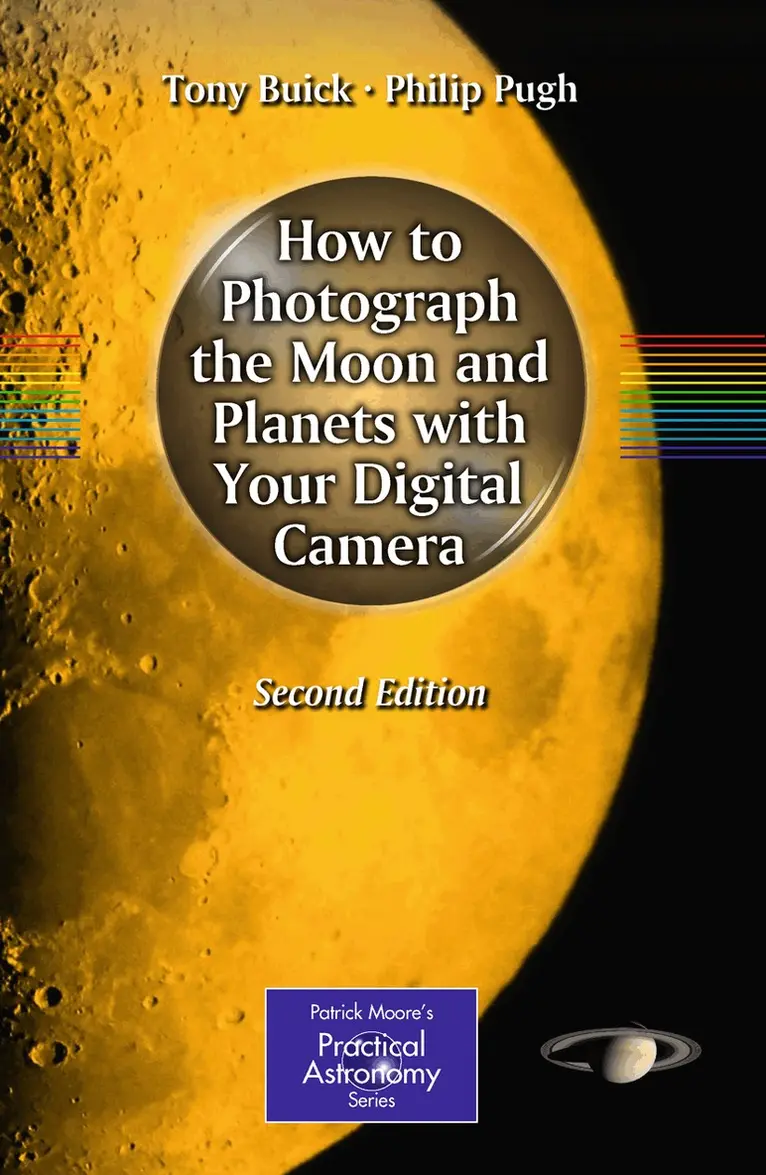
    How to Photograph the Moon and Planets with Your Digital Camera

    AvTony Buick,Philip Pugh

    Häftad, Engelska, 2011

    Del i serien Patrick Moore Practical Astronomy Series

    353 kr

    Beställningsvara. Skickas inom 10-15 vardagar. Fri frakt över 249 kr.

    Fler format och utgåvor

    E-bok

    306 kr

    Beskrivning

    Although astronomical CCD cameras can be very costly, digital cameras – the kind you use on holiday – on the other hand, are relatively inexpensive. Moreover, their technology – especially thermal noise, sensitivity (ISO number) and resolution – has progressed to a point where such cameras are more than capable of photographing the brighter astronomical objects. Now Tony Buick has teamed up with fellow author and astro imager Phil Pugh, to produce a completely revised, updated, and extended second edition to How to Photograph the Moon and Planets with your Digital Camera, first published in 2006. The revisions take into account changing (and improving) camera technology, and some items which are now available commercially but which previously had to be home-made. The section of solar observing has been expanded to include observing by H-alpha light, and among the many additional sections are photographing the constellations, aurorae, and basic post-imaging processing.

    Produktinformation

    • Utgivningsdatum:2011-01-28
    • Mått:155 x 235 x 15 mm
    • Vikt:558 g
    • Format:Häftad
    • Språk:Engelska
    • Serie:Patrick Moore Practical Astronomy Series
    • Antal sidor:346
    • Upplaga:2
    • Förlag:Springer-Verlag New York Inc.
    • ISBN:9781441958273

    Utforska kategorier

    • Astronomi inom Naturvetenskap och teknik

    Mer om författaren

    Although Tony Buick in his career worked in medical, veterinary, and agricultural science, specializing in analytical chemistry, he turned to his lifelong interest in astronomy following an early retirement and has encouraged the younger generation to observe and understand the sky while teaching science, computing, and geography. His fascination with the Moon was given a further boost through his friendship with Sir Patrick Moore, which led to the publication of the first edition of How to Photograph the Moon and Planets with your Digital Camera. Buick has a wide range of interests, from the 'infinitesimal' under a microscope to the 'infinite' through a telescope and has published articles on tardigrades, the robust microscopic animals that can even survive for a while in space, in addition to articles on the Moon. His latest book for Springer, The Rainbow Sky, published in 2009, is a product of Buick's interest in spectroscopy and color in general throughout the universe. Philip Pugh is a technical instructor in telecommunications. He was born in England and became interested in astronomy at age six, using his first telescope at the age of 9. However, by the age of 14, he had reached the limit of what could be done with a modest instrument. Philip majored in mathematics and worked as a computer programmer. Competitive chess and bridge had replaced astronomy as a hobby, and it was through fishing that he first became a published writer, in 1980, with a spoof about fishing for minnows. As his expertise in work improved, he started writing for computing magazines, culminating in a twelve-part series for a magazine. He married in 1989 and had a daughter in 1990. It was a view of Venus and trip to an observatory in New Zealand that rekindled his interest in astronomy, and in 1995, he was given a pair of binoculars for his 40th birthday. He was soon learning his way around the easier deep sky objects and following the moons of Jupiter. A small telescope followed in 1997 and a portable one in 1999. It seemed only natural that he would write about astronomy, and the articles soon began to flow. It was the Coronado Personal Solar Telescope that his wife and daughter presented him for his 50th birthday that led to his first book, Observing the Sun with Coronado Telescopes. Philip has experimented extensively with compact digital cameras. He has also researched the Messier objects. Philip no longer competes in chess or bridge and has not been fishing for a few years, but he now has the opportunity to view the sky from many different places. His interest in astrophotography spawned an interest in general photography, and he has collected many "tourist" shots from around the world.

    Recensioner i media

    On the first edition (2006): Buick, an experienced amateur astronomer, uses his own images... to illustrate a variety of equipment... [N]ovice imagers can rest assured that the images here are what the beginner can realistically expect to achieve... I enjoyed this book, and learned from it too. --Peter Grego, in Popular Astronomy, July-September 2006 The color images he has produced - there are over 300 of them in the book - are of breathtaking quality. His book is more than a manual of techniques (including details of how to make a low-cost DIY camera mount) and examples; it also provides a concise photographic atlas of the whole of the nearside of the Moon - with every image made using a standard digital camera - and describes the various lunar features, including the sites of manned and robotic landings. --eBook30.com

    Innehållsförteckning

    • Note on the Second Edition by Philip Pugh.- Foreword by Sir Patrick Moore.- Preface.-  Chapter 1: Introduction.- Chapter 2: Choosing Your Equipment.- Chapter 3: Setting Up.- Chapter 4: Photographing the Phases of the Moon.- Chapter 5: Identifiying Regions of the Moon.- Chapter 6: Techniques for Photographing the Moon.- Chapter 7: Photographing Lunar Events.- Chapter 8: Processing Lunar Images.- Chapter 9: Solar System Moons.- Chapter 10: Photographing the Planets.- Chapter 11: The Sun.- Chapter 12: Transits.- Chapter 13: And What Else?.- Chapter 14: A Few Final Words.- Appendix.- Glossary.- Index.