Tony Buick – författare
Visar alla böcker från författaren Tony Buick. Handla med fri frakt och snabb leverans.
8 produkter
Rainbow Sky
An Exploration of Colors in the Solar System and Beyond
Av Tony Buick
Häftad, 2009
361 kr
Lägg i varukorg
W here do you start to write about colors in the universe? Do you look to the deepest ocean trenches on Earth, with their awesome bioluminescent creatures roaming the blackness of the abyss? And where do you finish? With the most distant galaxies in the cosmos? A difficult question, p- haps, but in …
Rainbow Sky
An Exploration of Colors in the Solar System and Beyond
Av Tony Buick
E-bok, 2010
470 kr
Lägg i varukorg
W here do you start to write about colors in the universe? Do you look to the deepest ocean trenches on Earth, with their awesome bioluminescent creatures roaming the blackness of the abyss? And where do you finish? With the most distant galaxies in the cosmos? A difficult question, p- haps, but in …
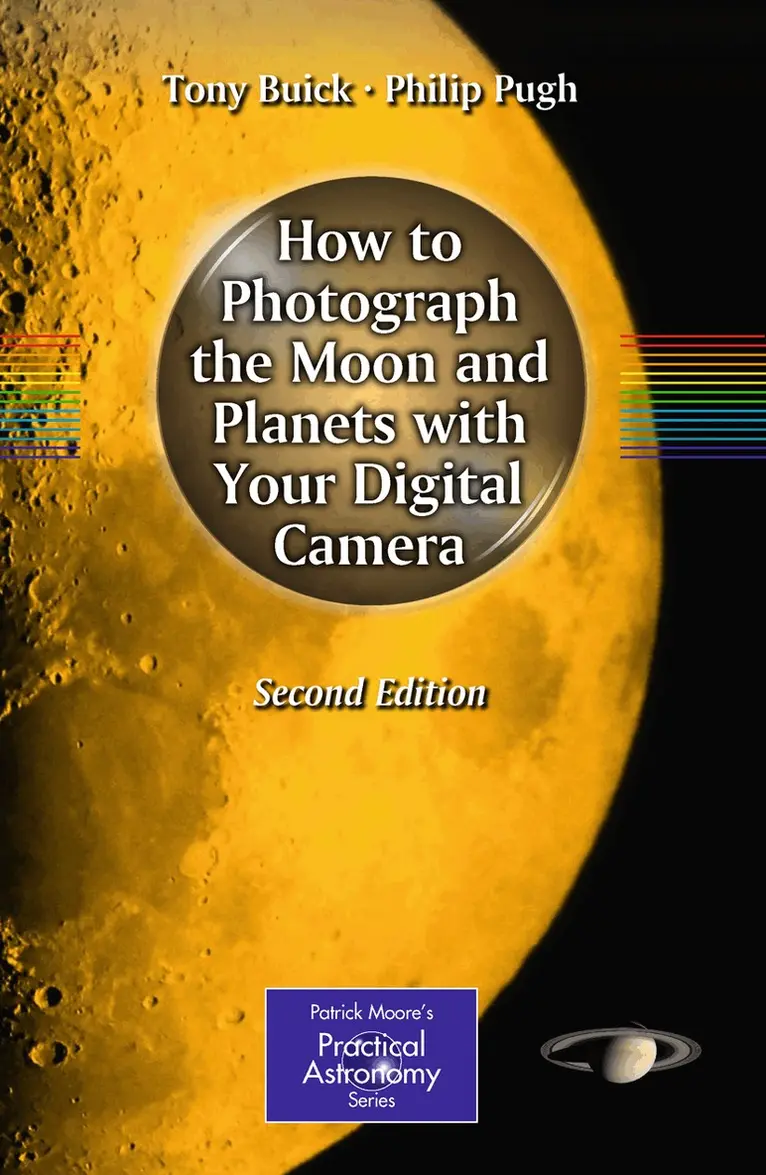
How to Photograph the Moon and Planets with Your Digital Camera
Häftad, 2011
356 kr
Lägg i varukorg
Although astronomical CCD cameras can be very costly, digital cameras – the kind you use on holiday – on the other hand, are relatively inexpensive. Moreover, their technology – especially thermal noise, sensitivity (ISO number) and resolution – has progressed to a point where such cameras are more …
How to Photograph the Moon and Planets with Your Digital Camera
E-bok, 2011
504 kr
Lägg i varukorg
Although astronomical CCD cameras can be very costly, digital cameras – the kind you use on holiday – on the other hand, are relatively inexpensive. Moreover, their technology – especially thermal noise, sensitivity (ISO number) and resolution – has progressed to a point where such cameras are more …
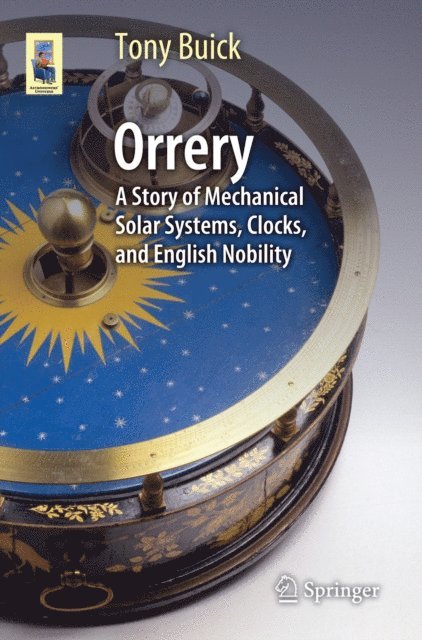
Orrery
A Story of Mechanical Solar Systems, Clocks, and English Nobility
Av Tony Buick
E-bok, 2013
538 kr
Lägg i varukorg
“Orrery” appeals to almost anyone interested in popular astronomy, astronomical mechanical devices, scientific instruments, the history of clocks - and even the history of aristocratic and prestigious families! Many people these days – not only astronomers – have a good idea of the main components …
How to Photograph the Moon and Planets with Your Digital Camera
Av Tony Buick
E-bok, 2007
316 kr
Lägg i varukorg
Since the advent of astronomical CCD imaging it has been possible for amateurs to produce images of a quality that was attainable only by universities and professional observatories just a decade ago. However, astronomical CCD cameras are still very expensive, and technology has now progressed so …
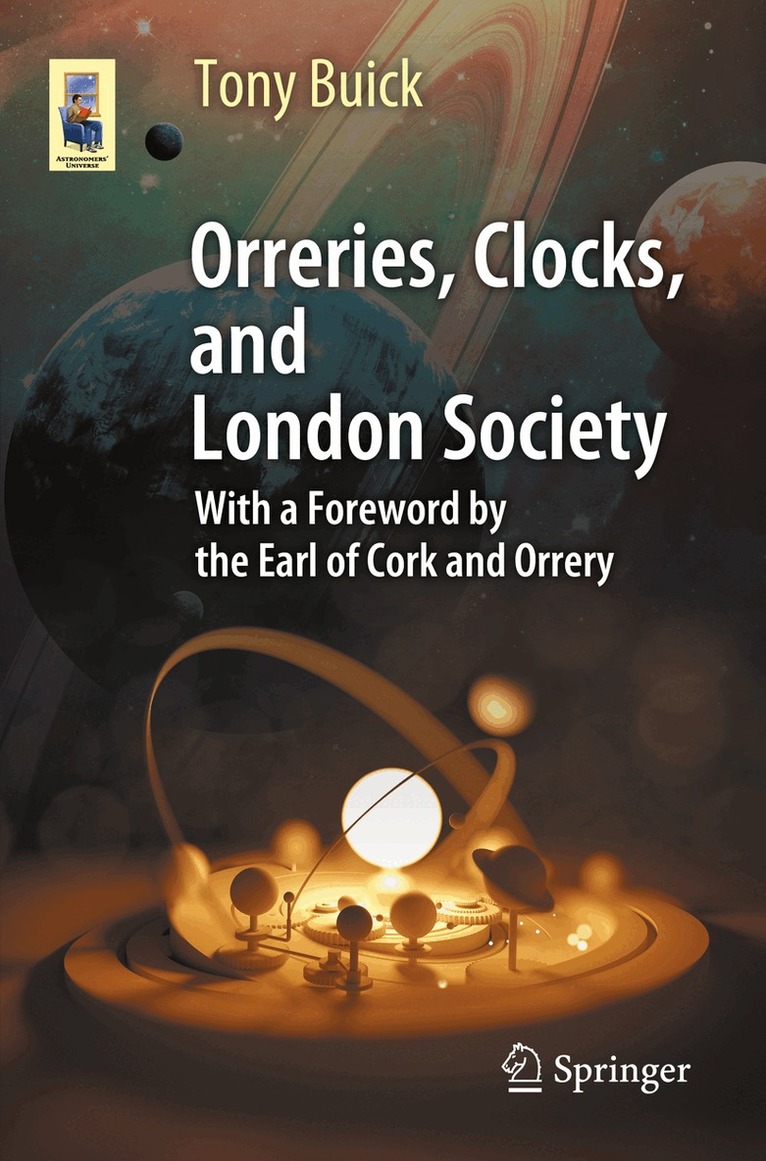
Orreries, Clocks, and London Society
The Evolution of Astronomical Instruments and Their Makers
Av Tony Buick
Häftad, 2020
405 kr
Lägg i varukorg
Orreries—mechanical models of the Solar System and its motions—are found everywhere. They appear in paintings, on computers, across natural landscapes, and in museums all over the world. The more you look, the more you find, yet their significance is often overlooked aside other great astronomical …
Orreries, Clocks, and London Society
The Evolution of Astronomical Instruments and Their Makers
Av Tony Buick
E-bok, 2020
930 kr
Lägg i varukorg
Orreries—mechanical models of the Solar System and its motions—are found everywhere. They appear in paintings, on computers, across natural landscapes, and in museums all over the world. The more you look, the more you find, yet their significance is often overlooked aside other great astronomical …