• Fri frakt över 249 kr
  • •
  • Snabba leveranser
  • •
  • Billiga böcker
Kundservice

Du är på sajten för privatpersoner.

Företag, bibliotek eller offentlig verksamhet?

Du handlar på classic.bokus.com, där alla dina funktioner finns intakta.
Till classic.bokus.com
Bokus logotyp. Gå till startsidan.
  • Erbjudanden
  • Nyheter
  • Student
  • Topplistor
  • Barn & ungdom
  • Bokus Play
  • E-böcker
  • Pocketböcker
  • Spel & pussel

10% rabatt på allt med kod: NYSTART10 →

Sidfot

Mina sidor

    Hjälp

    • Kundservice
    • Vanliga frågor och svar
    • Frakt och leverans
    • Retur vid ångerrätt
    • Reklamera vara
    • Betalning
    • Köpvillkor
    • Allmänna villkor
    • Information om webbplatsens tillgänglighet

    Om Bokus

    • Om oss
    • Pressrum
    • För studenter
    • För företag
    • För bibliotek och offentlig verksamhet
    • För leverantörer
    • Hållbarhet

    Populärt

    • Aktuella erbjudanden
    • Presentkort
    • Studentlitteratur
    • Nya böcker
    • Topplistor
    • Signerade böcker
    • Engelska böcker

    Inspiration

    • Boktips
    • BookTok
    • Populära bokserier
    • Barnbokskaraktärer
    • Populära författare
    Logotyp för Bokus
    Följ oss på Facebook (extern länk)Följ oss på Instagram (extern länk)Följ oss på YouTube (extern länk)Följ oss på TikTok (extern länk)
    bokus @ CookiesAnpassa cookiesIntegritetspolicyKöpvillkor
    Till Citymail hemsida (extern länk)Till Budbee hemsida (extern länk)Till Postnord hemsida (extern länk)Till Schenker hemsida (extern länk)Till Early Bird hemsida (extern länk)Till Walleys hemsida (extern länk)
    1. Medicin
    2. Andra medicinska specialiteter
    3. Farmakologi

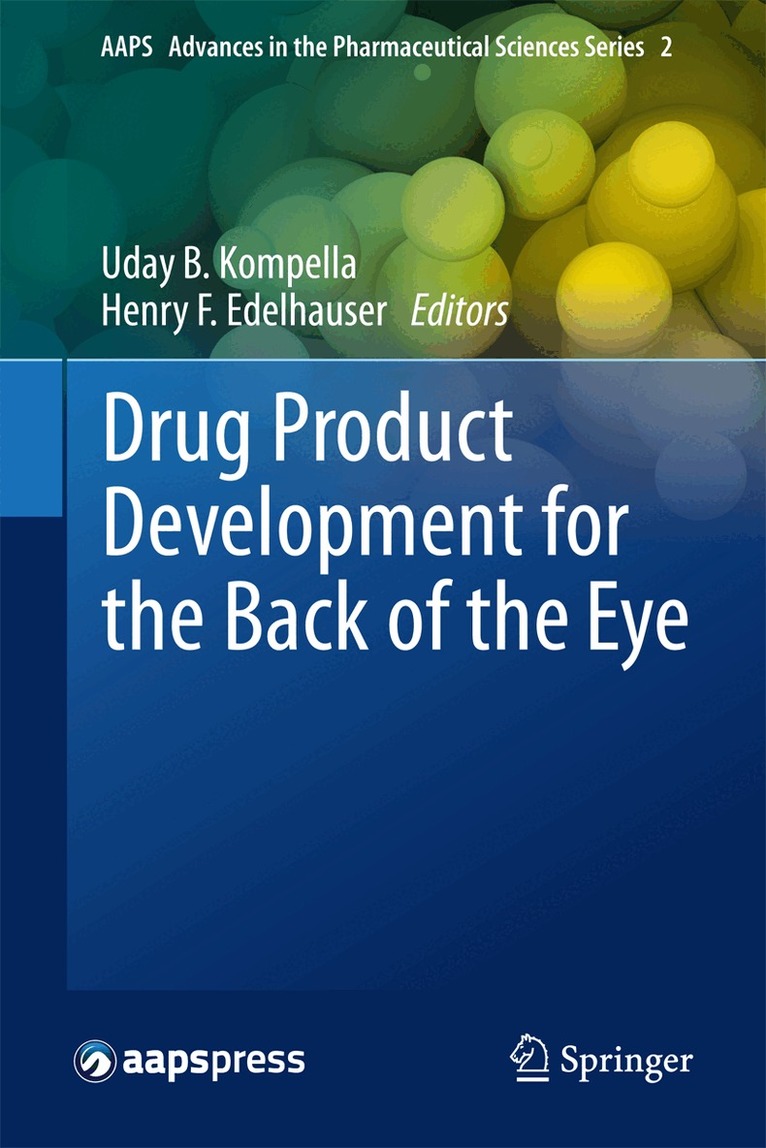
    Drug Product Development for the Back of the Eye

    AvUday B. Kompella,Henry F. Edelhauser

    Inbunden, Engelska, 2011

    Del 2 i serien AAPS Advances in the Pharmaceutical Sciences Series

    2 230 kr

    Beställningsvara. Skickas inom 10-15 vardagar. Fri frakt över 249 kr.

    Beskrivning

    This comprehensive volume discusses approaches for a systematic selection of delivery systems for various classes of therapeutic agents including small molecule, protein, and nucleic acid drugs.  Specific topics covered in this book include:Solution, suspension, gel, nanoparticle, microparticle, and implant dosage formsRefillable and microneedle devicesIntravitreal, suprachoroidal, intrascleral, transscleral, systemic, and topical routes of deliveryPhysical methods including iontophoresis for drug deliveryRational selection of routes of administration and delivery systemsNoninvasive and continuous drug monitoring Regulatory path to drug product developmentClinical endpoints for drug product developmentEmerging and existing drugs and drug targets  Drug Product Development for the Back of the Eye is authored by renowned ocular drug delivery experts, representing academic, clinical, and industrial organizations and serves as indispensable resource for ophthalmic researchers, drug formulation scientists, drug delivery and drug disposition scientists, as well as clinicians involved in designing and developing novel therapeutics for the back of the eye diseases. This book is also relevant for students in various disciplines including ophthalmology, pharmaceutical sciences, drug delivery, and biomedical engineering. Refillable and microneedle devicesIntravitreal, suprachoroidal, intrascleral, transscleral, systemic, and topical routes of deliveryPhysical methods including iontophoresis for drug deliveryRational selection of routesof administration and delivery systemsNoninvasive and continuous drug monitoring Regulatory path to drug product developmentClinical endpoints for drug product developmentEmerging and existing drugs and drug targets  Drug Product Development for the Back of the Eye is authored by renowned ocular drug delivery experts, representing academic, clinical, and industrial organizations and serves as indispensable resource for ophthalmic researchers, drug formulation scientists, drug delivery and drug disposition scientists, as well as clinicians involved in designing and developing novel therapeutics for the back of the eye diseases. This book is also relevant for students in various disciplines including ophthalmology, pharmaceutical sciences, drug delivery, and biomedical engineering. Refillable and microneedle devicesIntravitreal, suprachoroidal, intrascleral, transscleral, systemic, and topical routes of deliveryPhysical methods including iontophoresis for drug deliveryRational selection of routes of administration and delivery systemsNoninvasive and continuous drug monitoring Regulatory path to drug product developmentClinical endpoints for drug product developmentEmerging and existing drugs and drug targets  Drug Product Development for the Back of the Eye is authored by renowned ocular drug delivery experts, representing academic, clinical, and industrial organizations and serves as indispensable resource for ophthalmic researchers, drug formulation scientists, drug delivery and drug disposition scientists, as well as clinicians involved in designing and developing novel therapeutics for the back of theeye diseases. This book is also relevant for students in various disciplines including ophthalmology, pharmaceutical sciences, drug delivery, and biomedical engineering.

    Produktinformation

    • Utgivningsdatum:2011-08-03
    • Mått:155 x 235 x 36 mm
    • Vikt:1 062 g
    • Format:Inbunden
    • Språk:Engelska
    • Serie:AAPS Advances in the Pharmaceutical Sciences Series
    • Antal sidor:592
    • Upplaga:2011
    • Förlag:Springer-Verlag New York Inc.
    • ISBN:9781441999191

    Utforska kategorier

    • Farmakologi inom Medicin
    • Oftalmologi inom Medicin
    • Tillverkningsteknik inom Naturvetenskap och teknik

    Mer om författaren

    Uday B. Kompella, Ph.D. has been an independent faculty member in the field of drug delivery for 17 years, with ocular drug delivery being a key research focus. Prior to joining University of Colorado in 2008, he served as a faculty member at University of Nebraska for 10 years and at Auburn University for 4 years. Dr. Kompella's research, published in over 100 peer-reviewed articles, is focused on developing new drug and gene delivery approaches for treating neovascular diseases including diabetic retinopathy, age-related macular degeneration, and cancer. Dr. Kompella developed and assessed several drug delivery systems including functionalized nanoparticles, nanoporous microparticles, microparticles, injectable implants, dendrimers, liposomes, and in situ forming gels for ophthalmic applications. Dr. Kompella is a Fellow of the American Association of Pharmaceutical Scientists (2005) and the Association for Research in Vision and Ophthalmology (2010). He was recognized as a Distinguished Scientist in 2006 and as a Distinguished Teacher in 2003 at University of Nebraska Medical Center. Henry F. Edelhauser, Ph.D. is a world leader in ophthalmic drug delivery, with an academic career spanning over 4 decades in ophthalmic research. After serving as a faculty member at the Medical College of Wisconsin (1966-1989) as an assistant, associate and then full professor, Dr. Edelhauser joined Emory University in 1989 as the Ferst Professor of Ophthalmology and Director of Ophthalmic Research. Dr. Edelhauser published over 230 peer-reviewed articles in the areas of ophthalmic drug delivery, surgical pharmacology, corneal physiology, and ocular toxicology. Dr. Edelhauser made pioneering contributions towards transcorneal, transscleral, and suprachoroidal drug delivery to the eye. During 1990-91, Dr. Edelhauser served as the president of the Association for Research in Vision and Ophthalmology (ARVO). In 1999 he was awarded the Castroviejo Medal and the Alcon Research Award. In 2000, he received the senior achievement award from the American Academy of Ophthalmology. In 2005, Dr. Edelhauser was recognized with the Procter medal, ARVO's highest honor for his outstanding ophthalmic translational research from basic science to clinical applications. Henry F. Edelhauser, Ph.D. is a world leader in ophthalmic drug delivery, with an academic career spanning over 4 decades in ophthalmic research. After serving as a faculty member at the Medical College of Wisconsin (1966-1989) as an assistant, associate and then full professor, Dr. Edelhauser joined Emory University in 1989 as the Ferst Professor of Ophthalmology and Director of Ophthalmic Research. Dr. Edelhauser published over 230 peer-reviewed articles in the areas of ophthalmic drug delivery, surgical pharmacology, corneal physiology, and ocular toxicology. Dr. Edelhauser made pioneering contributions towards transcorneal, transscleral, and suprachoroidal drug delivery to the eye. During 1990-91, Dr. Edelhauser served as the president of the Association for Research in Vision and Ophthalmology (ARVO). In 1999 he was awarded the Castroviejo Medal and the Alcon Research Award. In 2000, he received the senior achievement award from the American Academy of Ophthalmology. In 2005, Dr. Edelhauser was recognized with the Procter medal, ARVO's highest honor for his outstanding ophthalmic translational research from basic science to clinical applications. Henry F. Edelhauser, Ph.D. is a world leader in ophthalmic drug delivery, with an academic career spanning over 4 decades in ophthalmic research. After serving as a faculty member at the Medical College of Wisconsin (1966-1989) as an assistant, associate and then full professor, Dr. Edelhauser joined Emory University in 1989 as the Ferst Professor of Ophthalmology and Director of Ophthalmic Research. Dr. Edelhauser published over 230 peer-reviewed articles in the areas of ophthalmic drug delivery, surgical pharmacology, corneal physiology, and ocular toxicology. Dr. Edelhauser made pioneering contributions towards transcorneal, transscleral, and suprachoroidal drug delivery to the eye. During 1990-91, Dr. Edelhauser served as the president of the Association for Research in Vision and Ophthalmology (ARVO). In 1999 he was awarded the Castroviejo Medal and the Alcon Research Award. In 2000, he received the senior achievement award from the American Academy of Ophthalmology. In 2005, Dr. Edelhauser was recognized with the Procter medal, ARVO's highest honor for his outstanding ophthalmic translational research from basic science to clinical applications.

    Innehållsförteckning

    • Selection of Drug Delivery Approaches for the Back of the Eye: Opportunities and Unmet Needs.- Microdialysis for Vitreal Pharmacokinetics.- Fluorophotometry for Pharmacokinetic Assessment.- Systemic Route for Retinal Drug Delivery: Role of the Blood-Retinal Barrier.- Topical Drug Delivery to the Back of the Eye.- Principles of Retinal Drug Delivery from Within the Vitreous.- Transscleral Drug Delivery.- Suprachoroidal and Intrascleral Drug Delivery.- Advances in Biodegradable Ocular Drug Delivery Systems.- Microparticles as Drug Delivery Systems for the Back of the Eye.- Nanotechnology and Nanoparticles.- Hydrogels for Ocular Posterior Segment Drug Delivery.- Refillable Devices for Therapy of Ophthalmic Diseases.- Targeted Drug Delivery to the Eye Enabled by Microneedles.- Ocular Iontophoresis.- Drug and Gene Therapy Mediated by Physical Methods.- Protein Drug Delivery and Formulation Development.- Drug Suspension Development for the Back of the Eye.- Regulatory Considerations in Product Development for Back of the Eye.- Clinical Endpoints for Back of the Eye Diseases.- Druggable Targets and Therapeutic Agents for Disorders of the Back of the Eye.- Development of Bile Acids as Anti-Apoptotic and Neuroprotective Agents in Treatment of Ocular Disease.