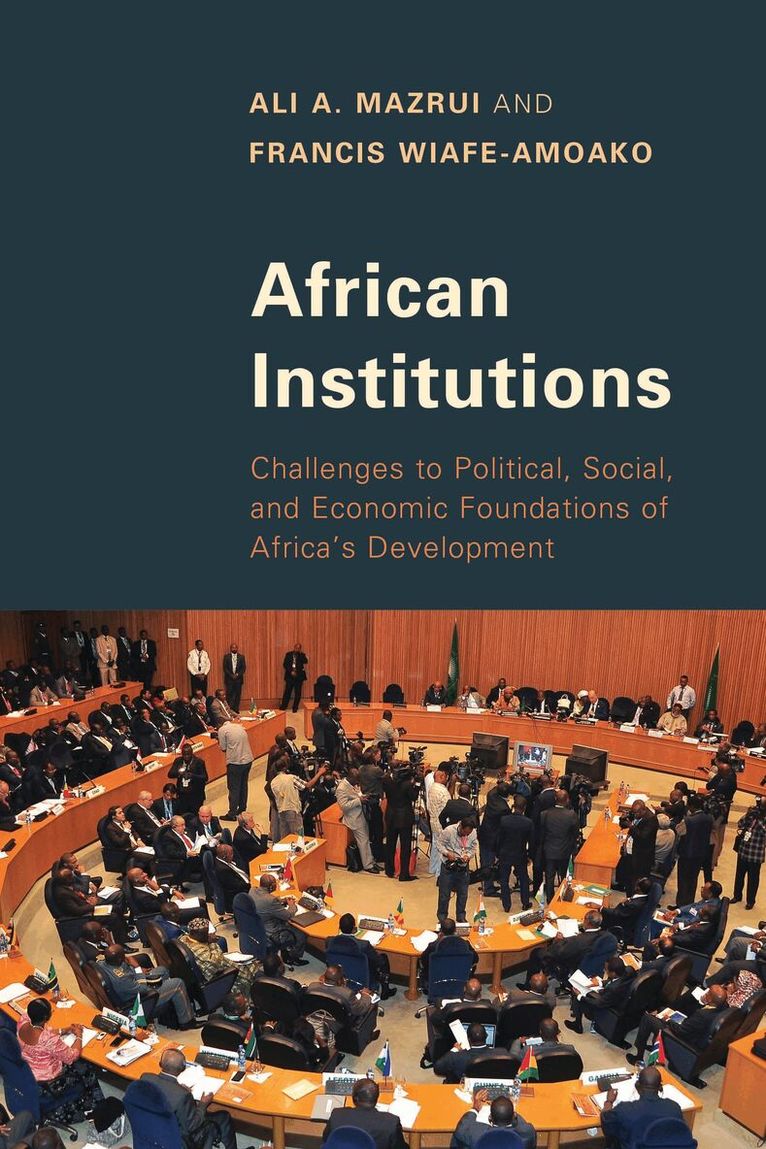
Häftad, Engelska, 2015
African Institutions
Challenges to Political, Social, and Economic Foundations of Africa's Development
Av Ali A. Mazrui, Francis Wiafe-Amoako
603 kr
Beställningsvara. Skickas inom 10-15 vardagar. Fri frakt över 249 kr.
Beskrivning
Produktinformation
- Utgivningsdatum: 2015-11-12
- Mått: 151 x 229 x 14 mm
- Vikt: 304 g
- Format: Häftad
- Språk: Engelska
- Antal sidor: 196
- Förlag: Bloomsbury Publishing Plc
- ISBN: 9781442239531
Utforska kategorier
Mer om författaren
Ali Al Amin Mazrui was Albert Schweitzer Professor in the Humanities and Director of the Institute of Global Cultural Studies at Binghamton University, SUNY. He was also Albert Luthuli Professor-at-Large at the University of Jos in Nigeria and Andrew D. White Professor-at-Large Emeritus and Senior Scholar in Africana Studies at Cornell University. Dr. Mazrui was appointed Chancellor of the Jomo Kenyatta University of Agriculture and Technology in Kenya. He was also Walter Rodney Professor at the University of Guyana, Georgetown, Guyana (1997-1998). He has served as Special Advisor to the World Bank, on the Board of Directors of the American Muslim Council, Washington, D.C., and as chair of the Board of the Center for the Study of Islam and Democracy, Washington, D.C. Mazrui has received numerous honors and awards, including the Association of Muslim Social Scientists UK (AMSS UK) Academic Achievement Award (2000).Francis Wiafe-Amoako is an instructor in International relations and security, international development, comparative politics and African politics at the University of Toronto and Ryerson University in Canada. He is also the Director of The Center for Sustained Domestic Security and Development (CESDOSED).
Recensioner i media
The work by Ali Mazrui and Francis Wiafe-Amoako is an important contribution to our understanding of African institutions, in particular, and the study of institutions as a pivot around which societies hang together in general. . . .The book by Mazrui and Wife-Amoako provides an important frame of reference for understanding Africa’s future political paths and how the continent could play its role in the world. On the whole, the authors are hopeful about the prospects of democracy in Africa. Theirs is not banal hope characteristic of the mood swings in much of the analyses that one day see an Africa that is rising and the next see a hopeless continent. Their hope is grounded in analysis of trends over time, including the fact that military coups are receding, democratisation and economic progress are advancing in countries where institutions are solidifying and women are increasingly realising their political and economic roles in the continent. The analytical and argumentative manner in which the book is written makes it a fascinating and informative text on Africa’s institutions, their lack of maturity and the conditions that are necessary to ensure that they work optimally.
Betyg & recensioner
0 recensioner
Inga recensioner tillgängliga.