• Fri frakt över 249 kr
  • •
  • Snabba leveranser
  • •
  • Billiga böcker
Kundservice

Du är på sajten för privatpersoner.

Företag, bibliotek eller offentlig verksamhet?

Du handlar på classic.bokus.com, där alla dina funktioner finns intakta.
Till classic.bokus.com
Bokus logotyp. Gå till startsidan.
  • Erbjudanden
  • Nyheter
  • Student
  • Topplistor
  • Barn & ungdom
  • Bokus Play
  • E-böcker
  • Pocketböcker
  • Spel & pussel

10% studentrabatt med kod TERM26

Sidfot

Mina sidor

    Hjälp

    • Kundservice
    • Vanliga frågor och svar
    • Frakt och leverans
    • Retur vid ångerrätt
    • Reklamera vara
    • Betalning
    • Köpvillkor
    • Allmänna villkor
    • Information om webbplatsens tillgänglighet

    Om Bokus

    • Om oss
    • Pressrum
    • För studenter
    • För företag
    • För bibliotek och offentlig verksamhet
    • För leverantörer
    • Hållbarhet

    Populärt

    • Aktuella erbjudanden
    • Presentkort
    • Studentlitteratur
    • Nya böcker
    • Topplistor
    • Signerade böcker
    • Engelska böcker

    Inspiration

    • Boktips
    • BookTok
    • Populära bokserier
    • Barnbokskaraktärer
    • Populära författare
    Logotyp för Bokus
    Följ oss på Facebook (extern länk)Följ oss på Instagram (extern länk)Följ oss på YouTube (extern länk)Följ oss på TikTok (extern länk)
    bokus @ CookiesAnpassa cookiesIntegritetspolicyKöpvillkor
    Till Citymail hemsida (extern länk)Till Budbee hemsida (extern länk)Till Postnord hemsida (extern länk)Till Schenker hemsida (extern länk)Till Early Bird hemsida (extern länk)Till Walleys hemsida (extern länk)
    1. Samhälle och politik
    2. Sociologi och antropologi
    3. Antropologi

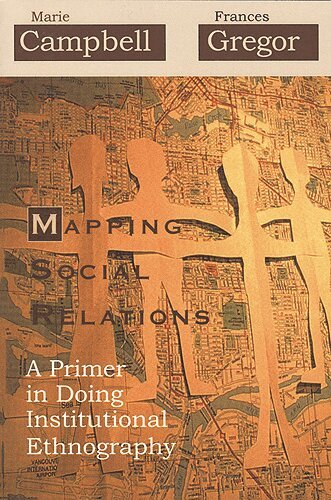
    Mapping Social Relations

    A Primer in Doing Institutional Ethnography

    AvMarie Campbell,Frances Gregor

    Häftad, Engelska, 2002

    240 kr

    Beställningsvara. Skickas inom 5-8 vardagar. Fri frakt över 249 kr.

    Fler format och utgåvor

    E-bok

    316 kr

    Beskrivning

    This is a book about a distinctive methodological approach inspired by one of Canada's most respected scholars, Dorothy Smith. Institutional ethnography aims to answer questions about how everyday life is organized. What is conventionally understood as "the relationship of micro to macro processes" is, in institutional ethnography, conceptualized and explored in terms of ruling relations. The authors suggest that institutional ethnographers must adopt a particular research stance, one that recognizes that people's own knolwedge and ways of knowing are crucial elements of social action and thus of social analysis. Specific attention to text analysis is integral to the approach.Institutional ethnography is remarkably well-suited to the human service curriculum and the training of professionals and activists. Its strategy for learning how to understand problems existing in everyday life appeals to many researchers who are looking for guidance on how to take practical action. At the same time, the highly elaborated theoretical foundation of institutional ethnography is difficult to deal with in the brief time most students are in the classroom. The authors successfully tackle the issue of teaching and applying institutional ethnography. Campbell and Gregor have been testing out instructional methods and materials for many years. Mapping Social Relations is the product of that effort.

    Produktinformation

    • Utgivningsdatum:2002-05-01
    • Mått:147 x 229 x 10 mm
    • Vikt:200 g
    • Format:Häftad
    • Språk:Engelska
    • Antal sidor:160
    • Förlag:University of Toronto Press
    • ISBN:9781442601192

    Utforska kategorier

    • Antropologi inom Samhälle och politik

    Mer om författaren

    Marie Campbell is a professor in the faculty of Human and Social Development at the University of Victoria in British Columbia. Frances Gregor is an associate professor in the School of Nursing at Dalhousie University in Halifax, Nova Scotia.

    Innehållsförteckning

    • Introduction Why Another "Methods" Text? About the AuthorsPositioning the Text in Relation to its Users and UsesHow the Book is OrganizedAcknowledgements Chapter One: Finding a Place to Begin  Practices of Knowing, Forms of Literacy The Located Knower: A Feminist Discovery Challenging Authoritative Ways of Knowing Learning to See "Social Organization" in a Health Care Setting Embodied Knowing in a Text-mediated World Chapter Two: Theory "in" Everyday Life Social Organization and Social Relations Texts and the Relations of Ruling Activating Texts as Ruling Relations Objectified Knowledge and Ruling Experience, Discourse, and Social Relations Chapter Three: Beginning an Institutional Ethnography Identifying the Problematic of the Research The Conceptual Frame for a Research Project Writing an Account of the Methodology Chapter Four: Collecting Data for an Institutional Ethnography Explicating Ruling Relations Positioning Oneself as a Researcher: Research Relations More about Data Collection and Interpersonal Relations with Informants Data Collection: How to "Look" and "Listen" Field Methods in Institutional Ethnography About Observations About Interviews About Texts as Data Chapter Five: Analyzing Data in Institutional Ethnography Moving from Data to Data Analysis: What Path to Follow? Different Ethnographies, Different Analytic Strategies Making Sense of Discursively-Organized Settings Writing Analysis in Institutional Ethnography Interpretation and Analysis Chapter Six: Putting Institutional Ethnography into Practice Studies by Institutional Ethnographers with Research Preparation in Master's Programs Practising a Sociology for People Subverting Institutionalization ReferencesNotesIndex