• Fri frakt över 249 kr
  • •
  • Snabba leveranser
  • •
  • Billiga böcker
Kundservice

Du är på sajten för privatpersoner.

Företag, bibliotek eller offentlig verksamhet?

Du handlar på classic.bokus.com, där alla dina funktioner finns intakta.
Till classic.bokus.com
Bokus logotyp. Gå till startsidan.
  • Erbjudanden
  • Nyheter
  • Student
  • Topplistor
  • Barn & ungdom
  • Bokus Play
  • E-böcker
  • Pocketböcker
  • Spel & pussel

10% rabatt på allt med kod: NYSTART10 →

Sidfot

Mina sidor

    Hjälp

    • Kundservice
    • Vanliga frågor och svar
    • Frakt och leverans
    • Retur vid ångerrätt
    • Reklamera vara
    • Betalning
    • Köpvillkor
    • Allmänna villkor
    • Information om webbplatsens tillgänglighet

    Om Bokus

    • Om oss
    • Pressrum
    • För studenter
    • För företag
    • För bibliotek och offentlig verksamhet
    • För leverantörer
    • Hållbarhet

    Populärt

    • Aktuella erbjudanden
    • Presentkort
    • Studentlitteratur
    • Nya böcker
    • Topplistor
    • Signerade böcker
    • Engelska böcker

    Inspiration

    • Boktips
    • BookTok
    • Populära bokserier
    • Barnbokskaraktärer
    • Populära författare
    Logotyp för Bokus
    Följ oss på Facebook (extern länk)Följ oss på Instagram (extern länk)Följ oss på YouTube (extern länk)Följ oss på TikTok (extern länk)
    bokus @ CookiesAnpassa cookiesIntegritetspolicyKöpvillkor
    Till Citymail hemsida (extern länk)Till Budbee hemsida (extern länk)Till Postnord hemsida (extern länk)Till Schenker hemsida (extern länk)Till Early Bird hemsida (extern länk)Till Walleys hemsida (extern länk)
    1. Filosofi och religion
    2. Filosofi
    3. Filosofiska discipliner

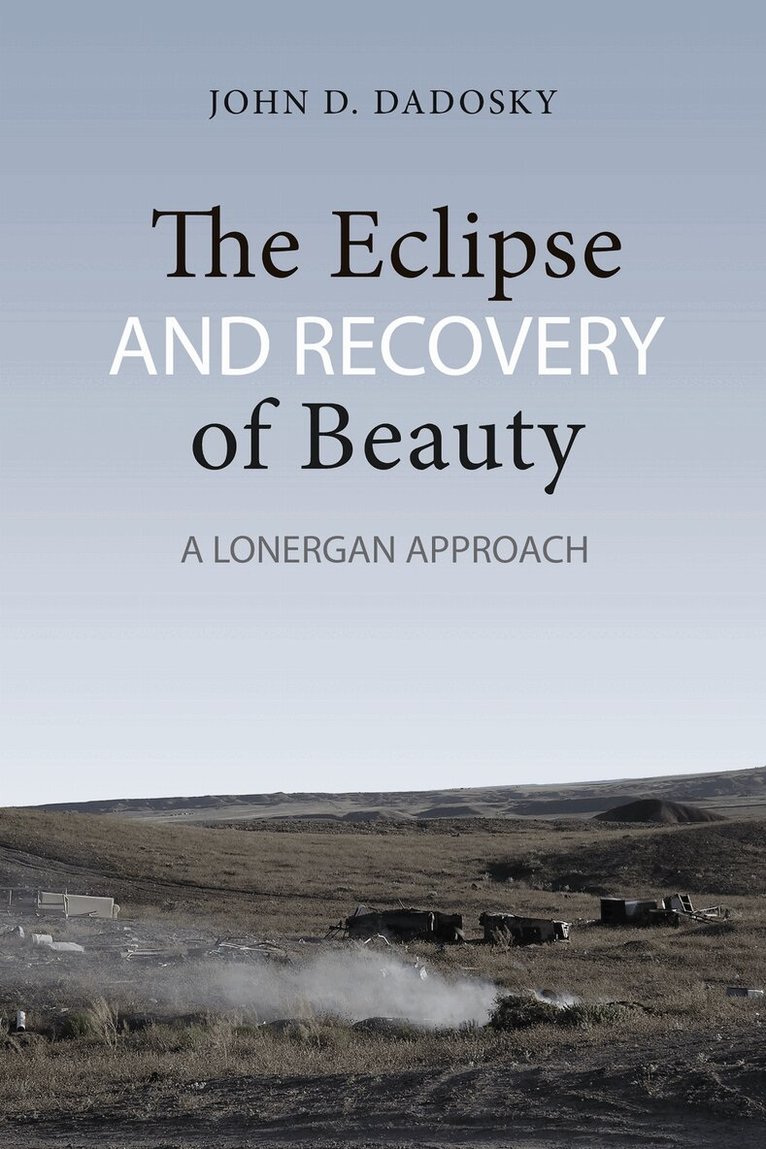
    Eclipse and Recovery of Beauty

    A Lonergan Approach

    AvJohn Dadosky

    E-bok
    Engelska, 2014

    Del i serien Lonergan Studies

    489 kr

    Läs direkt i Bokus Reader – eller ladda ned till din enhet

    Fler format och utgåvor

    Inbunden

    705 kr

    E-bok

    489 kr

    Häftad

    404 kr

    Beskrivning

    According to the Swiss theologian Hans Urs von Balthasar, a world that has lost sight of beauty is a world riddled with skepticism, moral and aesthetic relativism, conflicting religious worldviews, and escalating ecological crises. In The Eclipse and Recovery of Beauty, John D. Dadosky uses Kierkegaard and Nietzsche’s negative aesthetics to outline the context of that loss, and presents an argument for reclaiming beauty as a metaphysical property of being.Inspired by Bernard Lonergan’s philosophy of consciousness, Dadosky presents a philosophy of beauty that is grounded in contemporary Thomistic thought. Responding to Balthasar, he argues for a concept of beauty that can be experienced, understood, judged, created, contemplated, and even loved.Deeply engaged with the work of Aquinas, Kierkegaard, Nietzsche, and Kant, among others, The Eclipse and Recovery of Beauty will be essential reading for those interested in contemporary philosophy and theology.

    Produktinformation

    • Utgivningsdatum:2014-02-24
    • Språk:Engelska
    • Antal sidor:256
    • Filformat:EPUB
    • Kopieringsskydd:LCP
    • ISBN:9781442667327
    • Förlag:University of Toronto Press
    • Serie:Lonergan Studies
    • Vikt:1 g

    Utforska kategorier

    • Filosofiska discipliner inom Filosofi och religion

    Mer om författaren

    John D. Dadosky is a professor of philosophy and theology at the University of Toronto.

    Recensioner i media

    "…Dadosky’s effort to work out a philosophy of beauty on the basis of Lonergan’s thought, to enter into dialogue with significant figures, and to re-establish the transcendental status of beauty in a contemporary context amounts to an original and momentous achievement."- Paul St. Amour (American Catholic Philosophical Quarterly) "Within the boundaries of the wider Lonergan project, Dadosky’s argument is nuanced, differentiated, and, so far as I can discern, beyond reproach…students of theological aesthetics in particular will profit from the expositions and arguments he offers therein. The Eclipse and Recovery of Beauty is harmonious, well-integrated, and very clear. That is, in the specific terms Dadosky designates, it is a beautiful piece of work."- Reid B. Locklin (Toronto Journal of Theology) "John Dadosky has written a very good book on an overlooked, but important, topic… Using the tools of Lonergan’s generalized empirical method, Dadosky has made the case for the objectivity of aesthetic judgments and by extension for the recovery of beauty as a transcendental… The result is a beautifully written book that’s hints at much more to come from this author."- Michael Shute (Studies in Religion)

    Innehållsförteckning

    • PrefaceIntroduction1 The Eclipse of Beauty and Its Recovery 1.1 Introduction1.2 The Achievement of Thomistic Metaphysics and its Demise 1.2.1 A Post-Kantian Transposition of Thomistic Metaphysics1.3 Considerations for a Contemporary Philosophy of Beauty1.4 Lonergan’s Philosophy and Hermeneutics: A Brief Overview1.5 Conclusion2 Every Being is Beautiful 2.1 Beauty as a Transcendental Property of Being 2.1.1 The Development of Transcendental Beauty2.1.2 Aquinas and Transcendental Beauty?2.1.3 The Fourth Period2.2 Beauty: A Thomistic Interpretation 2.2.1 The Conditions of Beauty2.2.2 Further Questions2.2.3 Perception of Beauty2.2.4 Beauty and Art2.3. Beauty: A Lonergan Approach?3 Violence and the Loss of Beauty 3.1 Displacement and Distortion of Beauty3.2 Nietzsche’s Aesthetics3.3 Girard’s critique of Nietzsche 3.3.1 Dionysus and the Crucified3.3.2 Culpability in the Collective Murder3.3.3 Dionysus as a Mimicked Distortion of Christ3.4 A Re-orientation of Nietzchean Aesthetics?3.5 Conclusion4 Recovering Beauty in the Subject 4.1 Introduction4.2 Kierkegaard’s Spheres of Existence4.3 Balthasar’s Critique: A Closer Examination4.4 The Existential Spheres and Intentional Consciousness4.5 Conclusion5 The End of Aesthetic Experience? 5.1 Introduction5.2 The Loss of Aesthetic Experience 5.2.1 Major Post-Kantian Approaches to Aesthetic Experience5.2.2 Shusterman: "The End of Aesthetic Experience"5.3 Lonergan and Aesthetic Experience 5.3.1 The Unrestricted Desire for Beauty5.3.2 Freedom from Instrumentality5.3.3 Elemental Meaning5.3.4 Ulterior Significance and ‘Surplus of Meaning’5.3.5 Transformative and Distortive aspects of Aesthetic Experience5.3.6 Lonergan and Shusterman5.4 The Sensible and Intellectual Perception and Apprehension of Beauty5.5 Aesthetic Experience and the Sublime 5.1 Brief History of the Sublime5.2 The Sublime as Experienced5.6 Conclusion6 The Intelligibility of Beauty 6.1 Introduction6.2 Beauty and Architecture: The example of Christopher Alexander6.2.1Alexander’s 15 principles6.2.2 Alexander’s principles and Aquinas6.3 The Intelligibility of Beauty in Lonergan’s Theory of Consciousness6.4 Conclusion7 Judgments of Beauty 7.1 Introduction7.2 Aesthetic Judgments in Kant 7.2.1 Four Moments of Aesthetic Judgments7.3 Lonergan and Judgment 7.3.1 ‘Value’ in Method in Theology 7.4 Judging Beauty for Lonergan 7.4.1 A Lonergan Appropriation of Kant’s Four Moments7.4.2 Beauty and the Preferential Scales of Values7.4.3 Three Moments of Beauty7.4.4 Is Beauty distinct from Goodness?7.5 Concluding Comments8 Creating, Contemplating and Loving Beauty 8.1 Introduction8.2 The Aesthetic/Dramatic Operator8.3 Philosophy of Art 8.3.1Aesthetic and Artistic patterns of experience8.3.2 Art as Meaning8.3.3Developing Lonergan on Art8.3.4 Summing up: Lonergan on Art8.4 Life and Beauty 8.4.1Ethical living8.5 Contemplating Beauty8.6 Loving Beauty8.7 Beauty and God 7.1 From Aesthetic Experience to the Beauty of God8.8 Conclusion9 Philosophy for a Theology of Beauty 9.1 Introduction9.2 A Summary and Overview9.3 Towards a Theology of Beauty9.4 Conclusion