• Fri frakt över 249 kr
  • •
  • Snabba leveranser
  • •
  • Billiga böcker
Kundservice

Du är på sajten för privatpersoner.

Företag, bibliotek eller offentlig verksamhet?

Du handlar på classic.bokus.com, där alla dina funktioner finns intakta.
Till classic.bokus.com
Bokus logotyp. Gå till startsidan.
  • Erbjudanden
  • Nyheter
  • Student
  • Topplistor
  • Barn & ungdom
  • Bokus Play
  • E-böcker
  • Pocketböcker
  • Spel & pussel

10% studentrabatt med kod TERM26

Sidfot

Mina sidor

    Hjälp

    • Kundservice
    • Vanliga frågor och svar
    • Frakt och leverans
    • Retur vid ångerrätt
    • Reklamera vara
    • Betalning
    • Köpvillkor
    • Allmänna villkor
    • Information om webbplatsens tillgänglighet

    Om Bokus

    • Om oss
    • Pressrum
    • För studenter
    • För företag
    • För bibliotek och offentlig verksamhet
    • För leverantörer
    • Hållbarhet

    Populärt

    • Aktuella erbjudanden
    • Presentkort
    • Studentlitteratur
    • Nya böcker
    • Topplistor
    • Signerade böcker
    • Engelska böcker

    Inspiration

    • Boktips
    • BookTok
    • Populära bokserier
    • Barnbokskaraktärer
    • Populära författare
    Logotyp för Bokus
    Följ oss på Facebook (extern länk)Följ oss på Instagram (extern länk)Följ oss på YouTube (extern länk)Följ oss på TikTok (extern länk)
    bokus @ CookiesAnpassa cookiesIntegritetspolicyKöpvillkor
    Till Citymail hemsida (extern länk)Till Budbee hemsida (extern länk)Till Postnord hemsida (extern länk)Till Schenker hemsida (extern länk)Till Early Bird hemsida (extern länk)Till Walleys hemsida (extern länk)
    1. Kultur
    2. Arkitektur

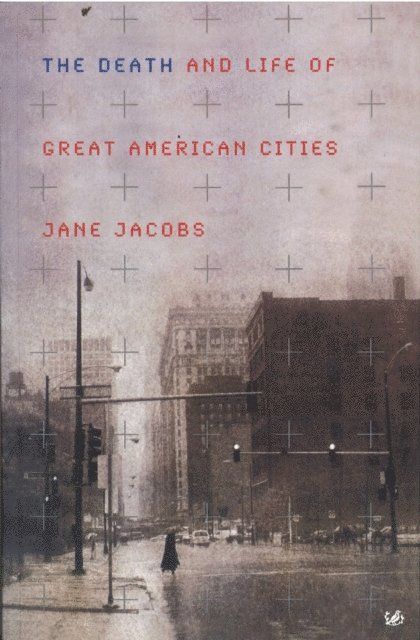
    Death and Life of Great American Cities

    AvJane Jacobs

    E-bok
    Engelska, 2016

    165 kr

    Läs direkt i Bokus Reader – eller ladda ned till din enhet

    Fler format och utgåvor

    Inbunden

    315 kr

    Häftad

    218 kr

    Beskrivning

    In this classic text, Jane Jacobs set out to produce an attack on current city planning and rebuilding and to introduce new principles by which these should be governed. The result is one of the most stimulating books on cities ever written. Throughout the post-war period, planners temperamentally unsympathetic to cities have been let loose on our urban environment. Inspired by the ideals of the Garden City or Le Corbusier's Radiant City, they have dreamt up ambitious projects based on self-contained neighbourhoods, super-blocks, rigid 'scientific' plans and endless acres of grass. Yet they seldom stop to look at what actually works on the ground. The real vitality of cities, argues Jacobs, lies in their diversity, architectural variety, teeming street life and human scale. It is only when we appreciate such fundamental realities that we can hope to create cities that are safe, interesting and economically viable, as well as places that people want to live in.'Perhaps the most influential single work in the history of town planning... Jacobs has a powerful sense of narrative, a lively wit, a talent for surprise and the ability to touch the emotions as well as the mind' New York Times Book Review

    Produktinformation

    • Utgivningsdatum:2016-11-17
    • Språk:Engelska
    • Filformat:EPUB
    • Kopieringsskydd:LCP
    • ISBN:9781448180288
    • Förlag:Vintage Publishing

    Utforska kategorier

    • Arkitektur inom Kultur
    • Arkitekturhistoria inom Kultur
    • Amerikas historia inom Historia och arkeologi

    Mer om författaren

    Jane Jacobs was born in Scranton, Pennsylvania, in 1916, but lived much of her life in Toronto, Canada. She was the author of The Economy of Cities, The Question of Separatism: Quebec and the Struggle over Sovereignty, Cities and the Wealth of Nations, and Systems of Survival. She died in 2006.

    Innehållsförteckning

    • 1: Introduction Part One: The Peculiar Nature of Cities 2: The uses of sidewalks: safety 3: The uses of sidewalks: contact 4: The uses of sidewalks: assimilating children 5: The uses of neighbourhood parks 6: The uses of city neighbourhoods Part Two: The Conditions for City Diversity 7: The generators of diversity 8: The need for mixed primary uses 9: The need for small blocks 10: The need for aged buildings 11: The need for concentration 12: Some myths about diversity Part Three: Forces of Decline and Regeneration 13: The self-destruction of diversity 14: The curse of border vacuums 15: Unslumming and slumming 16: Gradual money and cataclysmic money Part Four: Different Tactics 17: Subsidizing dwellings 18: Erosion of cities or attrition of automobiles 19: Visual order: its limitations and possibilities 20: Salvaging projects 21: Governing and planning districts 22: The kind of problem a city is