• Fri frakt över 249 kr
  • •
  • Snabba leveranser
  • •
  • Billiga böcker
Kundservice

Du är på sajten för privatpersoner.

Företag, bibliotek eller offentlig verksamhet?

Du handlar på classic.bokus.com, där alla dina funktioner finns intakta.
Till classic.bokus.com
Bokus logotyp. Gå till startsidan.
  • Erbjudanden
  • Nyheter
  • Student
  • Topplistor
  • Barn & ungdom
  • Bokus Play
  • E-böcker
  • Pocketböcker
  • Spel & pussel

10% rabatt på allt med kod: NYSTART10 →

Sidfot

Mina sidor

    Hjälp

    • Kundservice
    • Vanliga frågor och svar
    • Frakt och leverans
    • Retur vid ångerrätt
    • Reklamera vara
    • Betalning
    • Köpvillkor
    • Allmänna villkor
    • Information om webbplatsens tillgänglighet

    Om Bokus

    • Om oss
    • Pressrum
    • För studenter
    • För företag
    • För bibliotek och offentlig verksamhet
    • För leverantörer
    • Hållbarhet

    Populärt

    • Aktuella erbjudanden
    • Presentkort
    • Studentlitteratur
    • Nya böcker
    • Topplistor
    • Signerade böcker
    • Engelska böcker

    Inspiration

    • Boktips
    • BookTok
    • Populära bokserier
    • Barnbokskaraktärer
    • Populära författare
    Logotyp för Bokus
    Följ oss på Facebook (extern länk)Följ oss på Instagram (extern länk)Följ oss på YouTube (extern länk)Följ oss på TikTok (extern länk)
    bokus @ CookiesAnpassa cookiesIntegritetspolicyKöpvillkor
    Till Citymail hemsida (extern länk)Till Budbee hemsida (extern länk)Till Postnord hemsida (extern länk)Till Schenker hemsida (extern länk)Till Early Bird hemsida (extern länk)Till Walleys hemsida (extern länk)
    1. Naturvetenskap och teknik
    2. Matematik och naturvetenskap
    3. Kemi
    4. Analytisk kemi

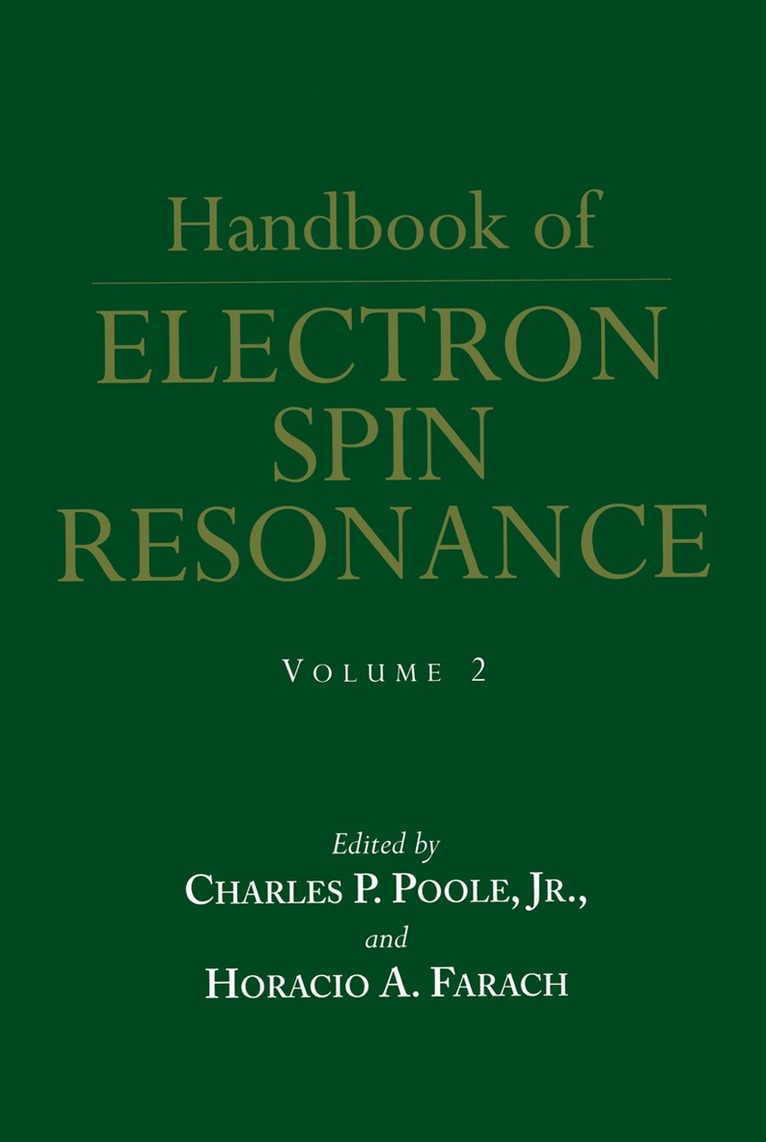
    Handbook of Electron Spin Resonance

    Volume 2

    AvCharles P. Jr. Poole,Horacio A. Farach

    Häftad, Engelska, 2012

    2 165 kr

    Beställningsvara. Skickas inom 10-15 vardagar. Fri frakt över 249 kr.

    Beskrivning

    The continuously expanding field of electron spin resonance (ESR) has broadened our understanding of physics, chemistry, biology, medicine and related sciences over the last fifty years. In the first volume Professors Poole and Farach provided one of the first definitive reference tools for this field. These handbooks bring together wide- ranging data from diverse disciplines within ESR and integrate the data into a comprehesive and definitive resource. In this second volume of the Handbook of Electron Spin Resonance, the authors present a comprehensive source subfields of ESR not covered in the first volume. Topics covered in this volume include: * Sensitivity * Field Swept versus Frequency Swept Spectra * Resonators * Line Shapes * Electron Spin Echo Envelope Modulation * Hamiltonian types and symmetries, including a comprehensive tabulation of transition ion data * ESR Imaging * High Magnetic Fields and High Frequencies Written by recognized experts in the field, and intended for students and researchers, the Handbook of Electron Spin Resonance will prove to be an invaluable reference for all those involved in ESR research.

    Produktinformation

    • Utgivningsdatum:2012-10-17
    • Mått:155 x 235 x 22 mm
    • Vikt:593 g
    • Format:Häftad
    • Språk:Engelska
    • Antal sidor:375
    • Förlag:Springer-Verlag New York Inc.
    • ISBN:9781461271628

    Utforska kategorier

    • Analytisk kemi inom Naturvetenskap och teknik
    • Materietillstånd inom Naturvetenskap och teknik

    Innehållsförteckning

    • I. Sensitivity.- A. Introduction.- B. Minimum Number of Detectable Spins.- C. Predicted Frequency Dependence of ESR Signal, Noise, and Signal-to-Noise Ratio.- D. Performance of Real Systems.- E. Definitions and Derivations.- Acknowledgments.- References.- II. Field-Swept Versus Frequency-Swept Spectra.- A. Introduction.- B. Lineshapes.- C. Applications.- D. Concluding Remarks.- References.- III. Resonators.- A. Introduction.- B. Waveguides and Cavities.- C. Coupling Structures.- D. Velocity and Impedance.- E. Rectangular Resonant Cavity.- F. Cylindrical Resonant Cavity.- G. Special Purpose Cavities.- H. Quality and Filling Factors.- References.- IV. Lineshapes.- A. Introduction.- B. Lorentzian and Gaussian Shapes.- C. Moments and Widths of Resonant Lines.- D. Overlapping Resonances.- E. Convolution Shape.- F. Anisotropicg-Factors.- G. Hyperfine Powder Patterns.- H. Small Spin Clusters.- I. Amorphous and Semirandom Distributions.- J. Conduction Electrons.- K. Exchange.- L. Saturation.- References.- V. Electron Spin Echo Envelope Modulation.- A. Introduction.- B. Qualitative Description of the ESEEM Experiment.- C. Comparison of ESEEM and ENDOR.- D. HYSCORE.- E. Outlook.- References.- VI. Transition Series Ions.- A. Introduction.- B. First-Transition Series (3dnIron Group) Ions.- C. Second-and Third-Transition Series (4dnPalladium and5dnPlatinum Group) Ions.- D. Rare-Earth (4f “) Ions.- E. Actinide(5fn)Ions.- F. S-State (3d54d55d54f7) Ions.- References.- VII. Transition Ion HamiltonianS.- A. Introduction.- B. Site Symmetries.- C. Spin Hamiltonians.- References.- Appendix I. Spin Operators and Their Matrix Elements.- Appendix II. Descent of Symmetry.- Appendix III. Site Symmetries of Host Crystals.- VIII. Transition Ion Data Tabulation.- Tabulations.- References.- IX.Evaluation of Spin-Hamiltonian Parameters from Epr Data of Single Crystals.- A. Introduction.- B. Perturbation Approach.- C. Brute-Force Methods.- D. Least-Squares Fitting (LSF) Method.- E. Other Applications of the LSF Method.- a. Spin Hamiltonian.- b. Eigenvalues.- c. Evaluation of SHP by the LSF Technique.- d. Numerical Evaluation of the Derivatives Required in the LSF Procedure.- e. General Remarks.- F. Discussion.- References.- X. Esr Imaging.- Tabulations.- Acknowledgments.- References.- XI. High Magnetic Fields and High Frequencies.- Tabulations.- Acknowledgments.- References.