• Fri frakt över 249 kr
  • •
  • Snabba leveranser
  • •
  • Billiga böcker
Kundservice

Du är på sajten för privatpersoner.

Företag, bibliotek eller offentlig verksamhet?

Du handlar på classic.bokus.com, där alla dina funktioner finns intakta.
Till classic.bokus.com
Bokus logotyp. Gå till startsidan.
  • Erbjudanden
  • Nyheter
  • Student
  • Topplistor
  • Barn & ungdom
  • Bokus Play
  • E-böcker
  • Pocketböcker
  • Spel & pussel

10% rabatt på allt med kod: NYSTART10 →

Sidfot

Mina sidor

    Hjälp

    • Kundservice
    • Vanliga frågor och svar
    • Frakt och leverans
    • Retur vid ångerrätt
    • Reklamera vara
    • Betalning
    • Köpvillkor
    • Allmänna villkor
    • Information om webbplatsens tillgänglighet

    Om Bokus

    • Om oss
    • Pressrum
    • För studenter
    • För företag
    • För bibliotek och offentlig verksamhet
    • För leverantörer
    • Hållbarhet

    Populärt

    • Aktuella erbjudanden
    • Presentkort
    • Studentlitteratur
    • Nya böcker
    • Topplistor
    • Signerade böcker
    • Engelska böcker

    Inspiration

    • Boktips
    • BookTok
    • Populära bokserier
    • Barnbokskaraktärer
    • Populära författare
    Logotyp för Bokus
    Följ oss på Facebook (extern länk)Följ oss på Instagram (extern länk)Följ oss på YouTube (extern länk)Följ oss på TikTok (extern länk)
    bokus @ CookiesAnpassa cookiesIntegritetspolicyKöpvillkor
    Till Citymail hemsida (extern länk)Till Budbee hemsida (extern länk)Till Postnord hemsida (extern länk)Till Schenker hemsida (extern länk)Till Early Bird hemsida (extern länk)Till Walleys hemsida (extern länk)
    1. Psykologi och pedagogik
    2. Pedagogik
    3. Pedagogisk metodik

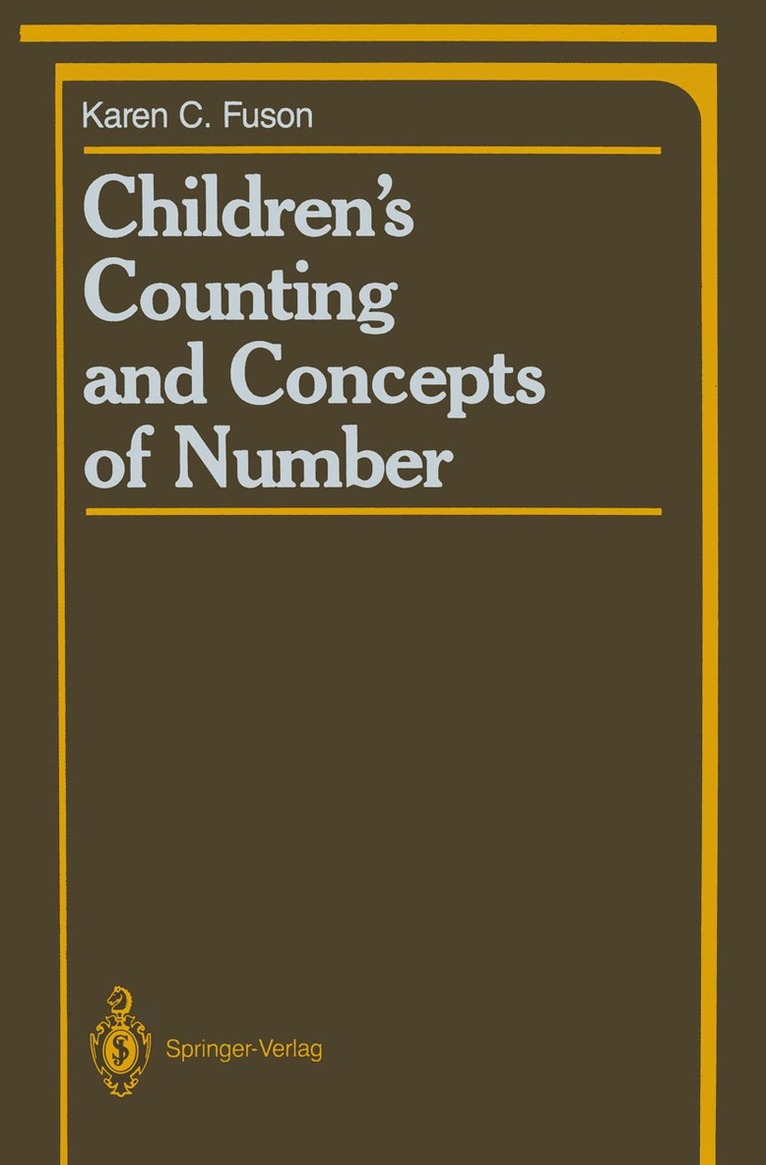
    Children’s Counting and Concepts of Number

    AvKaren C. Fuson

    Häftad, Engelska, 2013

    Del i serien Springer Series in Cognitive Development

    898 kr

    Beställningsvara. Skickas inom 10-15 vardagar. Fri frakt över 249 kr.

    Fler format och utgåvor

    E-bok

    1 143 kr

    Beskrivning

    For some time now, the study of cognitive development has been far and away the most active discipline within developmental psychology. Although there would be much disagreement as to the exact proportion of papers published in developmental journals that could be considered cognitive, 50% seems like a conservative estimate. Hence, a series of scholary books to be devoted to work in cognitive development is especially appropriate at this time. The Springer Series in Cognitive Development contains two basic types of books, namely, edited collections of original chapters by several authors, and original volumes written by one author or a small group of authors. The flagship for the Springer Series is a serial publication of the "advances" type, carrying the subtitle Progress in Cognitive Development Research. Volumes in the Progress sequence are strongly thematic, in that each is limited to some well-defined domain of cognitive­ developmental research (e. g. , logical and mathematical development, semantic development). All Progress volumes are edited collections. Editors of such books, upon consultation with the Series Editor, may elect to have their works published either as contributions to the Progress sequence or as separate volumes. All books written by one author or a small group of authors will be published as separate volumes within the series. is being used in the selec­ A fairly broad definition of cognitive development tion of books for this series.

    Produktinformation

    • Utgivningsdatum:2013-04-12
    • Mått:155 x 235 x 25 mm
    • Vikt:698 g
    • Format:Häftad
    • Språk:Engelska
    • Serie:Springer Series in Cognitive Development
    • Antal sidor:446
    • Förlag:Springer-Verlag New York Inc.
    • ISBN:9781461283355

    Utforska kategorier

    • Pedagogisk metodik inom Psykologi och pedagogik
    • Kognitiv psykologi inom Psykologi och pedagogik

    Innehållsförteckning

    • I Number Words.- 1 Introduction and Overview of Different Uses of Number Words.- 2 The Number-Word Sequence: An Overview of Its Acquisition and Elaboration.- II Correspondence Errors in Counting Objects.- 3 Correspondence Errors in Children’s Counting.- 4 Effects of Object Arrangement on Counting Correspondence Errors and on the Indicating Act.- 5 Effects of Object Variables and Age of Counter on Correspondence Errors Made When Counting Objects in Rows.- 6 Correspondence Errors in Children’s Counting: A Summary.- III Concepts of Cardinality.- 7 Children’s Early Knowledge About Relationships Between Counting and Cardinality.- 8 Later Conceptual Relationships Between Counting and Cardinality: Addition and Subtraction of Cardinal Numbers.- 9 Uses of Counting and Matching in Cardinal Equivalence Situations: Equivalence and Order Relations on Cardinal Numbers.- IV Number Words, Counting, and Cardinality: The Increasing Integration of Sequence, Count, and Cardinal Meanings.- 10 Early Relationships Among Sequence Number Words, Counting Correspondence, and Cardinality.- 11 An Overview of Changes in Children’s Number Word Concepts from Age 2 Through 8.- References.- Author Index.