• Fri frakt över 249 kr
  • •
  • Snabba leveranser
  • •
  • Billiga böcker
Kundservice

Du är på sajten för privatpersoner.

Företag, bibliotek eller offentlig verksamhet?

Du handlar på classic.bokus.com, där alla dina funktioner finns intakta.
Till classic.bokus.com
Bokus logotyp. Gå till startsidan.
  • Erbjudanden
  • Nyheter
  • Student
  • Topplistor
  • Barn & ungdom
  • Bokus Play
  • E-böcker
  • Pocketböcker
  • Spel & pussel

10% rabatt på allt med kod NYSTART10 →

Sidfot

Mina sidor

    Hjälp

    • Kundservice
    • Vanliga frågor och svar
    • Frakt och leverans
    • Retur vid ångerrätt
    • Reklamera vara
    • Betalning
    • Köpvillkor
    • Allmänna villkor
    • Information om webbplatsens tillgänglighet

    Om Bokus

    • Om oss
    • Pressrum
    • För studenter
    • För företag
    • För bibliotek och offentlig verksamhet
    • För leverantörer
    • Hållbarhet

    Populärt

    • Aktuella erbjudanden
    • Presentkort
    • Studentlitteratur
    • Nya böcker
    • Topplistor
    • Signerade böcker
    • Engelska böcker

    Inspiration

    • Boktips
    • BookTok
    • Populära bokserier
    • Barnbokskaraktärer
    • Populära författare
    Logotyp för Bokus
    Följ oss på Facebook (extern länk)Följ oss på Instagram (extern länk)Följ oss på YouTube (extern länk)Följ oss på TikTok (extern länk)
    bokus @ CookiesAnpassa cookiesIntegritetspolicyKöpvillkor
    Till Citymail hemsida (extern länk)Till Budbee hemsida (extern länk)Till Postnord hemsida (extern länk)Till Schenker hemsida (extern länk)Till Early Bird hemsida (extern länk)Till Walleys hemsida (extern länk)
    1. Samhälle och politik
    2. Sociologi och antropologi
    3. Sociologi

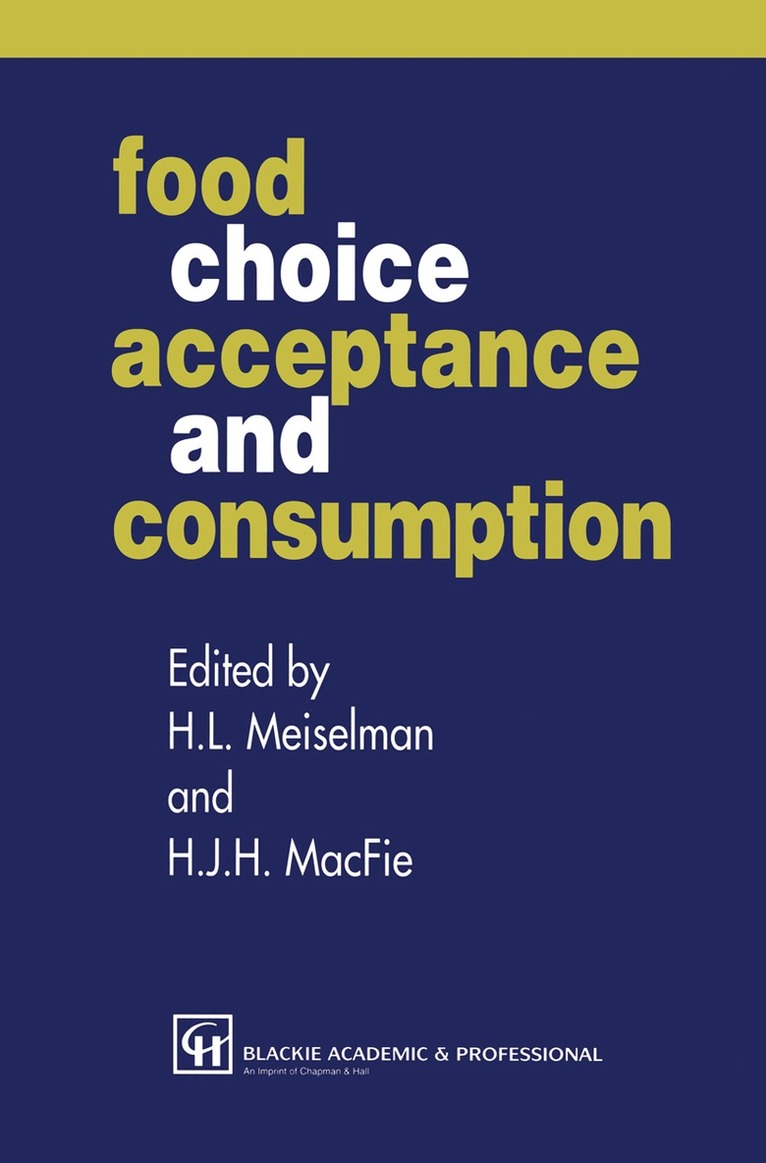
    Food Choice, Acceptance and Consumption

    AvH.J.H. MacFie,Herbert L. Meiselman

    Häftad, Engelska, 2012

    1 625 kr

    Beställningsvara. Skickas inom 10-15 vardagar. Fri frakt över 249 kr.

    Fler format och utgåvor

    Inbunden

    1 625 kr

    Beskrivning

    It is critical for the food industry to maintain a current understanding of the factors affecting food choice, acceptance and consumption since these influence all aspects of its activities. This subject has matured in recent years and, for the first time, this book brings together a coherent body of knowledge which draws on the experiences in industrial and academic settings of an international team of authors. Written for food technologists and marketeers, the book is also an essential reference for all those concerned with the economic, social, and psychological aspects of the subject.

    Produktinformation

    • Utgivningsdatum:2012-02-09
    • Mått:155 x 235 x 23 mm
    • Vikt:622 g
    • Format:Häftad
    • Språk:Engelska
    • Antal sidor:397
    • Förlag:Springer-Verlag New York Inc.
    • ISBN:9781461285182

    Utforska kategorier

    • Sociologi inom Samhälle och politik
    • Företagsekonomi inom Ekonomi och Ledarskap
    • Tillverkningsteknik inom Naturvetenskap och teknik

    Innehållsförteckning

    • 1 The role of the human senses in food acceptance.- 1.1 Introduction.- 1.2 The role of vision in food acceptance.- 1.3 The role of somesthesis and kinesthesis in food acceptance.- 1.4 The role of audition in food acceptance.- 1.5 The role of gustation in food acceptance.- 1.6 The role of olfaction in food acceptance.- 1.7 Food acceptance measurement: The relative importance of the senses.- 1.8 Future perspectives.- References.- 2 The socio-cultural context of eating and food choice.- 2.1 Indirect socio-cultural effects.- 2.2 Indirect personal effects.- 2.3 Direct on-line influences.- 2.4 Sociocultural aspects of the acquisition of norms, beliefs, knowledge and attitudes.- 2.5 Conclusion.- Acknowledgements.- References.- 3 What animal research tells us about human eating.- 3.1 Introduction.- 3.2 Methods for studying eating—both strategic and practical.- 3.3 Phenomena of eating in humans uncovered by studies in animals.- 3.4 Theoretical framework and experimental evidence.- 3.5 What animal research tells us about eating disorders in humans.- 3.6 Conclusions and limitations.- Acknowledgements.- References.- 4 The development of children’s eating habits.- 4.1 The frequency and timing of meals.- 4.2 Learning, experience and meal size.- 4.3 Children’s food preferences and food selection.- 4.4 Summary and implications for child feeding.- References.- 5 What does abnormal eating tell us about normal eating?.- 5.1 Introduction.- 5.2 Abnormal eating—quantity.- 5.3 Abnormal eating—speed.- 5.4 Abnormal eating—frequency.- 5.5 Type of food.- 5.6 Internal and extenal cues.- 5.7 Social influence.- 5.8 Precipitants.- 5.9 Conclusions.- References.- 6 The contextual basis for food acceptance, food choice and food intake: the food, the situation and the individual.- 6.1Introduction.- 6.2 The food.- 6.3 The eating situation.- 6.4 The individual.- 6.5 Summary.- References.- 7 Marketing and consumer behaviour with respect to foods.- 7.1 Introduction.- 7.2 Marketing.- 7.3 Marketing strategies at the product and brand level.- 7.4 Marketing tactics: organizing the marketing mix.- 7.5 Consumer orientation in marketing.- 7.6 Food choice behaviour in affluent societies.- 7.7 Implications for food marketing.- 7.8 Illustration: consumer oriented product development.- 7.9 Conclusions.- References.- 8 Economic influences on food choice—non-convenience versus convenience food consumption.- 8.1 Introduction.- 8.2 Time-saving and time-buying strategies.- 8.3 Methodology—data and variables.- 8.4 Food regimes.- 8.5 Statistical model.- 8.6 Estimation results.- 8.7 Conclusion.- Acknowledgement.- References.- 9 Food choice, mood and mental performance: some examples and some mechanisms.- 9.1 Introduction.- 9.2 Effects of foods and food constituents on mood and mental performance.- 9.3 Relationship between the mood and performance effects of foods and food choice.- 9.4 Conclusions.- Acknowledgement.- References.- 10 Attitudes and beliefs in food habits.- 10.1 Models of food choice.- 10.2 Theory of planned behaviour.- 10.3 Extensions of the theory of planned behaviour.- 10.4 Self-identity and organic food consumption.- 10.5 Moral obligation.- 10.6 Conclusions.- Acknowledgements.- References.- 11 Dietary change: changing patterns of eating.- 11.1 Introduction.- 11.2 Sources of evidence for dietary change.- 11.3 Dietary patterns.- 11.4 Factors involved in dietary change.- 11.5 Impact of recommendations on diet and health.- 11.6 Understanding dietary change: future directions.- References.