• Fri frakt över 249 kr
  • •
  • Snabba leveranser
  • •
  • Billiga böcker
Kundservice

Du är på sajten för privatpersoner.

Företag, bibliotek eller offentlig verksamhet?

Du handlar på classic.bokus.com, där alla dina funktioner finns intakta.
Till classic.bokus.com
Bokus logotyp. Gå till startsidan.
  • Erbjudanden
  • Nyheter
  • Student
  • Topplistor
  • Barn & ungdom
  • Bokus Play
  • E-böcker
  • Pocketböcker
  • Spel & pussel

10% rabatt på allt med kod: NYSTART10 →

Sidfot

Mina sidor

    Hjälp

    • Kundservice
    • Vanliga frågor och svar
    • Frakt och leverans
    • Retur vid ångerrätt
    • Reklamera vara
    • Betalning
    • Köpvillkor
    • Allmänna villkor
    • Information om webbplatsens tillgänglighet

    Om Bokus

    • Om oss
    • Pressrum
    • För studenter
    • För företag
    • För bibliotek och offentlig verksamhet
    • För leverantörer
    • Hållbarhet

    Populärt

    • Aktuella erbjudanden
    • Presentkort
    • Studentlitteratur
    • Nya böcker
    • Topplistor
    • Signerade böcker
    • Engelska böcker

    Inspiration

    • Boktips
    • BookTok
    • Populära bokserier
    • Barnbokskaraktärer
    • Populära författare
    Logotyp för Bokus
    Följ oss på Facebook (extern länk)Följ oss på Instagram (extern länk)Följ oss på YouTube (extern länk)Följ oss på TikTok (extern länk)
    bokus @ CookiesAnpassa cookiesIntegritetspolicyKöpvillkor
    Till Citymail hemsida (extern länk)Till Budbee hemsida (extern länk)Till Postnord hemsida (extern länk)Till Schenker hemsida (extern länk)Till Early Bird hemsida (extern länk)Till Walleys hemsida (extern länk)
    1. Naturvetenskap och teknik
    2. Matematik och naturvetenskap
    3. Biologi
    4. Biovetenskap

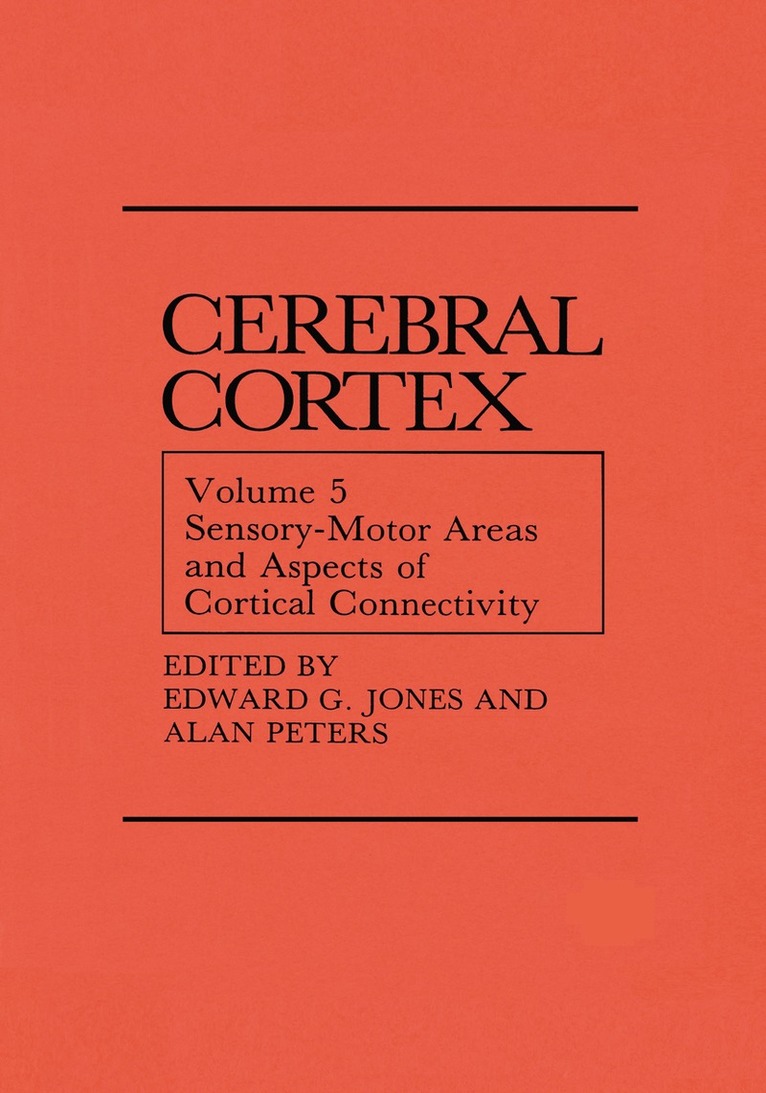
    Sensory-Motor Areas and Aspects of Cortical Connectivity

    Volume 5: Sensory-Motor Areas and Aspects of Cortical Connectivity

    AvEdward G. Jones,Alan Peters

    Häftad, Engelska, 2011

    Del i serien Cerebral Cortex

    1 626 kr

    Beställningsvara. Skickas inom 10-15 vardagar. Fri frakt över 249 kr.

    Beskrivning

    Volume 5 of Cerebral Cortex completes the sequence of three volumes on the individual functional areas of the cerebral cortex by covering the somatosensory and motor areas. However, the chapters on these areas lead naturally to a series of others on patterns of connectivity in the cortex, intracortical and subcortical, so that the volume as a whole achieves a much broader viewpoint. The individual chapters on the sensory-motor areas reflect the considerable diversity of interest within the field, for each of the authors has given his or her chapter a different emphasis, reflecting in part topical interest and in part the body of data resulting from work in a particular species. In considering the functional organization of the somatosensory cortex, Robert Dykes and Andre Ruest have chosen to concentrate on the nature of the mapping process and its significance. Harold Burton, in his chapter on the somatosensory fields buried in the sylvian fissure, shows how critical is an understanding of this mapping process in the functional subdivision of the cortex. A frequently overlooked subdivision of the cortex, the vestibular region, is given the emphasis it deserves in a chapter by John Fredrickson and Allan Rubin. The further functional subdivisions that occur within the first somatosensory area are given an anatom­ ical basis in the review by Edward Jones of connectivity in the primate sensory­ motor cortex.

    Produktinformation

    • Utgivningsdatum:2011-11-05
    • Mått:178 x 254 x 29 mm
    • Vikt:989 g
    • Format:Häftad
    • Språk:Engelska
    • Serie:Cerebral Cortex
    • Antal sidor:510
    • Upplaga:1986
    • Förlag:Springer-Verlag New York Inc.
    • ISBN:9781461292685

    Utforska kategorier

    • Biovetenskap inom Naturvetenskap och teknik

    Innehållsförteckning

    • 1 What Makes a Map in Somatosensory Cortex?.- 1. A Statement of the Problem.- 2. A History of Mapmaking in Somatosensory Cortex.- 3. Questions Currently of Interest.- 4. The Process of Mapping: Some Practical Considerations.- 5. Biological Mapping Functions.- 6. Reorganization following Deafferentation.- 7. Organization following Nerve Regeneration.- 8. Other Clues to the Nature of Biological Mapping Functions.- 9. Summary.- 10. References.- 2 Second Somatosensory Cortex and Related Areas.- 1. Introduction: A Problem of Definitions.- 2. Somatotopic Organization in SII.- 3. The Cytoarchitecture of SII.- 4. Thalamocortical Connections.- 5. Corticocortical Connections.- 6. Corticofugal Connections.- 7. Physiological Responses.- 8. Lesion—Behavioral Studies.- 9. Conclusions.- 10. References.- 3 Vestibular Corte.- 1. Introduction.- 2. Parietal Cortical Projections.- 3. SI Forelimb Field Projection.- 4. Convergence.- 5. The Ascending Pathway to the Cortex.- 6. Clinical Implications.- 7. References.- 4 Connectivity of the Primate Sensory-Motor Corte.- 1. Introduction.- 2. Thalamic Inputs.- 3. Thalamocortical Connectivity.- 4. Subcortical Connections.- 5. Corticocortical Connections.- 6. Conclusions.- 7. Abbreviations.- 8. References.- 5 Functions of Corticocortical Neurons of Somatosensory, Motor, and Parietal Cortex.- 1. Introduction.- 2. Properties of Corticocortical Neurons.- 3. Effects of Corticocortical Neurons.- 4. What Information Is Carried by Corticocortical Neurons?.- 5. Conclusions.- 6. References.- 6 Motor Cortex Output in Primates.- 1. Motor Cortex Neurons and ? Motoneurons.- 2. Movements of Hand and Jaw.- 3. Transcortical Reflexes.- 4. References.- 7 Motor Cortex of Rodents.- 1. Introduction.- 2. Cortical Field Definition in Rodent Motor Cortex.- 3.Input—Output Organization of Rat Motor Cortex.- 4. Functional Specializations of Rodent Motor Cortex.- 5. Conclusions.- 6. References.- 8 Termination of Thalamic Afferents in the Cerebral Cortex.- 1. Introduction.- 2. Thalamocortical Topography.- 3. Correlations of Cortical Physiology with Thalamocortical Projections.- 4. Neurons Postsynaptic to Thalamic Afferents.- 5. Quantitative Aspects of Thalmocortical Synaptic Relations.- 6. Synaptic Sequences Involving Neurons Postsynaptic to Thalamic Afferents.- 7. Conclusions.- 8. References.- 9 General Organization of Callosal Connections in the Cerebral Cortex.- 1. Introduction.- 2. The Callosal Neurons.- 3. The Callosal Tract.- 4. The Termination of Callosal Axons.- 5. Corticotopic Organization of Callosal Connections.- 6. Function of Callosal Connections.- 7. The Development of Callosal Connections.- 8. Conclusions.- 9. References.- 10 The Thalamic Intralaminar Nuclei and the Cerebral Cortex.- 1. Historical Introduction.- 2. Cytoarchitectonic Delimitation of the Intralaminar Nuclei, with Notes on Their Comparative Anatomy.- 3. The Intralaminar—Cortical Projections.- 4. The Subcortical Efferents of the Intralaminar Nuclei.- 5. The Subcortical Afferents to the Intralaminar Nuclei.- 6. The Cortico-Intralaminar Projections.- 7. Functional Role of the Intralaminar System.- 8. Conclusions.- 9. References.- 11 New Perspectives on the Organization and Evolution of Nonspecific Thalamocortical Projections.- 1. Historical Origins of the Term “Nonspecific Thalamus”.- 2. A Tripartite Division of Thalamus Based on Cortical Layers of Termination.- 3. Evidence for a Paralaminar Layer I-Projecting System Demonstrated by Retrograde Tracing.- 4. Comparative Aspects of the Nonspecific Thalamocortical System.- 5. Cellular Origins ofLayer I Projections.- 6. Speculation on the Phylogeny of the Nonspecific Thalamus.- 7. Functional Considerations.- 8. References.- 12 Topography of Corticostriatal Projections in Nonhuman Primates and Implications for Functional Parcellation of the Neostriatum.- 1. Introduction.- 2. Early Views of Corticostriatal Projections.- 3. New Topography of Corticostriatal Projections.- 4. Segregation of Cortical Terminal Fields in the Striatum: Double-Labeling Studies.- 5. Interdigitation of Cortical Terminal Fields in the Neostriatum.- 6. Neostriatal Compartments and Their Relationship to Corticostriatal Projections.- 7. Cortical Laminar Origin of the Striatal Projection.- 8. Implications for Neostriatal Function.- 9. Implications for Neurological Disease.- 10. References.- 13 The Claustrum and the Cerebral Cortex.- 1. Introduction.- 2. Location, Shape, and Cellular Composition of Claustrum.- 3. Development of Claustrum.- 4. Cortical Connections of Claustrum.- 5. Subcortical Connections of Claustrum.- 6. Physiological Properties of Claustral Neurons.- 7. Visual Field Map in Claustrum.- 8. Function of Claustrum.- 9. References.