• Fri frakt över 249 kr
  • •
  • Snabba leveranser
  • •
  • Billiga böcker
Kundservice

Du är på sajten för privatpersoner.

Företag, bibliotek eller offentlig verksamhet?

Du handlar på classic.bokus.com, där alla dina funktioner finns intakta.
Till classic.bokus.com
Bokus logotyp. Gå till startsidan.
  • Erbjudanden
  • Student
  • Topplistor
  • Barn & ungdom
  • Bokus Play
  • E-böcker
  • Ljudböcker
  • Pocketböcker
  • Spel och pussel

Pocketfynda! Hundratals böcker för 49 kr/st →

Sidfot

Mina sidor

    Hjälp

    • Kundservice
    • Vanliga frågor och svar
    • Frakt och leverans
    • Retur vid ångerrätt
    • Reklamera vara
    • Betalning
    • Köpvillkor
    • Allmänna villkor
    • Information om webbplatsens tillgänglighet

    Om Bokus

    • Om oss
    • Pressrum
    • För studenter
    • För företag
    • För bibliotek och offentlig verksamhet
    • För leverantörer
    • Hållbarhet

    Populärt

    • Aktuella erbjudanden
    • Presentkort
    • Studentlitteratur
    • Nya böcker
    • Topplistor
    • Signerade böcker
    • Engelska böcker

    Inspiration

    • Boktips
    • BookTok
    • Barnbokskaraktärer
    • Populära författare
    Logotyp för Bokus
    Följ oss på Facebook (extern länk)Följ oss på Instagram (extern länk)Följ oss på YouTube (extern länk)Följ oss på TikTok (extern länk)
    bokus @ CookiesAnpassa cookiesIntegritetspolicyKöpvillkor
    Till Citymail hemsida (extern länk)Till Budbee hemsida (extern länk)Till Postnord hemsida (extern länk)Till Schenker hemsida (extern länk)Till Early Bird hemsida (extern länk)Till Walleys hemsida (extern länk)
    1. Naturvetenskap och teknik
    2. Matematik och naturvetenskap
    3. Biologi
    4. Biokemi

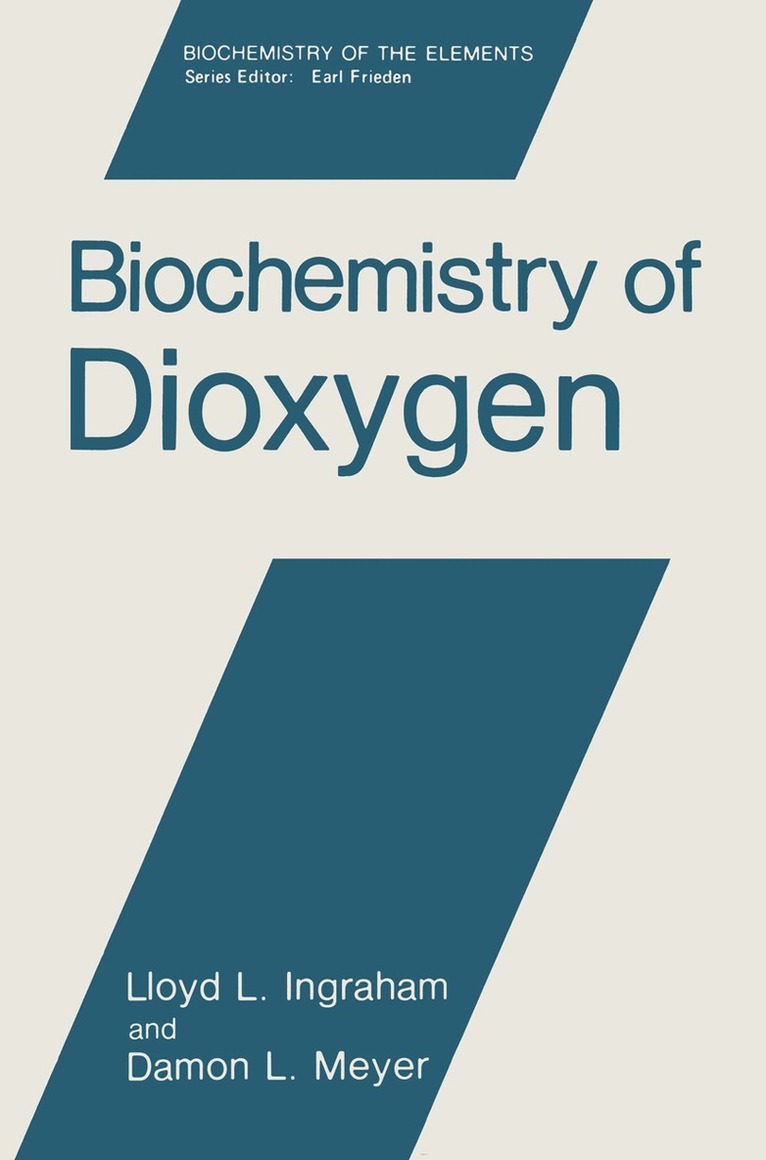
    Biochemistry of Dioxygen

    AvLloyd L. Ingraham,Damon L. Meyer

    Häftad, Engelska, 2011

    Del i serien Biochemistry of the Elements

    1 078 kr

    Beställningsvara. Skickas inom 10-15 vardagar. Fri frakt över 249 kr.

    Beskrivning

    This book is written for the research biochemist who needs to know more about the particular field of dioxygen metabolism, whether this be for designing lectures for a graduate level course or for his or her own research needs. We hope researchers in a given area of dioxygen metabolism will gain knowledge of related fields of dioxygen metabolism. We have decided to use the term dioxygen to distinguish molecular oxygen from divalent oxygen in water and organic compounds, dioxygen being a simpler term than molecular oxygen. We do not intend to review the metabolism of all compounds that contain oxygen, since this would include all of biochemistry. An understanding of dioxygen chemistry is essential to the discussion of the biochemistry of dioxygen. While this statement could be made about any biochemical constituent, the chemistry of dioxygen is so unusual that interpre­ tations without detailed chemical background are futile. Prediction of dioxygen reaction products by analogy with other oxidants is impossible. The partial reduction products of dioxygen, superoxide ion and peroxides, develop naturally in the chemistry of dioxygen. It would be difficult to discuss dioxygen biochemistry without first discussing these partial reduction products.

    Produktinformation

    • Utgivningsdatum:2011-09-27
    • Mått:155 x 235 x 17 mm
    • Vikt:464 g
    • Format:Häftad
    • Språk:Engelska
    • Serie:Biochemistry of the Elements
    • Antal sidor:300
    • Förlag:Springer-Verlag New York Inc.
    • ISBN:9781461295013

    Utforska kategorier

    • Biokemi inom Naturvetenskap och teknik
    • Fysikalisk kemi inom Naturvetenskap och teknik

    Innehållsförteckning

    • 1. Introduction.- 1.1 Chemical Reactions of Dioxygen.- 1.2 Biological Reactions of Dioxygen.- 1.3 Reduction Products of Dioxygen.- 1.4 Dioxygen Enzymes.- 1.5 Oxygen-17 Nuclear Magnetic Resonance Spectroscopy of Oxygen.- References.- 2. Ground-State Dioxygen.- 2.1 Properties of Dioxygen.- 2.2 Reactions of Dioxygen.- 2.3 Chain Reactions of Dioxygen.- 2.4 Examples of Dioxygen Chain Reactions.- References.- 3. Singlet Dioxygen.- 3.1 Physical Properties and Generation.- 3.2 Detection of Singlet Dioxygen.- 3.3 Organic Reactions of Singlet Dioxygen.- 3.4 Singlet Dioxygen-Tocopherol Reaction.- 3.5 Metathesis.- 3.6 Phototaxis.- 3.7 Singlet Sigma Dioxygen.- Summary.- References.- 4. Superoxide Ion.- 4.1 Properties, Sources, and Stability.- 4.2 Detection of Superoxide Ion.- 4.3 Haber-Weiss Reaction.- 4.4 Detection of -OH Radicals.- 4.5 Reactions of Superoxide Ion with Organic Compounds.- 4.6 Superoxide Dismutase.- References.- 5. Dialkyl Peroxides.- 5.1 Introduction.- 5.2 Naturally Occurring Dialkyl Peroxides other than Prostaglandin Intermediates.- 5.3 Prostaglandin.- References.- 6. Catalases and Peroxidases.- 6.1 Catalase.- 6.2 Peroxidase.- 6.3 Mechanisms of Catalase and Peroxidase.- 6.4 Chloroperoxidase.- 6.5 Glutathione Peroxidase.- References.- 7. Dioxygen as a Terminal Oxidant and the Formation of Dioxygen.- 7.1 Fitness of Dioxygen as a Terminal Oxidant.- 7.2 Formation of Dioxygen.- References.- 8. Metal-Dioxygen Complexes.- 8.1 Metal-Dioxygen Bonding.- 8.2 Activation of Dioxygen.- 8.3 Classification of Metal-Dioxygen Complexes.- 8.4 Bonding vs. Oxidation.- References.- 9. Biological Iron Dioxygen Carriers.- 9.1 Hemoglobin and Myoglobin.- 9.2 Hemoglobin Models.- 9.3 Hemerythrin.- References.- 10. Hemocyanin: A Biological Copper Dioxygen Carrier.- 10.1 General Properties.- 10.2 Hemocyanin Models.- References.- 11. Oxidases.- 11.1 Introduction.- 11.2 Laccase.- 11.3 Ceruloplasmin.- 11.4 Ascorbic Acid Oxidase.- 11.5 Amine Oxidases.- 11.6 Galactose Oxidase.- 11.7 Cytochrome Oxidase.- 11.8 Xanthine Oxidase.- 11.9 D-Amino Acid Oxidase.- 11.10 Glucose Oxidase.- 11.11 Lactate Oxidase.- References.- 12. Flavin Monooxygenases.- 12.1 Introduction.- 12.2 Salicylate Hydroxylase.- 12.3 m-Hydroxybenzoate Hydroxylase.- 12.4 m-Hydroxybenzoate 4-Hydroxylase.- 12.5 p-Hydroxybenzoate Hydroxylase.- 12.6 Melilotic Hydroxylase.- 12.7 Phenol Hydroxylase.- 12.8 Orcinol Hydroxylase.- 12.9 Kynurenine 3-Hydroxylase.- 12.10 Imidazoylacetate Monooxygenase.- 12.11 Amine Oxidase.- 12.12 p-Cresol Methyl Hydroxylase.- 12.13 Mechanisms of Hydroxylation.- 12.14 Baeyer-Villiger Enzymes.- 12.15 Lactic Monooxygenase.- 12.16 Lysine Monooxygenase.- 12.17 Arginine Monooxygenase.- 12.18 Oxalic Acid Oxidase.- 12.19 Mechanism of Oxidative Decarboxylation.- References.- 13. Pterin Monooxygenases.- 13.1 Introduction.- 13.2 Phenylalanine Hydroxylase.- 13.3 Tyrosine Hydroxylase.- References.- 14. Copper Hydroxylases.- 14.1 Tyrosine.- 14.2 Dopamine-?-Hydroxylase.- References.- 15. Cytochrome P-450.- 15.1 Properties.- 15.2 Reaction Mechanisms.- 15.3 Model Studies.- 15.4 Oxides and Amine Dealkylation.- References.- 16. Other Iron Monooxygenases.- 16.1 Heme Oxidation.- 16.2 Tryptophan Side-Chain Oxidation.- 16.3 Indolyl-l,3-alkane ?-Hydroxylase.- References.- 17. Ribulose Bisphosphate Oxygenase.- 17.1 Introduction.- 17.2 Chemical Analysis.- 17.3 Effectors and Inhibitors.- 17.4 Reaction Mechanism.- References.- 18. Dioxygenases.- 18.1 Lipoxygenase.- 18.2 Lipoxygenase Mechanism.- 18.3 Other Lipoxygenases.- 18.4 Prostaglandin Synthetase.- 18.5 Pyrrolases.- 18.6 Tryptophan Dioxygenase.- 18.7Indoleamine 2,3-Dioxygenase.- 18.9 ?-Keto-Acid-Dependent Hydroxylases.- 18.10 2-Methyl-3-hydroxy-5-carboxy-pyridine Dioxygenase.- 18.11 Quercetinase.- 18.12 Benzene Dioxygenase.- References.- 19. Bioluminescence.- 19.1 General Concepts.- 19.2 Firefly Bioluminescence.- 19.3 Cypridina Bioluminescence.- 19.4 Bacterial Bioluminescence.- 19.5 Limpet Bioluminescence.- 19.6 Centipede Bioluminescence.- References.- 20. Dioxygen Toxicity.- 20.1 Introduction.- 20.2 Superoxide Toxicity.- 20.3 Measurement of Lipid Oxidation.- 20.4 Cytotoxic Compounds.- 20.5 Beneficial Functions of Dioxygen.- References.- 21. Further Chemistry of Singlet Dioxygen.- 21.1 A Word of Explanation.- 21.2 Reaction of Singlet Dioxygen with Olefins to Form Allylic Hydroperoxides.- 21.3 Concerted Cyclic Transition State Hypothesis in Allylic Hydroperoxides.- 21.4 Perepoxide Hypothesis.- 21.5 Diradical Hypothesis.- 21.6 An Alternative Hypothesis for Allylic Hydroperoxide Formation.- 21.7 Reaction of Singlet Dioxygen with ?,?-Unsaturated Diketones.- 21.8 Reaction of Singlet Dioxygen with Strained Acetylene.- References.