• Fri frakt över 249 kr
  • •
  • Snabba leveranser
  • •
  • Billiga böcker
Kundservice

Du är på sajten för privatpersoner.

Företag, bibliotek eller offentlig verksamhet?

Du handlar på classic.bokus.com, där alla dina funktioner finns intakta.
Till classic.bokus.com
Bokus logotyp. Gå till startsidan.
  • Erbjudanden
  • Nyheter
  • Student
  • Topplistor
  • Barn & ungdom
  • Bokus Play
  • E-böcker
  • Pocketböcker
  • Spel & pussel

Må bättre, för mindre! Upp till 50% rabatt på hälsoböcker

Sidfot

Mina sidor

    Hjälp

    • Kundservice
    • Vanliga frågor och svar
    • Frakt och leverans
    • Retur vid ångerrätt
    • Reklamera vara
    • Betalning
    • Köpvillkor
    • Allmänna villkor
    • Information om webbplatsens tillgänglighet

    Om Bokus

    • Om oss
    • Pressrum
    • För studenter
    • För företag
    • För bibliotek och offentlig verksamhet
    • För leverantörer
    • Hållbarhet

    Populärt

    • Aktuella erbjudanden
    • Presentkort
    • Studentlitteratur
    • Nya böcker
    • Topplistor
    • Signerade böcker
    • Engelska böcker

    Inspiration

    • Boktips
    • BookTok
    • Populära bokserier
    • Barnbokskaraktärer
    • Populära författare
    Logotyp för Bokus
    Följ oss på Facebook (extern länk)Följ oss på Instagram (extern länk)Följ oss på YouTube (extern länk)Följ oss på TikTok (extern länk)
    bokus @ CookiesAnpassa cookiesIntegritetspolicyKöpvillkor
    Till Citymail hemsida (extern länk)Till Budbee hemsida (extern länk)Till Postnord hemsida (extern länk)Till Schenker hemsida (extern länk)Till Early Bird hemsida (extern länk)Till Walleys hemsida (extern länk)
    1. Psykologi och pedagogik
    2. Psykologi
    3. Kognitiv psykologi

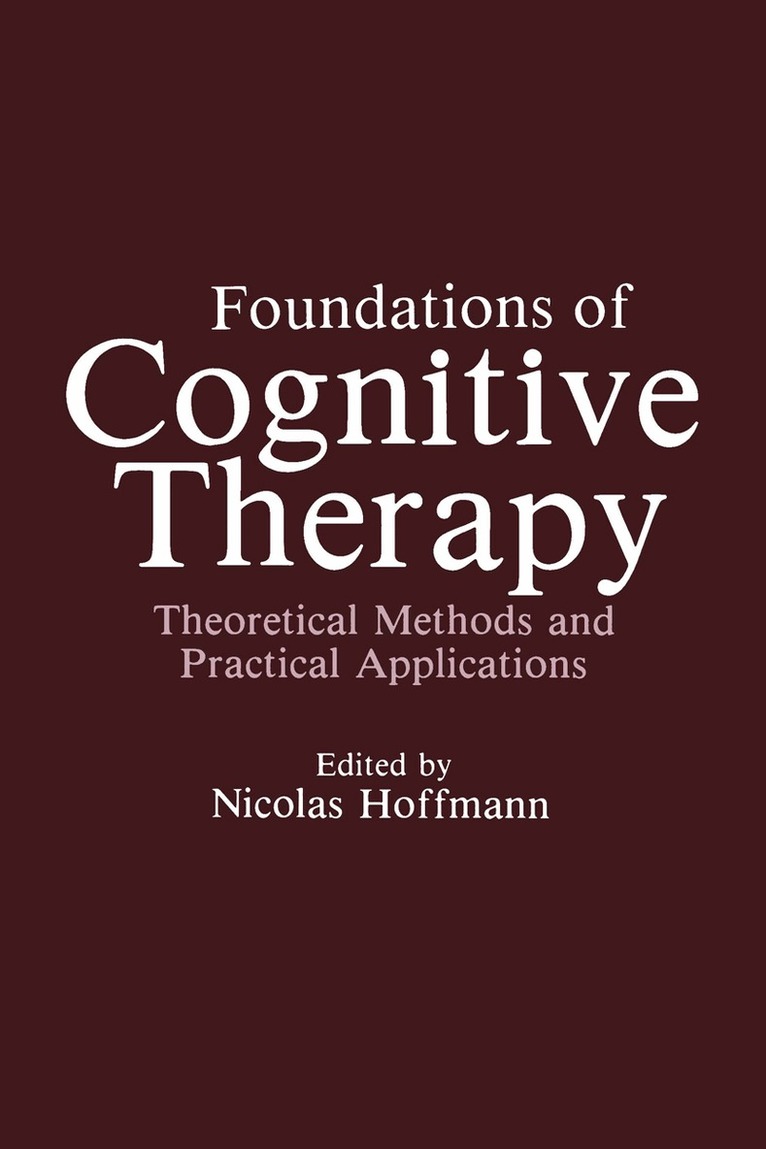
    Foundations of Cognitive Therapy

    Theoretical Methods and Practical Applications

    AvNicolas Hoffmann

    Häftad, Engelska, 2011

    531 kr

    Beställningsvara. Skickas inom 10-15 vardagar. Fri frakt över 249 kr.

    Beskrivning

    Cognitive therapy is one of the newest and most promising developments in the psychotherapeutic field. Following the basic proposals of Beck, Ellis, and Frankl, an increasing amount of work is being done which shows a strong interest by behavior therapists in cognitive strategies. An in­ creasing number of outcome studies show that cognitive methods are effective in many disorders, and it can be predicted that they will have a growing part to play in the practice of psychological therapies. In spite of this, the development is only in its beginnings. Especially from a theoretical standpoint, many of the proposed techniques lack a sufficient foundation, and the implications of important results from dif­ ferent areas of psychology for providing a theoretical basis for cognitive intervention have not yet been sufficiently recognized. To investigate these developments is the main purpose of this book. The intention of the authors is not to give a summary of the present status of cognitive therapy but to try to show its possibilities for future development. A number of areas of psychological research have been selected as being the most important for future development of cognitive therapeutic techniques: the genetic theory of Piaget, the investigations of attitude theory, attribution theory, and psychological action theory, and the psy­ chology of problem-solving. After a description of the latest developments in these areas, the authors attempt to extract the theoretical implications for cognitive ther­ apy and, on this basis, to make a few initial proposals for practice.

    Produktinformation

    • Utgivningsdatum:2011-09-26
    • Mått:152 x 229 x 15 mm
    • Vikt:376 g
    • Format:Häftad
    • Språk:Engelska
    • Antal sidor:238
    • Förlag:Springer-Verlag New York Inc.
    • ISBN:9781461296485

    Utforska kategorier

    • Kognitiv psykologi inom Psykologi och pedagogik

    Innehållsförteckning

    • 1 Cognitive Therapy: Introduction to the Subject.- 1. Definitions.- 2. Cognitive Therapy.- 3. The Common Elements of Cognitive Therapies.- 4. The Present Theoretical Status of Cognitive Therapy.- References.- 2 Developmental Cognitive Theory, Personality, and Therapy.- 1. Principles of a Genetic Theory of Cognition.- 2. Personality and Personality Disorders from the Viewpoint of the Theory of Cognition.- 3. Therapy Based on Cognitive Theory.- 4. Cognitive-Theory Interpretations of Behavior Therapy.- Techniques.- References.- 3 Attitude Change and Cognitive Therapy.- 1. Introduction.- 2. Attitude and Behavior.- 3. Attitude Change and Cognitive Therapy.- References.- 4 The Problem of Attribution and Cognitive Therapy.- 1. Introduction.- 2. Classical Theories of Attribution: General Introduction and Comparison of the Theories.- 3. Aspects of the More Recent Attribution Research Relevant to Clinical Practice.- 4. Attribution Therapy.- 5. Summary and Critique.- References.- 5 Implications of Action Theory for Cognitive Therapy.- 1. Introduction.- 2. Cognition versus Reinforcement: Is There a Noncognitive Therapy?.- 3. Cognition and Emotion.- 4. Cognition and Behavior I: Cognitive Factors in the Regulation of Behavior.- 5. Cognition and Behavior II: Mechanisms of Cognitive Action Regulation.- 6. Implications of an Action-Theory Approach.- 7. Conclusion.- References.- 6 Problem Solving and Cognitive Therapy.- 1. Introduction.- 2. Problem-Solving Skills as the Therapeutic Goal.- 3. Problems and Their Classification.- 4. Cognitive Structures and Cognitive Operations.- 5. Heuristic Procedures in Problem Solving.- 6. Approaches for the Enhancement of Competence in Problem Solving.- 7. Problem Solving in Cognitive Therapy.- 8. Problem Solving under the Conditions of Therapy.- References.- 7 Cognitive Therapy in the Treatment of Depression.- 1. Overview.- 2. The Cognitive Model of Depression.- 3. Cognitive Therapy of Depression.- References.- 8 The Applicability of Cognitive Components of Behavior in Diagnosis and Therapy: Practical Approaches for a Cognitive Theory.- 1. Therapy as a Cognitive-Social Problem-Solving Process.- 2. Diagnostic Applicability of Cognitive Components of Behavior.- 3. Therapeutic Applicability of Cognitive Components of Behavior.- 4. Final Remarks.- References.- 9 The Problem of the Use of Cognitive Constructs and Cognitive Terminology: A Critical Analysis Exemplified by the Construct of ‘Learned Helplessness’.- 1. The Definition of Cognition.- 2. The Use of Cognitive Concepts in the Paradigm of Helplessness.- 3. The Use of Cognitive Concepts.- References.- Author Index.