• Fri frakt över 249 kr
  • •
  • Snabba leveranser
  • •
  • Billiga böcker
Kundservice

Du är på sajten för privatpersoner.

Företag, bibliotek eller offentlig verksamhet?

Du handlar på classic.bokus.com, där alla dina funktioner finns intakta.
Till classic.bokus.com
Bokus logotyp. Gå till startsidan.
  • Erbjudanden
  • Nyheter
  • Student
  • Topplistor
  • Barn & ungdom
  • Bokus Play
  • E-böcker
  • Pocketböcker
  • Spel & pussel

10% rabatt på allt med kod: NYSTART10 →

Sidfot

Mina sidor

    Hjälp

    • Kundservice
    • Vanliga frågor och svar
    • Frakt och leverans
    • Retur vid ångerrätt
    • Reklamera vara
    • Betalning
    • Köpvillkor
    • Allmänna villkor
    • Information om webbplatsens tillgänglighet

    Om Bokus

    • Om oss
    • Pressrum
    • För studenter
    • För företag
    • För bibliotek och offentlig verksamhet
    • För leverantörer
    • Hållbarhet

    Populärt

    • Aktuella erbjudanden
    • Presentkort
    • Studentlitteratur
    • Nya böcker
    • Topplistor
    • Signerade böcker
    • Engelska böcker

    Inspiration

    • Boktips
    • BookTok
    • Populära bokserier
    • Barnbokskaraktärer
    • Populära författare
    Logotyp för Bokus
    Följ oss på Facebook (extern länk)Följ oss på Instagram (extern länk)Följ oss på YouTube (extern länk)Följ oss på TikTok (extern länk)
    bokus @ CookiesAnpassa cookiesIntegritetspolicyKöpvillkor
    Till Citymail hemsida (extern länk)Till Budbee hemsida (extern länk)Till Postnord hemsida (extern länk)Till Schenker hemsida (extern länk)Till Early Bird hemsida (extern länk)Till Walleys hemsida (extern länk)
    1. Medicin
    2. Medicin: allmänt
    3. Samhällsmedicin och preventiv medicin
    4. Folkhälsa och hälsopedagogik

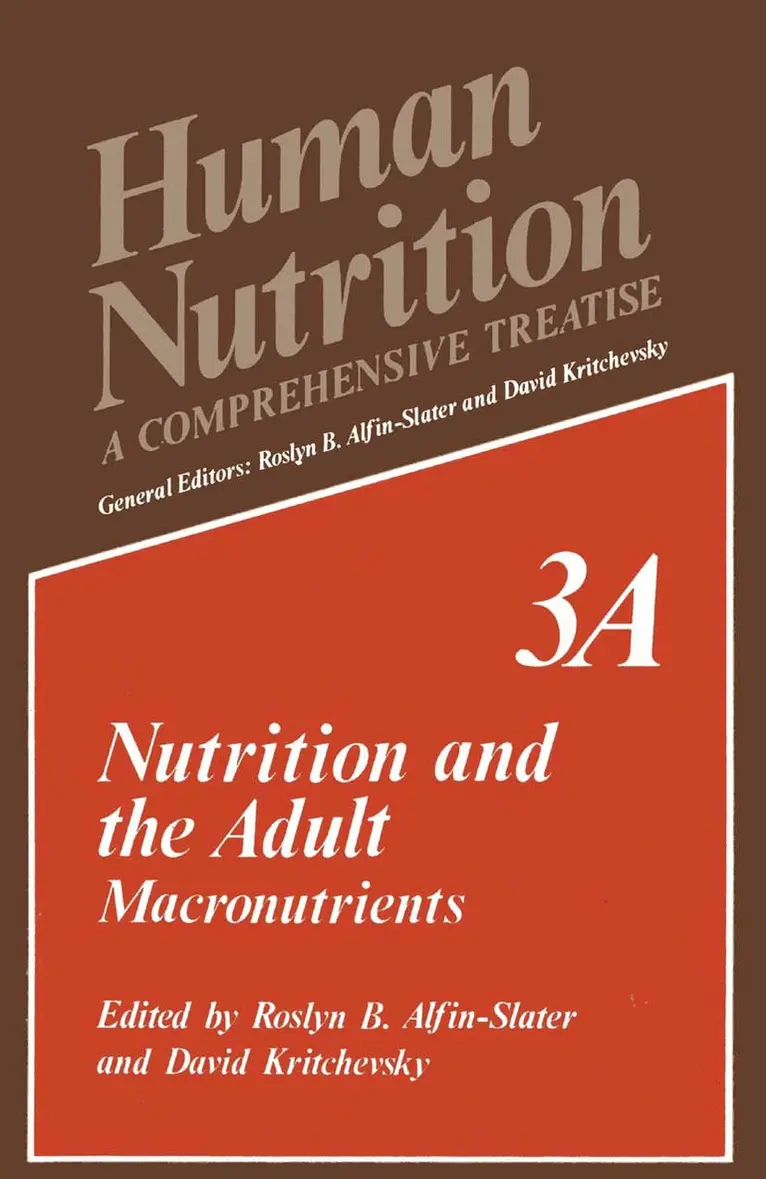
    Nutrition and the Adult

    Macronutrients Volume 3A

    AvRoslyn B. Alfin-Slater,David Kritchevsky

    Häftad, Engelska, 2011

    Del i serien Human Nutrition

    1 119 kr

    Beställningsvara. Skickas inom 10-15 vardagar. Fri frakt över 249 kr.

    Beskrivning

    The science of nutrition has advanced beyond expectation since Antoine La­ voisier as early as the 18th century showed that oxygen was necessary to change nutrients in foods to compounds which would become a part of the human body. He was also the first to measure metabolism and to show that oxidation within the body produces heat and energy. In the two hundred years that have elapsed, the essentiality of nitrogen-containing nutrients and of proteins for growth and maintenance of tissue has been established; the ne­ cessity for carbohydrates and certain types of fat for health has been docu­ mented; vitamins necessary to prevent deficiency diseases have been identified and isolated; and the requirement of many mineral elements for health has been demonstrated. Further investigations have defined the role of these nutrients in metabolic processes and quantitated their requirements at various stages of development. Additional studies have involved their use in the possible prevention of,and therapy for, disease conditions.

    Produktinformation

    • Utgivningsdatum:2011-11-09
    • Mått:170 x 244 x 17 mm
    • Vikt:542 g
    • Format:Häftad
    • Språk:Engelska
    • Serie:Human Nutrition
    • Antal sidor:308
    • Förlag:Springer-Verlag New York Inc.
    • ISBN:9781461330172

    Utforska kategorier

    • Folkhälsa och hälsopedagogik inom Medicin

    Innehållsförteckning

    • 1 Nutrient Requirements: What They Are and Bases for Recommendations.- 1. Introduction.- 2. Techniques Used to Determine Nutritional Status.- 3. Standards of Nutrient Intake.- 4. Energy.- 5. Fats.- 6. Protein.- 7. Vitamins.- 8. Mineral Elements.- 9. References.- 2 Energy: Caloric Requirements.- 1. Brief History of Bioenergetics.- 2. Definitions.- 3. Calorimetry.- 4. Assessing Energy Balance.- 5. Caloric Allowances.- 6. Metabolic Size.- 7. Caloric Content of Foods.- 8. Methods of Determining Caloric Content of Foods.- 9. Calories and Obesity.- 10. Undernutrition.- 11. Source of Calories during Exercise.- 12. References.- 3 Suppliers of Energy: Carbohydrates.- 1. Introduction.- 2. Digestion.- 3. Carbohydrate Tolerance Tests.- 4. Carbohydrate Metabolism in the Liver.- 5. Carbohydrates and Muscle.- 6. Carbohydrates and Adipose Tissue.- 7. Carbohydrate Metabolism in the Brain.- 8. Carbohydrate Metabolism in the Fetus and Neonate.- 9. Carbohydrate and Lipid Metabolism.- 10. Factors Affectingthe Metabolic Response to Dietary Carbohydrate.- 11. Carbohydrates in the Etiology of Disease.- 12. Other Carbohydrates Consumed by Humans.- 13. Conclusion.- 14. References.- 15. Further Reading.- 4 Suppliers of Energy: Fat.- 1. Introduction.- 2. Distribution of Lipids in the Diet.- 3. Triglycerides: Physical and Chemical Properties.- 4. Digestion and Absorption.- 5. Transport.- 6. Utilization of Fats by Tissues.- 7. Fat as an Energy. Source.- 8. Fatty Acid Isomerism.- 9. Conclusions.- 10. References.- 5 Suppliers of Energy: Carbohydrate-Fat Interrelationships.- 1. Introduction.- 2. Growth.- 3. Obesity.- 4. Diabetes.- 5. Blood Lipids.- 6. Exercise.- 7. References.- 6 Energetics and the Demands for Maintenance.- 1. Introduction.- 2. Measurement of Energy Exchange.- 3. Partition of Food Energy.- 4. Conclusion.- 5. References.- 7 Nutrients with Special Functions: Proteins and Amino Acids in Tissue Maintenance.- 1. Introduction.- 2. Hydrolysis and Absorption of Dietary Protein.- 3. Meal-Related Interorgan Movements of Amino Acids.- 4. Protein Synthesis.- 5. Protein Breakdown.- 6. Interrelationships of Amino Acid Supply and Protein and Nucleic Acid Metabolism.- 7. Overall Total-Body Protein Synthesis and Breakdown.- 8. General Conclusions.- 9. References.- 8 Nutrients with Special Functions: Essential Fatty Acids.- 1. What Are the Essential Fatty Acids?.- 2. How Do We Name the Essential Fatty Acids?.- 3. What Structures Confer Essential Fatty Acid Activity?.- 4. How Are the Essential Fatty Acids Obtained?.- 5. How Are the Essential Fatty Acids Synthesized and Altered?.- 6. How Is Essential Fatty Acid Deficiency Established?.- 7. How Do We Recognize Essential Fatty Acid Deficiency in Experimental Animals?.- 8. What About Deficiency Symptoms in Humans?.- 9. What Actually Is the Function of the Essential Fatty Acids?.- 10. What Is an Adequate Intake of Essential Fatty Acids?.- 11. What About Excess Essential Fatty Acids?.- 12. Conclusions.- 13. References.- 9 Nutrients with Special Functions: Cholesterol.- 10 Nutrients with Special Functions: Dietary Fiber.- 1. Introduction.- 2. A Definition of Fiber.- 3. The Composition of Fiber.- 4. Intestinal Function and Disease.- 5. Lipid Metabolism and Atherosclerosis.- 6. Diabetes Mellitus.- 7. Overconsumption of Fiber.- 8. Summary.- 9. References.