• Fri frakt över 249 kr
  • •
  • Snabba leveranser
  • •
  • Billiga böcker
Kundservice

Du är på sajten för privatpersoner.

Företag, bibliotek eller offentlig verksamhet?

Du handlar på classic.bokus.com, där alla dina funktioner finns intakta.
Till classic.bokus.com
Bokus logotyp. Gå till startsidan.
  • Erbjudanden
  • Nyheter
  • Student
  • Topplistor
  • Barn & ungdom
  • Bokus Play
  • E-böcker
  • Pocketböcker
  • Spel & pussel

10% rabatt på allt med kod NYSTART10 →

Sidfot

Mina sidor

    Hjälp

    • Kundservice
    • Vanliga frågor och svar
    • Frakt och leverans
    • Retur vid ångerrätt
    • Reklamera vara
    • Betalning
    • Köpvillkor
    • Allmänna villkor
    • Information om webbplatsens tillgänglighet

    Om Bokus

    • Om oss
    • Pressrum
    • För studenter
    • För företag
    • För bibliotek och offentlig verksamhet
    • För leverantörer
    • Hållbarhet

    Populärt

    • Aktuella erbjudanden
    • Presentkort
    • Studentlitteratur
    • Nya böcker
    • Topplistor
    • Signerade böcker
    • Engelska böcker

    Inspiration

    • Boktips
    • BookTok
    • Populära bokserier
    • Barnbokskaraktärer
    • Populära författare
    Logotyp för Bokus
    Följ oss på Facebook (extern länk)Följ oss på Instagram (extern länk)Följ oss på YouTube (extern länk)Följ oss på TikTok (extern länk)
    bokus @ CookiesAnpassa cookiesIntegritetspolicyKöpvillkor
    Till Citymail hemsida (extern länk)Till Budbee hemsida (extern länk)Till Postnord hemsida (extern länk)Till Schenker hemsida (extern länk)Till Early Bird hemsida (extern länk)Till Walleys hemsida (extern länk)
    1. Naturvetenskap och teknik
    2. Teknik och industri
    3. Energiteknik

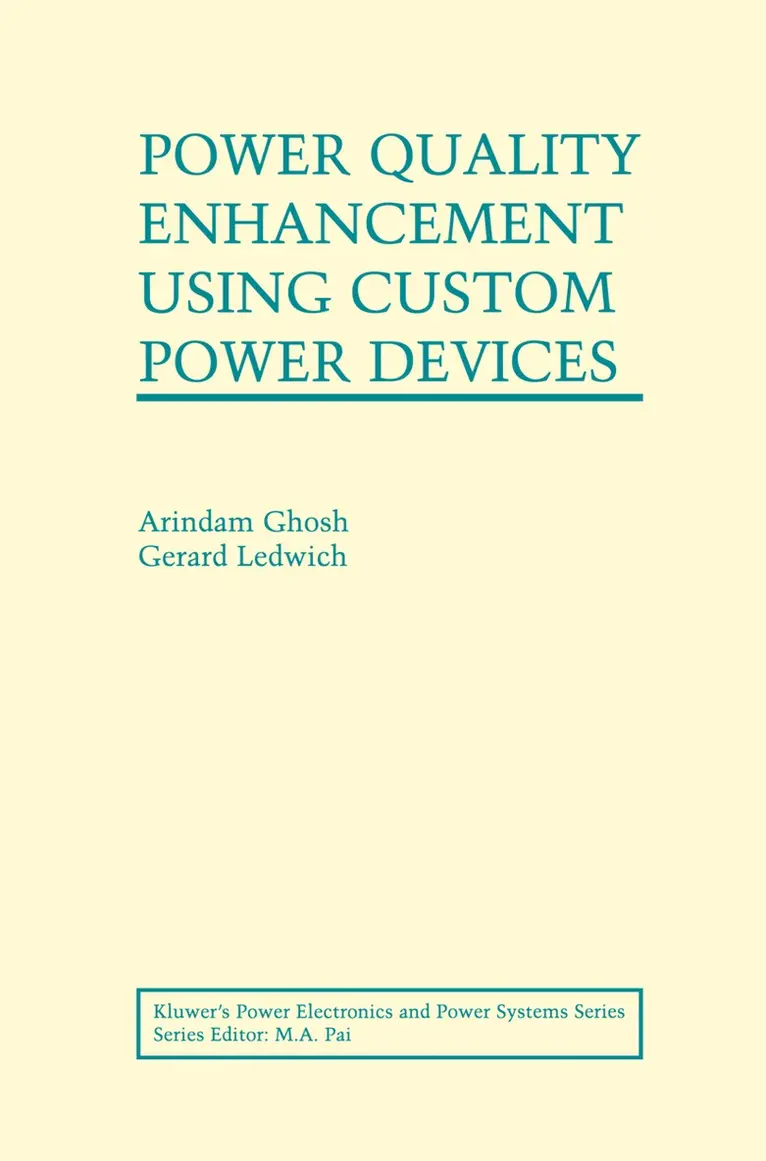
    Power Quality Enhancement Using Custom Power Devices

    AvArindam Ghosh,Gerard Ledwich

    Häftad, Engelska, 2012

    Del i serien Power Electronics and Power Systems

    2 164 kr

    Beställningsvara. Skickas inom 10-15 vardagar. Fri frakt över 249 kr.

    Fler format och utgåvor

    Inbunden

    2 164 kr

    Beskrivning

    Power Quality Enhancement Using Custom Power Devices considers the structure, control and performance of series compensating DVR, the shunt DSTATCOM and the shunt with series UPQC for power quality improvement in electricity distribution.Also addressed are other power electronic devices for improving power quality in Solid State Transfer Switches and Fault Current Limiters. Applications for these technologies as they relate to compensating busses supplied by a weak line and for distributed generation connections in rural networks, are included. In depth treatment of inverters to achieve voltage support, voltage balancing, harmonic suppression and transient suppression in realistic network environments are also covered. New material on the potential for shunt and series compensation which emphasizes the importance of control design has been introduced.

    Produktinformation

    • Utgivningsdatum:2012-10-30
    • Mått:155 x 235 x 27 mm
    • Vikt:727 g
    • Format:Häftad
    • Språk:Engelska
    • Serie:Power Electronics and Power Systems
    • Antal sidor:460
    • Förlag:Springer-Verlag New York Inc.
    • ISBN:9781461354185

    Utforska kategorier

    • Energiteknik inom Naturvetenskap och teknik
    • Miljövetenskap och miljöpolitik inom Naturvetenskap och teknik

    Innehållsförteckning

    • Content.- 1 Introduction.- 1.1 Electric Power Quality.- 1.2 Power Electronic Applications in Power Transmission Systems.- 1.3 Power Electronic Applications in Power Distribution Systems.- 1.4 Distributed Generation.- 1.5 References.- 2 Characterization of Electric Power Quality.- 2.1 Power Quality Terms and Definitions.- 2.2 Power Quality Problems.- 2.3 Conclusions.- 2.4 References.- 3 Analysis and Conventional Mitigation Methods.- 3.1 Analysis of Power Outages.- 3.2 Analysis of Unbalance.- 3.3 Analysis of Distortion.- 3.5 Analysis of Voltage Flicker.- 3.6 Reduced Duration and Customer Impact of Outages.- 3.7 Classical Load Balancing Problem.- 3.8 Harmonic Reduction.- 3.9 Voltage Sag or Dip Reduction.- 3.10 Conclusions.- 3.11 References.- 4 Custom Power Devices: An Introduction.- 4.1 Utility-Customer Interface.- 4.2 Introduction to Custom Power Devices.- 4.3 Custom Power Park.- 4.4 Status of Application of Cp Devices.- 4.5 Conclusions.- 4.6 References.- 5 Structure and Control of Power Converters.- 5.1 Inverter Topology.- 5.2 Hard-Switched Versus Soft-Switched.- 5.3 High Voltage Inverters.- 5.4 Combining Inverters for Increased Power and Voltage.- 5.5 Open-Loop Voltage Control.- 5.6 Closed-Loop Switching Control.- 5.7 Second and Higher Order Systems.- 5.8 Conclusions.- 5.9 References.- 6 Solid State Limiting, Breaking and Transferring Devices.- 6.1 Solid State Current Limiter.- 6.2 Solid State Breaker (SSB).- 6.3 Issues in Limiting and Switching Operations.- 6.4 Solid State Transfer Switch (SSTS).- 6.5 Sag/Swell Detection Algorithms.- 6.6 Conclusions.- 6.7 References.- 7 Load Compensation using DSTATCOM.- 7.1 Compensating Single-Phase Loads.- 7.2 Ideal Three-Phase Shunt Compensator Structure.- 7.3 Generating Reference Currents Using Instantaneous PQ Theory.- 7.4 Generating Reference Currents Using Instantaneous Symmetrical Components.- 7.5 General Algorithm for Generating Reference Currents.- 7.6 Generating Reference Currents When the Source Is Unbalanced.- 7.7 Conclusions.- 7.8 References.- 8 Realization and Control of DSTATCOM.- 8.1 DSTATCOM Structure.- 8.2 Control of DSTATCOM Connected To a Stiff Source.- 8.3 DSTATCOM Connected To Weak Supply Point.- 8.4 DSTATCOM Current Control through Phasors.- 8.5 DSTATCOM in Voltage Control Mode.- 8.6 Conclusions.- 8.7 References.- 9 Series Compensation of Power Distribution System.- 9.1 Rectifier Supported DVR.- 9.2 Dc Capacitor Supported DVR.- 9.3 DVR Structure.- 9.4 Voltage Restoration.- 9.5 Series Active Filter.- 9.6 Conclusions.- 9.7 References.- 10 Unified Power Quality Conditioner.- 10.1 UPQC Configurations.- 10.2 Right-Shunt UPQC Characteristics.- 10.3 Left-Shunt UPQC Characteristics.- 10.4 Structure and Control of Right-Shunt Upqc.- 10.5 Structure and Control of Left-Shunt UPQC.- 10.6 Conclusions.- 10.7 References.- 11 Distributed Generation and Grid Interconnection.- 11.1 Distributed Generation — Connection Requirements and Impacts on the Network.- 11.2 Interaction and Optimal Location of DG.- 11.3 Power Quality in DG.- 11.4 Islanding Issues.- 11.5 Distribution Line Compensation.- 11.6 Real Generation.- 11.7 Protection Issues for Distributed Generation.- 11.8 Technologies for Distributed Generation.- 11.9 Power Quality Impact from Different DG Types.- 11.10 Conclusions.- 11.11 References.- 12 Future Directions and Opportunities for Power Quality Enhancement.- 12.1 Power Quality Sensitivity.- 12.2 Utility Based Versus Customer Based Correction.- 12.3 Power Quality Contribution to the Network from Customer Owned Equipment.- 12.4 Interconnection Standards.- 12.5 Power QualityPerformance Requirements and Validation.- 12.6 Shape of Energy Delivery.- 12.7 Role of Compensators in Future Energy Delivery.- 12.8 Conclusions.- 12.9 References.