• Fri frakt över 249 kr
  • •
  • Snabba leveranser
  • •
  • Billiga böcker
Kundservice

Du är på sajten för privatpersoner.

Företag, bibliotek eller offentlig verksamhet?

Du handlar på classic.bokus.com, där alla dina funktioner finns intakta.
Till classic.bokus.com
Bokus logotyp. Gå till startsidan.
  • Erbjudanden
  • Nyheter
  • Student
  • Topplistor
  • Barn & ungdom
  • Bokus Play
  • E-böcker
  • Pocketböcker
  • Spel & pussel

Må bättre, för mindre! Upp till 50% rabatt på hälsoböcker

Sidfot

Mina sidor

    Hjälp

    • Kundservice
    • Vanliga frågor och svar
    • Frakt och leverans
    • Retur vid ångerrätt
    • Reklamera vara
    • Betalning
    • Köpvillkor
    • Allmänna villkor
    • Information om webbplatsens tillgänglighet

    Om Bokus

    • Om oss
    • Pressrum
    • För studenter
    • För företag
    • För bibliotek och offentlig verksamhet
    • För leverantörer
    • Hållbarhet

    Populärt

    • Aktuella erbjudanden
    • Presentkort
    • Studentlitteratur
    • Nya böcker
    • Topplistor
    • Signerade böcker
    • Engelska böcker

    Inspiration

    • Boktips
    • BookTok
    • Populära bokserier
    • Barnbokskaraktärer
    • Populära författare
    Logotyp för Bokus
    Följ oss på Facebook (extern länk)Följ oss på Instagram (extern länk)Följ oss på YouTube (extern länk)Följ oss på TikTok (extern länk)
    bokus @ CookiesAnpassa cookiesIntegritetspolicyKöpvillkor
    Till Citymail hemsida (extern länk)Till Budbee hemsida (extern länk)Till Postnord hemsida (extern länk)Till Schenker hemsida (extern länk)Till Early Bird hemsida (extern länk)Till Walleys hemsida (extern länk)
    1. Naturvetenskap och teknik
    2. Teknik och industri
    3. Tillverkningsteknik

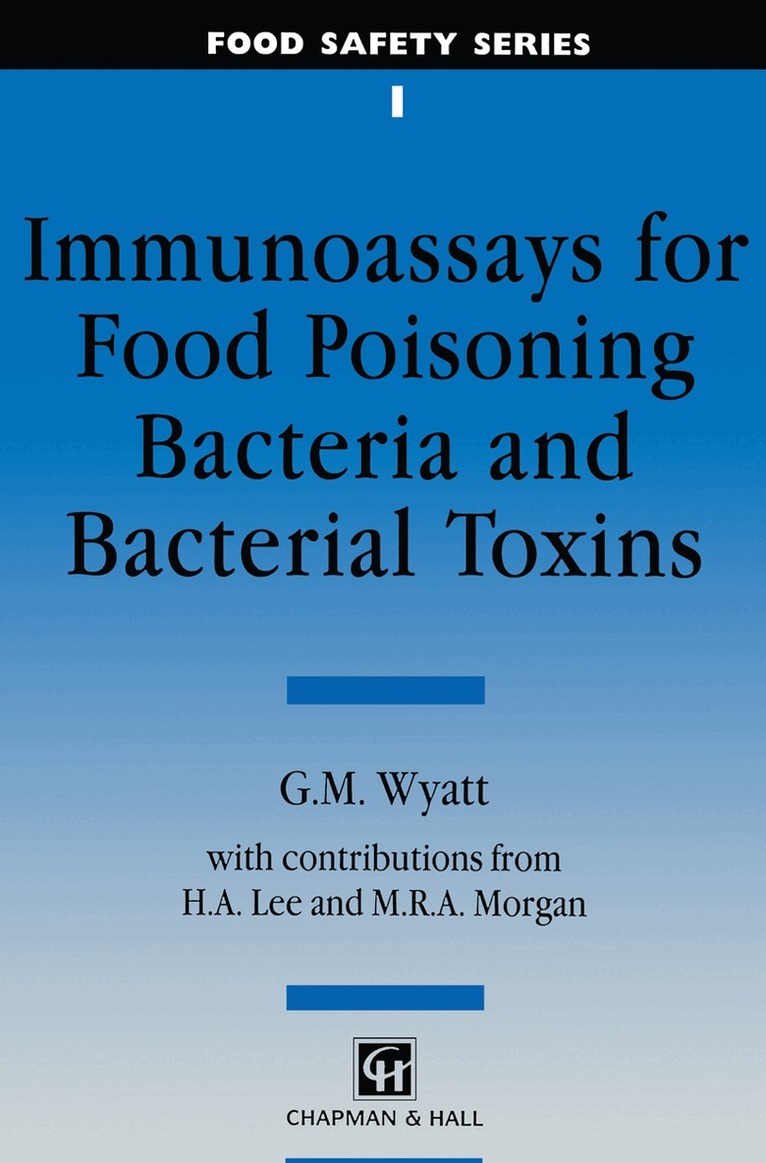
    Immunoassays for Food-poisoning Bacteria and Bacterial Toxins

    AvG. M. Wyatt

    Häftad, Engelska, 2011

    Del i serien Food Safety Series

    547 kr

    Beställningsvara. Skickas inom 10-15 vardagar. Fri frakt över 249 kr.

    Fler format och utgåvor

    E-bok

    710 kr

    Beskrivning

    Consumer safety has become a central issue of the food supply system in most countries. It encompasses a large number of interacting scientific and tech­ nological matters, such as agricultural practice, microbiology, chemistry, food technology, processing, handling and packaging. The techniques used in understanding and controlling contaminants and toxicity range from the most sophisticated scientific laboratory methods, through industrial engineering science to simple logical rules implemented in the kitchen. The problems of food safety, however, spread far beyond those directly occupied in food production. Public interest and concern has become acute in recent years, alerting a wide spectrum of specialists in research, education and public affairs. This series aims to present timely volumes covering all aspects of the subject. They will be up-to-date, specialist reviews written by acknowledged experts in their fields of research to express each author's own viewpoint. The readership is intended to be wide and international, and the style to be comprehensible to non-specialists, albeit professionals. The series will be of interest to food scientists and technologists working in industry, universities, polytechnics and government institutes; legislators and regulators concerned with the food supply; and specialists in agriculture, engineering, health care and consumer affairs. One of the most difficult situations to control is the contamination of food by small numbers of pathogenic micro-organisms before they multiply to give the large populations causing food poisoning when eaten.

    Produktinformation

    • Utgivningsdatum:2011-12-31
    • Mått:155 x 235 x 9 mm
    • Vikt:236 g
    • Format:Häftad
    • Språk:Engelska
    • Serie:Food Safety Series
    • Antal sidor:130
    • Förlag:Springer-Verlag New York Inc.
    • ISBN:9781461358268

    Utforska kategorier

    • Tillverkningsteknik inom Naturvetenskap och teknik

    Innehållsförteckning

    • 1 Introduction.- 2 Food-borne bacteria.- 3 Historical aspects.- 4 Food as an assay matrix.- 5 Antibody technology.- 6 Equipment and instrumentation.- 7 Assessment of assay performance.- 8 Assays available commercially.- 9 Conclusions.- Appendices.- 1 Definition of terms used.- 2 Hapten conjugation methods.- 3 Preparation of antigenic structures from bacterial cells.- 4 Monoclonal antibody techniques.- 5 Enzyme/substrate systems.- 6 Antibody labelling methods.- 7 Immunoassay reagents and methods.- 8 Preparation of immunoaffinity columns.- 9 Suppliers of equipment and consumables.- References.