• Fri frakt över 249 kr
  • •
  • Snabba leveranser
  • •
  • Billiga böcker
Kundservice

Du är på sajten för privatpersoner.

Företag, bibliotek eller offentlig verksamhet?

Du handlar på classic.bokus.com, där alla dina funktioner finns intakta.
Till classic.bokus.com
Bokus logotyp. Gå till startsidan.
  • Erbjudanden
  • Nyheter
  • Student
  • Topplistor
  • Barn & ungdom
  • Bokus Play
  • E-böcker
  • Pocketböcker
  • Spel & pussel

10% rabatt på allt med kod: NYSTART10 →

Sidfot

Mina sidor

    Hjälp

    • Kundservice
    • Vanliga frågor och svar
    • Frakt och leverans
    • Retur vid ångerrätt
    • Reklamera vara
    • Betalning
    • Köpvillkor
    • Allmänna villkor
    • Information om webbplatsens tillgänglighet

    Om Bokus

    • Om oss
    • Pressrum
    • För studenter
    • För företag
    • För bibliotek och offentlig verksamhet
    • För leverantörer
    • Hållbarhet

    Populärt

    • Aktuella erbjudanden
    • Presentkort
    • Studentlitteratur
    • Nya böcker
    • Topplistor
    • Signerade böcker
    • Engelska böcker

    Inspiration

    • Boktips
    • BookTok
    • Populära bokserier
    • Barnbokskaraktärer
    • Populära författare
    Logotyp för Bokus
    Följ oss på Facebook (extern länk)Följ oss på Instagram (extern länk)Följ oss på YouTube (extern länk)Följ oss på TikTok (extern länk)
    bokus @ CookiesAnpassa cookiesIntegritetspolicyKöpvillkor
    Till Citymail hemsida (extern länk)Till Budbee hemsida (extern länk)Till Postnord hemsida (extern länk)Till Schenker hemsida (extern länk)Till Early Bird hemsida (extern länk)Till Walleys hemsida (extern länk)
    1. Naturvetenskap och teknik
    2. Teknik och industri
    3. Tillverkningsteknik

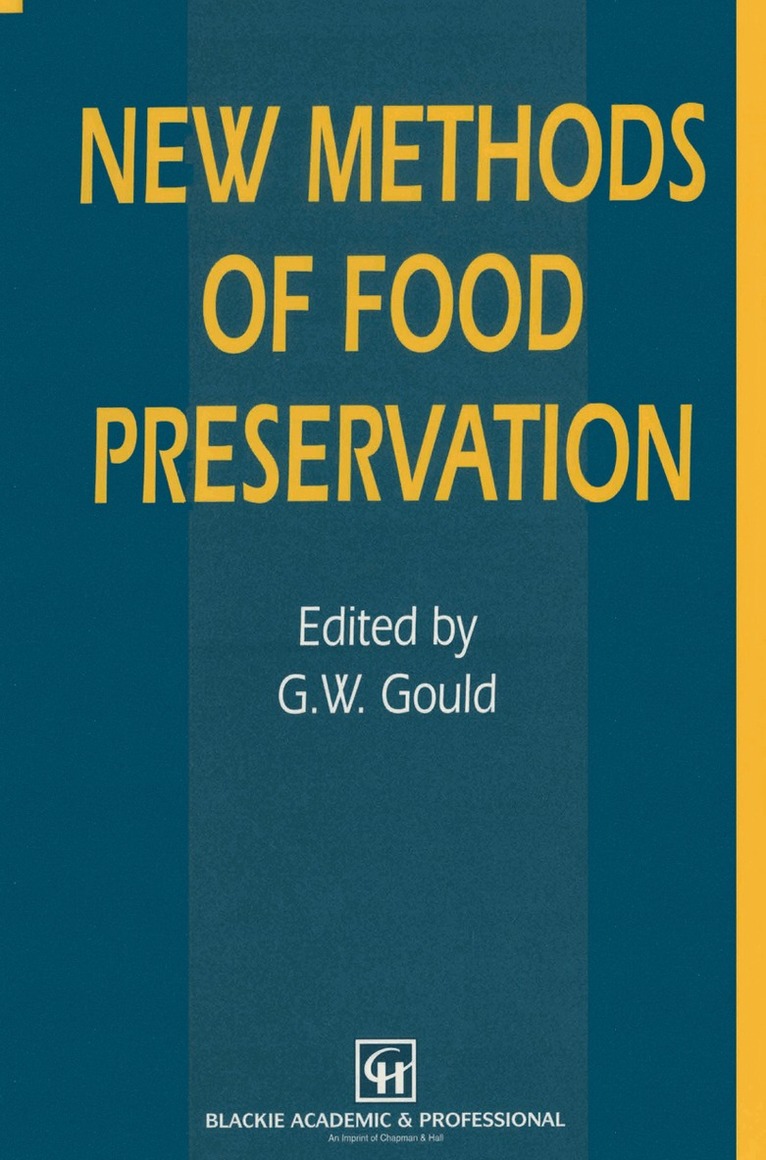
    New Methods of Food Preservation

    AvG. W. Gould

    Häftad, Engelska, 2012

    547 kr

    Beställningsvara. Skickas inom 10-15 vardagar. Fri frakt över 249 kr.

    Fler format och utgåvor

    Inbunden

    870 kr

    E-bok

    712 kr

    Beskrivning

    The majO.r techniques emplO.yed fO.r fO.O.d preservatiO.n have a 100ng histo'ry O.f use. They include chilling; freezing; drying; curing; cO.nserving; fer- menting O.r O.therwise acidifying; the additiO.n O.f preservatives; heat- pasteurisatiO.n and sterilisatiO.n. Newer techniques mO.re-O.r-less derived frO.m these traditiO.nal proce- dures include the successful applicatiO.n O.f cO.mbinatiO.n. preservatiO.n O.r 'hurdle' methO.ds, vacuum- and mO.dified atmO.sphere-packaging, and cO.ntinuO.us sterilisatiO.n cO.upled to' aseptic packaging. More innO.vative techniques, such as the use O.f iO.nising radiatiO.n, are increasingly being emplO.yed. At the same time, there is a reawakening O.f interest in even mO.re radical apprO.aches. The reaSO.ns fO.r this derive principally from cO.nsumers' requirements fO.r fO.O.ds that are higher in quality, so. less severely prO.ces- sed; mO.re natural, so. less heavily preserved; nutritiO.nally healthier, so. cO.ntaining less salts, sugars and fats; and, with respect to' fO.O.d pO.isO.ning, with retained, O.r preferably improved, assurance O.f safety.

    Produktinformation

    • Utgivningsdatum:2012-10-20
    • Mått:155 x 235 x 19 mm
    • Vikt:528 g
    • Format:Häftad
    • Språk:Engelska
    • Antal sidor:324
    • Förlag:Springer-Verlag New York Inc.
    • ISBN:9781461358763

    Utforska kategorier

    • Tillverkningsteknik inom Naturvetenskap och teknik

    Innehållsförteckning

    • 1 Principles and applications of hurdle technology.- 1.1 Introduction.- 1.2 Examples of the hurdle effect.- 1.3 Behaviour of microorganisms during food preservation.- 1.4 Total quality of foods.- 1.5 Application of hurdle technology in less developed countries.- 1.6 Future potential.- References.- 2 Bacteriocins: natural antimicrobials from microorganisms.- 2.1 Introduction.- 2.2 Bacteriocin structure and function.- 2.3 Genetics of bacteriocins from LAB.- 2.4 Application of bacteriocins in food systems.- 2.5 Future prospects for bacteriocins.- References.- 3 Natural antimicrobials from animals.- 3.1 Introduction.- 3.2 The phagosome.- 3.3 Antibiotic peptides.- 3.4 Protein amendment and production of antibiotic peptides.- 3.5 The lactoperoxidase system (LPS).- 3.6 Lysozymes.- 3.7 Prospects.- References.- 4 Natural antimicrobials from plants.- 4.1 Introduction.- 4.2 Phytoalexins.- 4.3 Organic acids.- 4.4 Essential oils.- 4.5 Phenolics, pigments and related compounds.- 4.6 Modes of action.- 4.7 Health and legislative aspects.- 4.8 Conclusions.- References.- 5 Food irradiation: current status and future prospects.- 5.1 Introduction.- 5.2 Development of national regulations.- 5.3 Technical advantages and limitations of food irradiation.- 5.4 Limitations of food irradiation.- 5.5 Consumer acceptance of irradiated food.- 5.6 Commercial applications of food irradiation.- 5.7 International co-operation in the field of food irradiation.- 5.8 Conclusions.- References.- 6 Microwave processing.- 6.1 Introduction.- 6.2 Introduction to microwaves and their interaction with food materials.- 6.3 Microwaves and microorganisms.- 6.4 Microwave processing equipment.- 6.5 Case histories.- 6.6 The future.- References.- 7 Hydrostatic pressure treatment of food: equipment and processing.- 7.1 Introduction.- 7.2 General description of an industrial high pressure system.- 7.3 Current commercial applications of high pressure technology.- 7.4 Current status of high hydrostatic pressure technology with a view to food processing.- 7.5 The challenges of the commercial application of high pressure technology in the food industry.- 7.6 Outlook.- Acknowledgements.- References.- 8 Hydrostatic pressure treatment of food: microbiology.- 8.1 History and key issues of high pressure application.- 8.2 Current applications.- 8.3 Pressure effects of microorganisms.- 8.4 Combination treatments.- 8.5 Conclusions.- Acknowledgements.- References.- 9 Effect of heat and ultrasound on microorganisms and enzymes.- 9.1 Historical perspective.- 9.2 Destructive effect of combined treatments of heat and ultrasound under pressure: Mano-Thermo-Sonication (MTS).- 9.3 Conclusions.- References.- 10 Electrical resistance heating of foods.- 10.1 Introduction.- 10.2 The physics of electrical heating.- 10.3 Models for electrical heating.- 10.4 Electrically processed foods.- 10.5 Conclusions.- Acknowledgements.- References.- Nomenclature.- 11 High-voltage pulse techniques for food preservation.- 11.1 Introduction.- 11.2 Cell count reduction by using electricity: a historical review.- 11.3 The Elsteril Process.- 11.4 The influence of high-voltage pulses on microorganisms.- 11.5 The influence of electric high-voltage pulses on food ingredients.- 11.6 Mathematical modelling of cell count reduction.- 11.7 Conclusions.- References.- 12 Preservation by microbial decontamination; the surface treatment of meats by organic acids.- 12.1 Introduction.- 12.2 Critical control points in carcass contamination.- 12.3 Organic acids as meat decontaminants.- 12.4 Effects of acid treatment on sensory properties.- 12.5 Mode of application of acids; technologies available.- 12.6 Acceptability of acid treatment.- 12.7 Conclusions and actions needed.- Acknowledgements.- References.- 13 Advances and potential for aseptic processing.- 13.1 Aseptic technology.- 13.2 Regulatory effects.- 13.3 Aspects of food manufacturing practice.- 13.4 GMP guidelines.- 13.5 Design and development.- 13.6 Commissioning tests.- 13.7 Manufacturing directive.- 13.8 Economics and market trends.- 13.9 Conclusions.- References.- 14 Advances in modified-atmosphere packaging.- 14.1 Introduction.- 14.2 Market status and potential.- 14.3 Microbiology of MAP.- 14.4 Developments in MAP.- 14.5 The future.- Acknowledgement.- References.