• Fri frakt över 249 kr
  • •
  • Snabba leveranser
  • •
  • Billiga böcker
Kundservice

Du är på sajten för privatpersoner.

Företag, bibliotek eller offentlig verksamhet?

Du handlar på classic.bokus.com, där alla dina funktioner finns intakta.
Till classic.bokus.com
Bokus logotyp. Gå till startsidan.
  • Erbjudanden
  • Nyheter
  • Student
  • Topplistor
  • Barn & ungdom
  • Bokus Play
  • E-böcker
  • Pocketböcker
  • Spel & pussel

10% rabatt på allt med kod: NYSTART10 →

Sidfot

Mina sidor

    Hjälp

    • Kundservice
    • Vanliga frågor och svar
    • Frakt och leverans
    • Retur vid ångerrätt
    • Reklamera vara
    • Betalning
    • Köpvillkor
    • Allmänna villkor
    • Information om webbplatsens tillgänglighet

    Om Bokus

    • Om oss
    • Pressrum
    • För studenter
    • För företag
    • För bibliotek och offentlig verksamhet
    • För leverantörer
    • Hållbarhet

    Populärt

    • Aktuella erbjudanden
    • Presentkort
    • Studentlitteratur
    • Nya böcker
    • Topplistor
    • Signerade böcker
    • Engelska böcker

    Inspiration

    • Boktips
    • BookTok
    • Populära bokserier
    • Barnbokskaraktärer
    • Populära författare
    Logotyp för Bokus
    Följ oss på Facebook (extern länk)Följ oss på Instagram (extern länk)Följ oss på YouTube (extern länk)Följ oss på TikTok (extern länk)
    bokus @ CookiesAnpassa cookiesIntegritetspolicyKöpvillkor
    Till Citymail hemsida (extern länk)Till Budbee hemsida (extern länk)Till Postnord hemsida (extern länk)Till Schenker hemsida (extern länk)Till Early Bird hemsida (extern länk)Till Walleys hemsida (extern länk)
    1. Samhälle och politik
    2. Samhälle och kultur

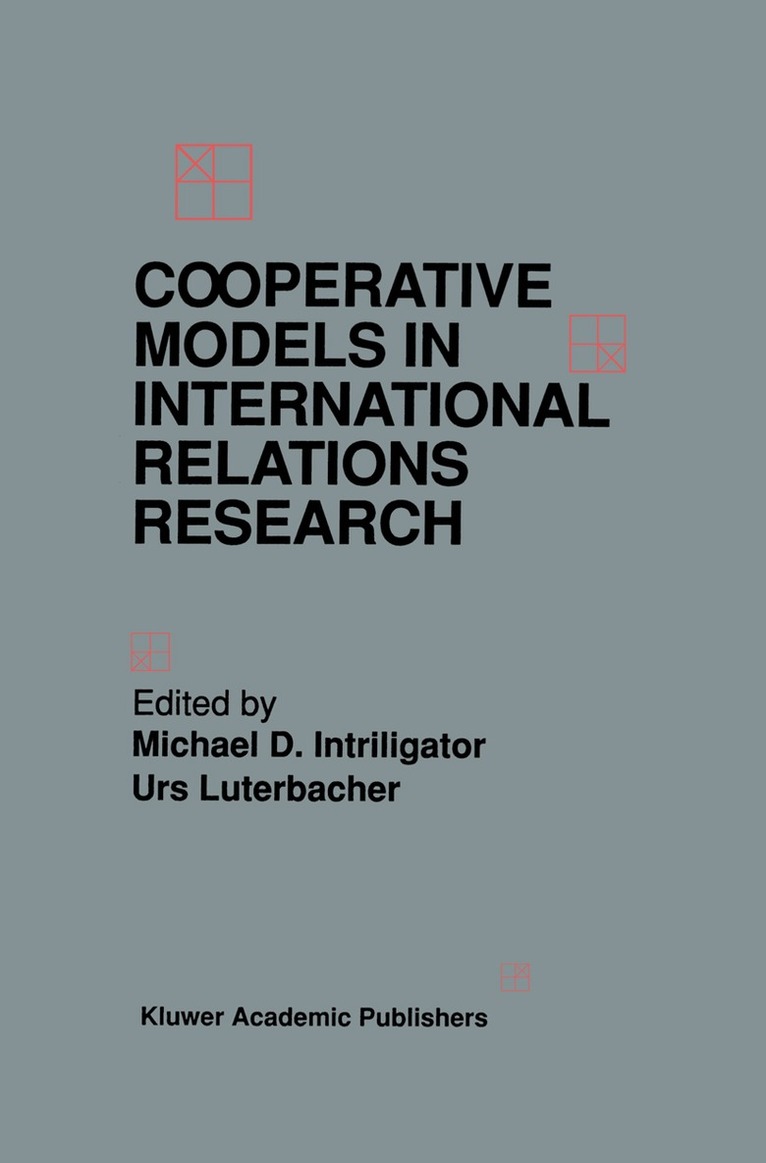
    Cooperative Models in International Relations Research

    AvMichael D. Intriligator,Urs Luterbacher

    Häftad, Engelska, 2012

    1 625 kr

    Beställningsvara. Skickas inom 10-15 vardagar. Fri frakt över 249 kr.

    Beskrivning

    Cooperative Models in International Relations Michael D. Intriligator and Urs Luterbacher Cooperation problems in international relations research have been asso­ ciated with a variety of approaches. Game theoretical and rational-choice perspectives have been used extensively to analyze international conflict at a bilateral two-actor level. Problems of deterrence and conflict escalation and deterrence maintaining and conflict dilemma-solving strategies have been studied with a variety ofgame theoretical constructs. These range from two­ by-two games in normal form (Axelrod, 1984) to sequential games. It is obvi­ ous that the analysis of conflict-solving strategies and metastrategies deals implicitly and some times explicitly with cooperation. ! The emphasis on cooperation-promoting strategies plays therefore an important role within rational-choice analysis of two-actor problems. However, problems ofinternational cooperation have also been tradition­ ally associated with literary and qualitative approaches. This is especially true for studies carried out at a multilateral or systemic level ofanalysis. The association between cooperation problems at the international level and the study of international organizations influenced by the international legal tradition have certainly contributed to this state of affairs. The concept of international regime ofcooperation (Krasner, 1983), which derives itselffrom legal studies, has been developed entirely within the context of this literary 1 2 COOPERATIVE MODELS IN INTERNATIONAL RELATIONS RESEARCH conception. However, as such studies evolved, various authors tended to use more formal constructs to justify their conclusions and to refine their analy­ ses.

    Produktinformation

    • Utgivningsdatum:2012-10-21
    • Mått:155 x 235 x 22 mm
    • Vikt:604 g
    • Format:Häftad
    • Språk:Engelska
    • Antal sidor:385
    • Förlag:Springer-Verlag New York Inc.
    • ISBN:9781461362067

    Utforska kategorier

    • Samhälle och kultur inom Samhälle och politik
    • Ledarskap och motivation inom Ekonomi och Ledarskap
    • Sociologi inom Samhälle och politik

    Innehållsförteckning

    • Cooperative Models in International Relations Research.- I Game Theory and Cooperation: General Aspects.- 1 Sources in Game Theory for International Relations Specialists.- 2 On Coalition Games.- 3 From Conflict to Cooperation in the Study of International Security.- 4 A Theory of Cooperation in the Triad.- II Game Theory and Cooperation: Specific Applications.- 5 International Cooperation Among Relative-Gains Maximizers.- 6 The Problem of Absolute and Relative Gains in International Relations Theory.- 7 Implementation Through Sequential Unanimity Games.- III Deterrence.- 8 Rational Deterrence in an Imperfect World.- 9 A Question of Procedure at the Vienna Arms Talks.- IV Escalation and Crises.- 10 Limited Nuclear Options and the Dynamics of Escalation.- 11 Signaling Difficulties with Linkage in Crisis Bargaining.- 12 Are Crises Rational? A Game-Theoretic Analysis.- V Other Approaches to Modeling International Cooperation.- 13 The Origin of Games: A Theory of the Formation of Ordinal Preferences and Games.- 14 An Economic Analysis of Cooperation in the European Community.- 15 Labor Relations in International Comparison, or Why Humans (and Nations) Sometimes Cooperate and Sometimes Don’t.