Häftad, Engelska, 2012
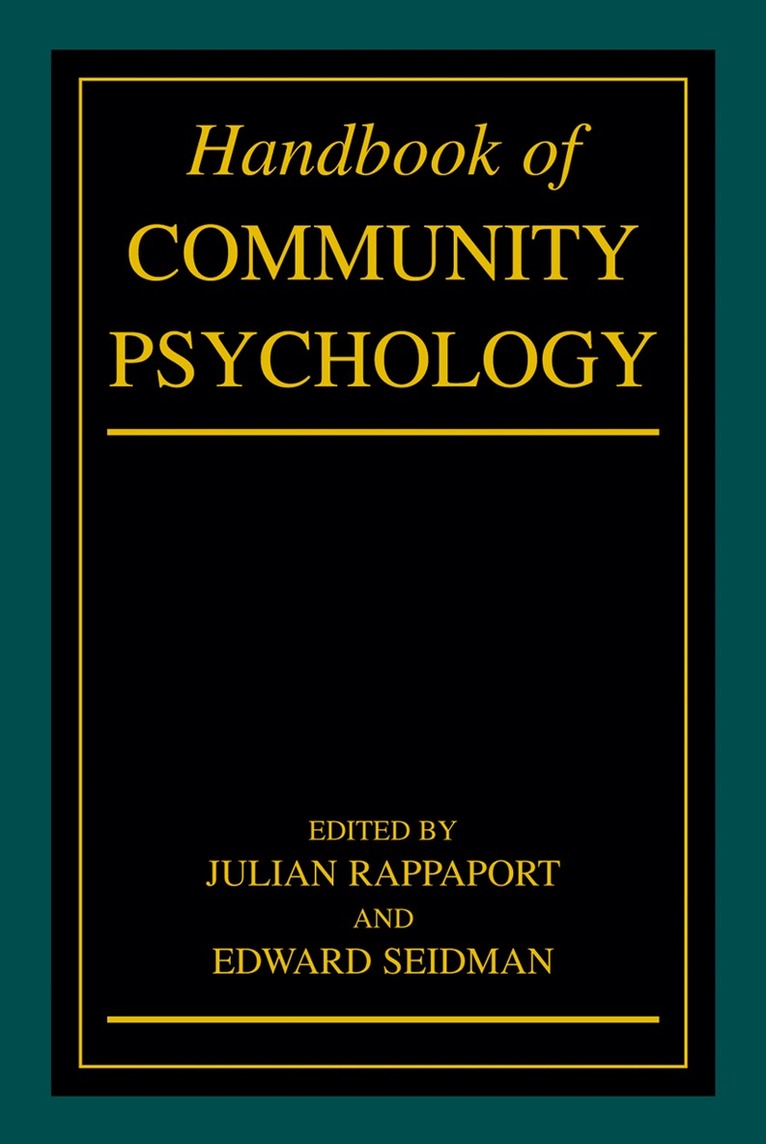
Handbook of Community Psychology
Av Julian Rappaport, Edward Seidman
6172 kr
Beställningsvara. Skickas inom 10-15 vardagar. Fri frakt över 249 kr.
Beskrivning
As a field progresses, people write about their own work in journals, chapters, and books; but periodically the work needs to be collected and organized. It needs to be brought together in a format that can both introduce new members to the field and reacquaint continuing members with the work of their colleagues. Such a collection also affords an opportunity for the growing number of people with particular expertise to provide a reference for others whose work is related, but differs in focus. This is the first Handbook of Community Psychology. It contains contributions from 106 different authors, in addition to our editorial introductions. Its thirty-eight chapters (including two that are divided into multiple, individually authored parts) are concerned with conceptual frameworks, empirically grounded constructs, intervention strategies and tactics, social sys tems, design, assessment and analysis, cross-cutting professional issues, and contemporary intersections with community psychology. Although interrelated, each chapter stands on its own as a statement about a particular part of the field, and the volume can serve as a reference for those who may want to explore an area about which they are not yet familiar. To some extent community psychologists eschew the distinction between researcher and practitioner; and regardless of one's primary work environment (university, small college, practice setting, government, or grassroots organiza tion), there is something of interest for anyone who wants to explore the community psychol ogy approach.
Produktinformation
- Utgivningsdatum: 2012-11-06
- Mått: 178 x 254 x 58 mm
- Vikt: 1 978 g
- Format: Häftad
- Språk: Engelska
- Antal sidor: 1 011
- Förlag: Springer-Verlag New York Inc.
- ISBN: 9781461368816
Utforska kategorier
Betyg & recensioner
0 recensioner
Inga recensioner tillgängliga.