• Fri frakt över 249 kr
  • •
  • Snabba leveranser
  • •
  • Billiga böcker
Kundservice

Du är på sajten för privatpersoner.

Företag, bibliotek eller offentlig verksamhet?

Du handlar på classic.bokus.com, där alla dina funktioner finns intakta.
Till classic.bokus.com
Bokus logotyp. Gå till startsidan.
  • Erbjudanden
  • Nyheter
  • Student
  • Topplistor
  • Barn & ungdom
  • Bokus Play
  • E-böcker
  • Pocketböcker
  • Spel & pussel

10% rabatt på allt med kod: NYSTART10 →

Sidfot

Mina sidor

    Hjälp

    • Kundservice
    • Vanliga frågor och svar
    • Frakt och leverans
    • Retur vid ångerrätt
    • Reklamera vara
    • Betalning
    • Köpvillkor
    • Allmänna villkor
    • Information om webbplatsens tillgänglighet

    Om Bokus

    • Om oss
    • Pressrum
    • För studenter
    • För företag
    • För bibliotek och offentlig verksamhet
    • För leverantörer
    • Hållbarhet

    Populärt

    • Aktuella erbjudanden
    • Presentkort
    • Studentlitteratur
    • Nya böcker
    • Topplistor
    • Signerade böcker
    • Engelska böcker

    Inspiration

    • Boktips
    • BookTok
    • Populära bokserier
    • Barnbokskaraktärer
    • Populära författare
    Logotyp för Bokus
    Följ oss på Facebook (extern länk)Följ oss på Instagram (extern länk)Följ oss på YouTube (extern länk)Följ oss på TikTok (extern länk)
    bokus @ CookiesAnpassa cookiesIntegritetspolicyKöpvillkor
    Till Citymail hemsida (extern länk)Till Budbee hemsida (extern länk)Till Postnord hemsida (extern länk)Till Schenker hemsida (extern länk)Till Early Bird hemsida (extern länk)Till Walleys hemsida (extern länk)
    1. Naturvetenskap och teknik
    2. Teknik och industri
    3. Byggnadsteknik

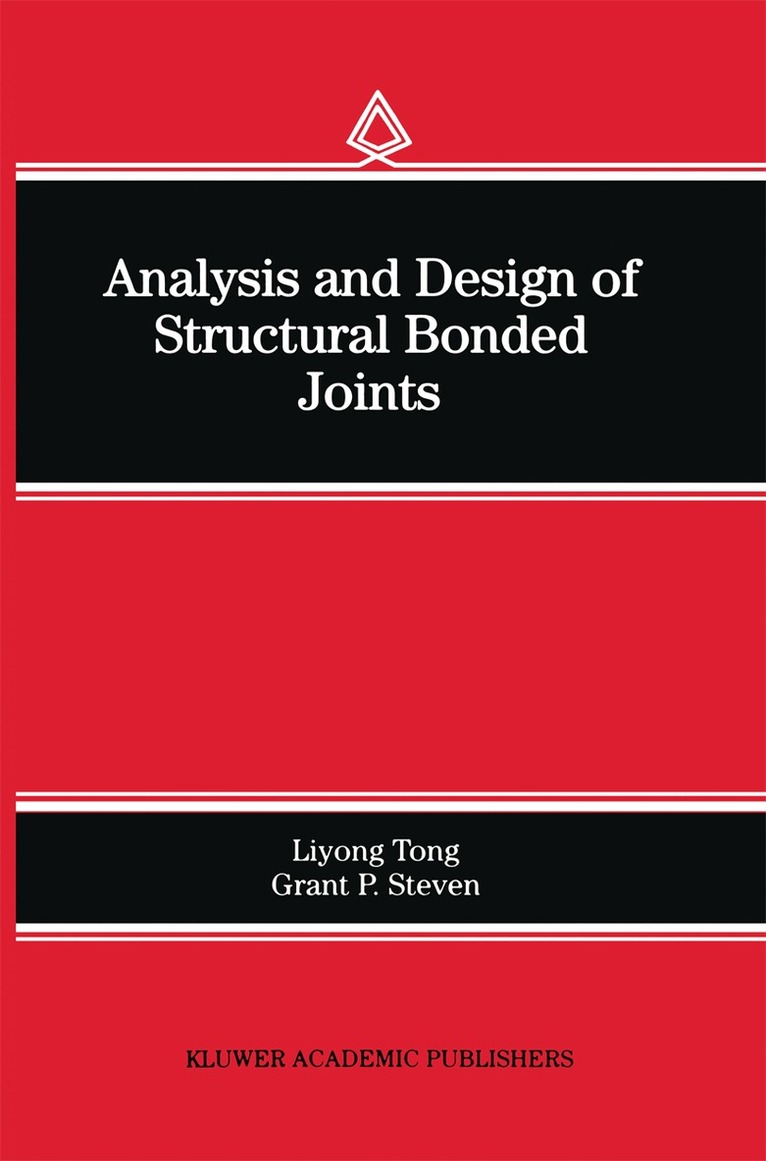
    Analysis and Design of Structural Bonded Joints

    AvLiyong Tong,Grant P. Steven

    Häftad, Engelska, 2014

    2 165 kr

    Beställningsvara. Skickas inom 10-15 vardagar. Fri frakt över 249 kr.

    Fler format och utgåvor

    Inbunden

    2 164 kr

    Beskrivning

    254 7. 2 AEROSPACE 261 7. 3 MARINE 265 7. 4 GROUND TRANSPORTATION 268 7. 5 CNIL 270 References 285 Index Preface Most structures consist of an assembly of a number of individual components that must be connected to form an integral load transmission path. These connections are often referred to as joints and can be achieved in a variety of forms, e. g. by bolting, riveting, or other forms of mechanical fastening, or by welding or brazing for connecting metallic elements, or by adhesive bonding. No matter what forms of connections are used in the structure, these joints are potentially the weakest points in the structure and the locations where a weight penalty may apply. Thus structural joints must be designed adequately to meet the specific design requirements. Adhesive bonding represents one of the most important enabling technologies for developing innovative design concepts and structural configurations as well as exploiting new materials. The evolution of adhesive bonding technology, and its current knowledge base, was made possibly by the explosive growth in the adhesive applications in a great variety of industries over the past few decades. While it is easy for everyone to identify examples of adhesive bonding in the world around us, analysis and design of structural bonded joints represent one of the most challenging jobs in structural design and manufacturing. Compared to other joining methods, particularly mechanical fastening, adhesive bonding can offer substantial performance and economic advantages.

    Produktinformation

    • Utgivningsdatum:2014-02-23
    • Mått:155 x 235 x 20 mm
    • Vikt:476 g
    • Format:Häftad
    • Språk:Engelska
    • Antal sidor:288
    • Förlag:Springer-Verlag New York Inc.
    • ISBN:9781461373360

    Utforska kategorier

    • Byggnadsteknik inom Naturvetenskap och teknik
    • Klassisk mekanik inom Naturvetenskap och teknik
    • Maskinteknik och material inom Naturvetenskap och teknik

    Innehållsförteckning

    • 1 Introduction.- 1.1 Background.- 1.2 Joint Classifications.- 1.3 Adhesive Characterisation.- 1.4 Fatigue and Durability.- 2 Stress Analysis Techniques.- 2.1 Introduction.- 2.2 Adhesive Properties.- 2.3 Analytical Analysis.- 2.4 Finite Element Analysis.- 2.5 Correlation of Analytical, Fea and Test Results.- 3 Failure Criteria and Strength Prediction.- 3.1 Introduction.- 3.2 Strength of Materials Criteria.- 3.3 Fracture Mechanics Criteria.- 3.4 Applications of Strength of Materials Criteria.- 3.5 Applications of Fracture Mechanics Criteria.- 3.6 Fatigue Strength Prediction.- 4 Damage Tolerance.- 4.1 Introduction.- 4.2 Effect of Debond or Voids in Adhesive.- 4.3 Effect of Damage in Adherends.- 4.4 Modeling of Single Lap Joints.- 4.5 An Analytical Model.- 4.6 Summary.- 5 Optimum Design.- 5.1 Introduction.- 5.2 1-D Linear Optimum Analysis.- 5.3 Methods of Structural Optimization.- 5.4 Research on Shape Optimization of Bonded Joints.- 5.5 Application of Shape Basis Vector Technique.- 5.6 Application of the Eso Method.- 6 Effect of Transverse Stitching.- 6.1 Introduction.- 6.2 Manufactruing.- 6.3 Single-Lap Joints — Experimental Results.- 6.4 Strength Prediction.- 6.5 Numerical Modeling and Angled Stitching.- 7 Selected Applications.- 7.1 Introduction.- 7.2 Aerospace.- 7.3 Marine.- 7.4 Ground Transportation.- 7.5 Civil.- References.