E-bok, Engelska, 2012
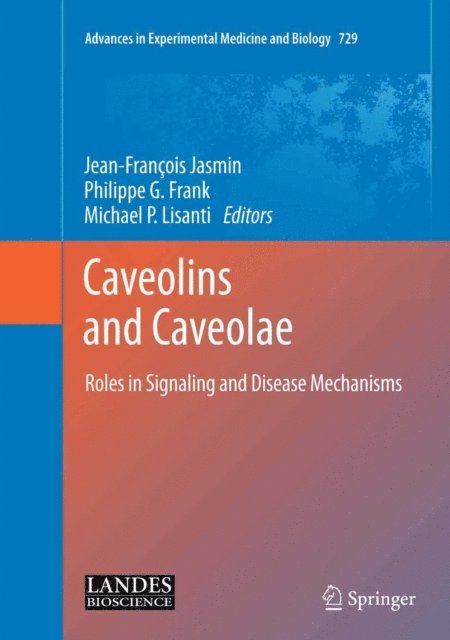
Caveolins and Caveolae
Av Michael P. Lisanti, Philippe Frank, Jean-Francois Jasmin
2127 kr
Skickas tisdag 13/10
Beskrivning
Caveolae are 50-100 nm flask-shaped invaginations of the plasma membrane that are primarily composed of cholesterol and sphingolipids. Using modern electron microscopy techniques, caveolae can be observed as omega-shaped invaginations of the plasma membrane, fully-invaginated caveolae, grape-like clusters of interconnected caveolae (caveosome), or as transcellular channels as a consequence of the fusion of individual caveolae. The caveolin gene family consists of three distinct members, namely Cav-1, Cav-2 and Cav-3. Cav-1 and Cav-2 proteins are usually co-expressed and particularly abundant in epithelial, endothelial, and smooth muscle cells as well as adipocytes and fibroblasts. On the other hand, the Cav-3 protein appears to be muscle-specific and is therefore only expressed in smooth, skeletal and cardiac muscles. Caveolin proteins form high molecular weight homo- and/or hetero-oligomers and assume an unusual topology with both their N- and C-terminal domains facing the cytoplasm.
Produktinformation
- Utgivningsdatum: 2012-03-12
- Format: E-bok
- Språk: Engelska
- Förlag: Springer New York
- ISBN: 9781461412229
Utforska kategorier
Betyg & recensioner
0 recensioner
Inga recensioner tillgängliga.