• Fri frakt över 249 kr
  • •
  • Snabba leveranser
  • •
  • Billiga böcker
Kundservice

Du är på sajten för privatpersoner.

Företag, bibliotek eller offentlig verksamhet?

Du handlar på classic.bokus.com, där alla dina funktioner finns intakta.
Till classic.bokus.com
Bokus logotyp. Gå till startsidan.
  • Erbjudanden
  • Nyheter
  • Student
  • Topplistor
  • Barn & ungdom
  • Bokus Play
  • E-böcker
  • Pocketböcker
  • Spel & pussel

10% rabatt på allt med kod: NYSTART10 →

Sidfot

Mina sidor

    Hjälp

    • Kundservice
    • Vanliga frågor och svar
    • Frakt och leverans
    • Retur vid ångerrätt
    • Reklamera vara
    • Betalning
    • Köpvillkor
    • Allmänna villkor
    • Information om webbplatsens tillgänglighet

    Om Bokus

    • Om oss
    • Pressrum
    • För studenter
    • För företag
    • För bibliotek och offentlig verksamhet
    • För leverantörer
    • Hållbarhet

    Populärt

    • Aktuella erbjudanden
    • Presentkort
    • Studentlitteratur
    • Nya böcker
    • Topplistor
    • Signerade böcker
    • Engelska böcker

    Inspiration

    • Boktips
    • BookTok
    • Populära bokserier
    • Barnbokskaraktärer
    • Populära författare
    Logotyp för Bokus
    Följ oss på Facebook (extern länk)Följ oss på Instagram (extern länk)Följ oss på YouTube (extern länk)Följ oss på TikTok (extern länk)
    bokus @ CookiesAnpassa cookiesIntegritetspolicyKöpvillkor
    Till Citymail hemsida (extern länk)Till Budbee hemsida (extern länk)Till Postnord hemsida (extern länk)Till Schenker hemsida (extern länk)Till Early Bird hemsida (extern länk)Till Walleys hemsida (extern länk)
    1. Ekonomi och Ledarskap
    2. Nationalekonomi
    3. Mikroekonomi

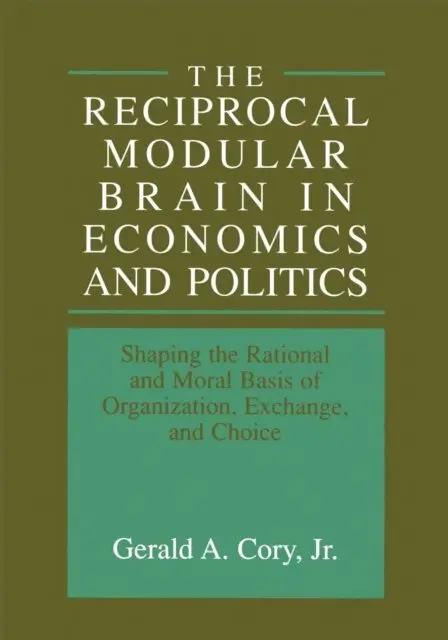
    Reciprocal Modular Brain in Economics and Politics

    Shaping the Rational and Moral Basis of Organization, Exchange, and Choice

    AvGerald A. Cory Jr.

    E-bok
    PDF, Engelska, 2012

    1 416 kr

    Läs direkt i Bokus Reader – eller ladda ned till din enhet (PDF kräver ofta zoom och scroll på små skärmar).

    Beskrivning

    The present work is an extension of my doctoral thesis done at Stanford in the early 1970s. In one clear sense it responds to the call for consilience by Edward O. Wilson. I agree with Wilson that there is a pressing need in the sciences today for the unification of the social with the natural sciences. I consider the present work to proceed from the perspective of behavioral ecology, specifically a subfield which I choose to call interpersonal behavioral ecology th Ecology, as a general field, has emerged in the last quarter of the 20 century as a major theme of concern as we have become increasingly aware that we must preserve the planet whose limited resources we share with all other earthly creatures. Interpersonal behavioral ecology, however, focuses not on the physical environment, but upon our social environment. It concerns our interpersonal behavioral interactions at all levels, from simple dyadic one-to-one personal interactions to our larger, even global, social, economic, and political interactions. Interpersonal behavioral ecology, as I see it, then, is concerned with our behavior toward each other, from the most obvious behaviors of war between nations, to excessive competition, exploitation, crime, abuse, and even to the ways in which we interact with each other as individuals in the family, in our social lives, in the workplace, and in the marketplace.

    Produktinformation

    • Utgivningsdatum:2012-12-06
    • Språk:Engelska
    • Filformat:PDF
    • Kopieringsskydd:LCP
    • ISBN:9781461547471
    • Förlag:Springer US

    Utforska kategorier

    • Mikroekonomi inom Ekonomi och Ledarskap
    • Biovetenskap inom Naturvetenskap och teknik