• Fri frakt över 249 kr
  • •
  • Snabba leveranser
  • •
  • Billiga böcker
Kundservice

Du är på sajten för privatpersoner.

Företag, bibliotek eller offentlig verksamhet?

Du handlar på classic.bokus.com, där alla dina funktioner finns intakta.
Till classic.bokus.com
Bokus logotyp. Gå till startsidan.
  • Erbjudanden
  • Nyheter
  • Student
  • Topplistor
  • Barn & ungdom
  • Bokus Play
  • E-böcker
  • Pocketböcker
  • Spel & pussel

10% rabatt på allt med kod NYSTART10 →

Sidfot

Mina sidor

    Hjälp

    • Kundservice
    • Vanliga frågor och svar
    • Frakt och leverans
    • Retur vid ångerrätt
    • Reklamera vara
    • Betalning
    • Köpvillkor
    • Allmänna villkor
    • Information om webbplatsens tillgänglighet

    Om Bokus

    • Om oss
    • Pressrum
    • För studenter
    • För företag
    • För bibliotek och offentlig verksamhet
    • För leverantörer
    • Hållbarhet

    Populärt

    • Aktuella erbjudanden
    • Presentkort
    • Studentlitteratur
    • Nya böcker
    • Topplistor
    • Signerade böcker
    • Engelska böcker

    Inspiration

    • Boktips
    • BookTok
    • Populära bokserier
    • Barnbokskaraktärer
    • Populära författare
    Logotyp för Bokus
    Följ oss på Facebook (extern länk)Följ oss på Instagram (extern länk)Följ oss på YouTube (extern länk)Följ oss på TikTok (extern länk)
    bokus @ CookiesAnpassa cookiesIntegritetspolicyKöpvillkor
    Till Citymail hemsida (extern länk)Till Budbee hemsida (extern länk)Till Postnord hemsida (extern länk)Till Schenker hemsida (extern länk)Till Early Bird hemsida (extern länk)Till Walleys hemsida (extern länk)
    1. Psykologi och pedagogik
    2. Psykologi
    3. Psykologiska teorier och skolor
    4. Freudiansk psykologi

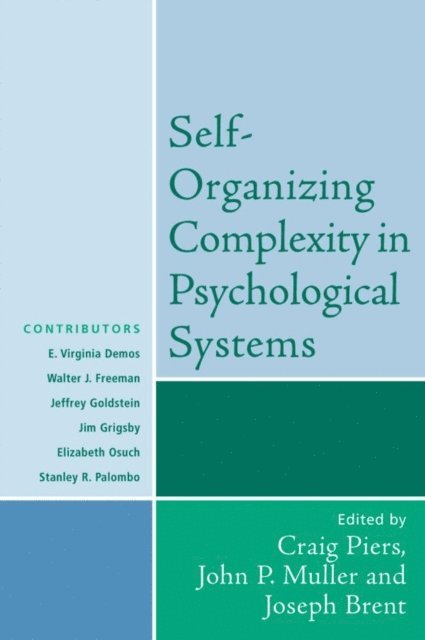
    Self-Organizing Complexity in Psychological Systems

    AvCraig Piers,John P. Muller

    E-bok
    Engelska, 2007

    Del i serien Psychological Issues

    807 kr

    Läs direkt i Bokus Reader – eller ladda ned till din enhet

    Beskrivning

    This volume addresses itself to the ways in which the so-called ''new sciences of complexity'' can deepen and broaden neurobiological and psychological theories of mind. Complexity theory has gained increasing attention over the past 20 years across diverse areas of inquiry, including mathematics, physics, economics, biology, and the social sciences. Complexity theory concerns itself with how nonlinear dynamical systems evolve and change over time and draws on research arising from chaos theory, self-organization, artificial intelligence and cellular automata, to name a few. This emerging discipline shows many points of convergence with psychological theory and practice, emphasizing that history is irreversible and discontinuous, that small early interventions can have large and unexpected later effects, that each life trajectory is unique yet patterned, that measurement error is not random and cannot be justifiably distributed equally across experimental conditions, that a system''s collective and coordinated organization is emergent and often arises from simple components in interaction, and that change is more likely to emerge under conditions of optimal turbulence.

    Produktinformation

    • Utgivningsdatum:2007-04-18
    • Språk:Engelska
    • Antal sidor:192
    • Filformat:EPUB
    • Kopieringsskydd:LCP
    • ISBN:9781461630654
    • Förlag:Bloomsbury Publishing Plc
    • Serie:Psychological Issues

    Utforska kategorier

    • Freudiansk psykologi inom Psykologi och pedagogik