• Fri frakt över 249 kr
  • •
  • Snabba leveranser
  • •
  • Billiga böcker
Kundservice

Du är på sajten för privatpersoner.

Företag, bibliotek eller offentlig verksamhet?

Du handlar på classic.bokus.com, där alla dina funktioner finns intakta.
Till classic.bokus.com
Bokus logotyp. Gå till startsidan.
  • Erbjudanden
  • Nyheter
  • Student
  • Topplistor
  • Barn & ungdom
  • Bokus Play
  • E-böcker
  • Pocketböcker
  • Spel & pussel

10% rabatt på allt med kod NYSTART10 →

Sidfot

Mina sidor

    Hjälp

    • Kundservice
    • Vanliga frågor och svar
    • Frakt och leverans
    • Retur vid ångerrätt
    • Reklamera vara
    • Betalning
    • Köpvillkor
    • Allmänna villkor
    • Information om webbplatsens tillgänglighet

    Om Bokus

    • Om oss
    • Pressrum
    • För studenter
    • För företag
    • För bibliotek och offentlig verksamhet
    • För leverantörer
    • Hållbarhet

    Populärt

    • Aktuella erbjudanden
    • Presentkort
    • Studentlitteratur
    • Nya böcker
    • Topplistor
    • Signerade böcker
    • Engelska böcker

    Inspiration

    • Boktips
    • BookTok
    • Populära bokserier
    • Barnbokskaraktärer
    • Populära författare
    Logotyp för Bokus
    Följ oss på Facebook (extern länk)Följ oss på Instagram (extern länk)Följ oss på YouTube (extern länk)Följ oss på TikTok (extern länk)
    bokus @ CookiesAnpassa cookiesIntegritetspolicyKöpvillkor
    Till Citymail hemsida (extern länk)Till Budbee hemsida (extern länk)Till Postnord hemsida (extern länk)Till Schenker hemsida (extern länk)Till Early Bird hemsida (extern länk)Till Walleys hemsida (extern länk)
    1. Naturvetenskap och teknik
    2. Matematik och naturvetenskap
    3. Matematik
    4. Matematisk statistik

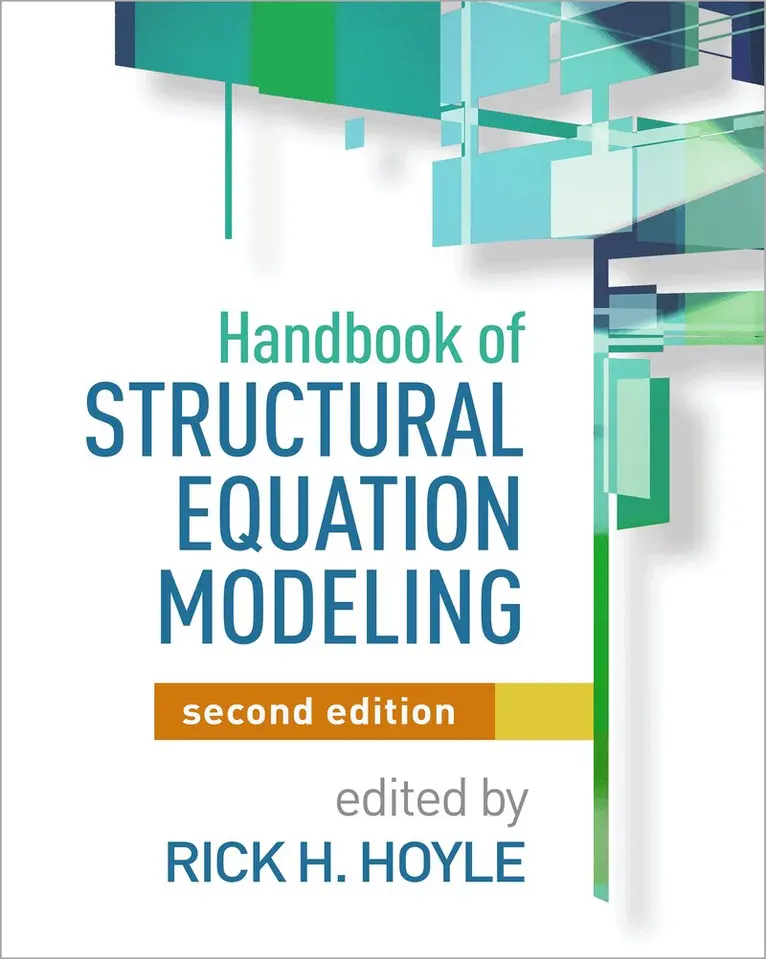
    Handbook of Structural Equation Modeling, Second Edition

    AvRick H. Hoyle

    Inbunden, Engelska, 2023

    1 609 kr

    Beställningsvara. Skickas inom 5-8 vardagar. Fri frakt över 249 kr.

    Beskrivning

    The definitive one-stop resource on structural equation modeling (SEM) from leading methodologists is now in a significantly revised second edition. Twenty-three new chapters cover model selection, bifactor models, item parceling, multitrait–multimethod models, exploratory SEM, mixture models, SEM with small samples, and more. The book moves from fundamental SEM topics (causality, visualization, assumptions, estimation, model fit, and managing missing data); to major model types focused on unobserved causes of covariance between observed variables; to more complex, specialized applications. Each chapter provides conceptually oriented descriptions, fully explicated analyses, and engaging examples that reveal modeling possibilities for use with the reader's data. The expanded companion website presents full data sets, code, and output for many of the chapters, as well as bonus selected chapters from the prior edition.New to This Edition*Chapters on additional topics not mentioned above: SEM-based meta-analysis, dynamic SEM, machine-learning approaches, and more.*Chapters include computer code associated with example analyses (in Mplus and/or the R package lavaan), along with written descriptions of results.*60% new material reflects a decade's worth of developments in the mechanics and application of SEM.*Many new contributors and fully rewritten chapters.

    Produktinformation

    • Utgivningsdatum:2023-03-31
    • Mått:244 x 194 x 43 mm
    • Vikt:1 440 g
    • Format:Inbunden
    • Språk:Engelska
    • Antal sidor:785
    • Upplaga:2
    • Förlag:Guilford Publications
    • ISBN:9781462544646

    Utforska kategorier

    • Matematisk statistik inom Naturvetenskap och teknik

    Mer om författaren

    Rick H. Hoyle, PhD, is Professor of Psychology and Neuroscience and Director of the Center for the Study of Adolescent Risk and Resilience at Duke University. He is a Fellow of the Association for Psychological Science, the American Psychological Association (Divisions 1, 5, 8, and 9), and the Society for Experimental Social Psychology. Dr. Hoyle has written extensively on structural equation modeling and other statistical and methodological strategies for the study of complex social and behavioral processes.

    Recensioner i media

    "A tremendous resource that will be of great value to researchers and students who study SEM and apply it in their research. SEM statistical models and methods have continued to be developed over the past decade; the second edition of this volume incorporates these developments along with coverage of new estimation algorithms, computer programs, and empirical applications. The Handbookcould be used in graduate courses--students could be introduced to its basic chapters for contemporary articulations of SEM models and methods, and to subsequent chapters for specialized models and applications."--Kenneth C. Land, PhD, John Franklin Crowell Professor Emeritus of Sociology and Demography and Research Professor, Social Science Research Institute, Duke University"The world of SEM--in terms of both applications and methodological advances--has expanded dramatically in recent years. Just learning SEM in the first place can be hard enough, let alone keeping up with all of the new developments. The second edition of this handbook is an invaluable resource for anyone seeking a comprehensive summary of current possibilities and best practices using SEM. The authors are all leading experts who have tackled an exhaustive list of topics, with an eye toward accessibility for new learners, but without shying away from the material’s inherent complexity."--Lesa Hoffman, PhD, Department of Psychological and Quantitative Foundations, College of Education, University of Iowa"SEM provides unity to disparate analyses and facilitates model evaluation and modification in the everyday practice of uncountable researchers. This is an impressive, 'must-read' book for practitioners of SEM and those who want to apprehend the strength and usefulness of the SEM idea."--Albert Satorra, PhD, Emeritus Professor of Statistics, Universitat Pompeu Fabra, Barcelona, Spain“This handbook is an outstanding desk reference on a wide variety of advanced and foundational topics. I recommend it either for personal use or for a class with students with strong quantitative backgrounds. The second edition has excellent coverage of exciting developments regarding analysis of longitudinal data. The chapter authors are a 'who's who' of the field.”--Jeffrey S. Simons, PhD, Department of Psychology, University of South Dakota“I have always recommended this book for anyone interested in conducting or teaching SEM. The second edition continues to be my favorite comprehensive SEM reference book, with new chapters covering advanced topics.”--Dana Joseph, PhD, College of Business Administration, University of Central Florida-The breadth of topics covered in this reference text leaves little doubt that a firm grasp of data analysis with latent variables is essential to the advancement of scholarship in the social and behavioral sciences....An excellent resource for the many conceptual and analytical problems frequently encountered by researchers making use of SEM….Readers will find themselves returning to the Handbook again and again as a starting point for their work on virtually any topic currently within the broad reach of SEM. (on the first edition)--Structural Equation Modeling, 4/1/2013

    Innehållsförteckning

    • I. Foundations1. Structural Equation Modeling: An Overview, Rick H. Hoyle2. A Brief History of Structural Equation Modeling, Ross L. Matsueda3. The Causal Foundations of Structural Equation Modeling, Judea Pearl4. Visualizations for Structural Equation Modeling, Jolynn Pek, Erin K. Davisson, & Rick H. Hoyle5. Latent Variables in Structural Equation Modeling, Kenneth A. Bollen & Rick H. Hoyle6. Simulation Methods in Structural Equation Modeling, Walter L. Leite, Deborah L. Bandalos, & Zuchao Shen7. Assumptions in Structural Equation Modeling, Rex B. Kline8. On the Estimation of Structural Equation Models with Latent Variables, Yunxiao Chen, Irini Moustaki, & Siliang Zhang9. Power Analysis within a Structural Equation Modeling Framework, Yi Feng & Gregory R. Hancock10. Model Fit in Structural Equation Modeling, Stephen G. West, Wei Wu, Daniel McNeish, & Andrea Savord11. Model Selection in Structural Equation Modeling, Kristopher J. Preacher & Haley E. Yaremych12. Fitting Structural Equation Models with Missing Data, Craig K. Enders13. Structural Equation Modeling with the Mplus and lavaan Programs, Christian GeiserII. Basic Models and Applications14. Confirmatory Factor Analysis, Timothy A. Brown15. Confirmatory Measurement Models for Dichotomous and Ordered Polytomous Indicators, Natalie A. Koziol16. Item Parceling in SEM: A Researcher Degree-of-Freedom Ripe for Opportunistic Use, Sonya K. Sterba & Jason D. Rights17. Using Factor Scores in Structural Equation Modeling, Ines Devlieger & Yves Rosseel18. Bifactor Measurement Models, Steven P. Reise, Maxwell Mansolf, & Mark G. Haviland19. Multitrait-Multimethod Models, Michael Eid, Tobias Koch, & Christian Geiser20. Investigating Measurement Invariance Using Confirmatory Factor Analysis, Keith F. Widaman & Margarita Olivera-Aguilar21. Flexible Structural Equation Modeling Approaches for Analyzing Means, Marilyn S. Thompson, Yixing Liu, & Samuel B. Green22. Mediation/Indirect Effects in Structural Equation Modeling, Oscar Gonzalez, Matthew J. Valente, Jeewon Cheong, & David P. MacKinnon23. Latent Interaction Effects, Augustin Kelava & Holger Brandt24. Dynamic Moderation with Latent Interactions: General Cross-lagged Panel Models with Interaction Effects Over Time, Michael J. Zyphur & Ozlem Ozkok25. Psychometric Scale Evaluation Using Structural Equation Modeling and Latent Variable Modeling, Tenko Raykov26. Multilevel Structural Equation Modeling, Ronald H. Heck & Tingting ReidIII. Specialized and Advanced Models and Applications27. Exploratory Structural Equation Modeling, Alexandre J. S. Morin28. Structural Equation Modeling with Small Samples and Many Variables, Katerina M. Marcoulides, Ke-Hai Yuan, & Lifang Deng29. Mixture Models, Douglas Steinley30. Latent Curve Modeling of Longitudinal Growth Data, Kevin J. Grimm & John J. McArdle31. Dynamic Structural Equation Modeling as a Combination of Time Series Modeling, Multilevel Modeling, and Structural Equation Modeling, Ellen L. Hamaker, Tihomir Asparouhov, & Bengt Muthén32. Continuous-Time Dynamic Models: Connections to Structural Equation Models and Other Discrete-Time Models, Sy-Miin Chow, Diane Losardo, Jonathan Park, & Peter C. M. Molenaar33. Latent Trait-State Models, David A. Cole & Qimin Liu34. Longitudinal Models for Assessing Dynamics in Dyadic Data, Meng Chen, Hairong Song, & Emilio Ferrer35. Structural Equation Modeling in Genetics, Susanne Bruins, Sanja Franić, Conor V. Dolan, Denny Borsboom, & Dorret I. Boomsma36. Structural Equation Modeling (SEM)-Based Meta-Analysis, Mike W.-L. Cheung37. Nonlinear Structural Equation Models: Advanced Methods and Applications, Jeffrey R. Harring & Jinwang Zou38. Foundations and Extensions of Bayesian Structural Equation Modeling, Sarah Depaoli, David Kaplan, & Sonja D. Winter39. Machine Learning Approaches to Structural Equation Modeling, Andreas M. Brandmaier & Ross C. Jacobucci