• Fri frakt över 249 kr
  • •
  • Snabba leveranser
  • •
  • Billiga böcker
Kundservice

Du är på sajten för privatpersoner.

Företag, bibliotek eller offentlig verksamhet?

Du handlar på classic.bokus.com, där alla dina funktioner finns intakta.
Till classic.bokus.com
Bokus logotyp. Gå till startsidan.
  • Erbjudanden
  • Student
  • Topplistor
  • Barn & ungdom
  • Bokus Play
  • E-böcker
  • Ljudböcker
  • Pocketböcker
  • Spel och pussel

Skapa nya rutiner – hälsoböcker upp till 50% →

Sidfot

Mina sidor

    Hjälp

    • Kundservice
    • Vanliga frågor och svar
    • Frakt och leverans
    • Retur vid ångerrätt
    • Reklamera vara
    • Betalning
    • Köpvillkor
    • Allmänna villkor
    • Information om webbplatsens tillgänglighet

    Om Bokus

    • Om oss
    • Pressrum
    • För studenter
    • För företag
    • För bibliotek och offentlig verksamhet
    • För leverantörer
    • Hållbarhet

    Populärt

    • Aktuella erbjudanden
    • Presentkort
    • Studentlitteratur
    • Nya böcker
    • Topplistor
    • Signerade böcker
    • Engelska böcker

    Inspiration

    • Boktips
    • BookTok
    • Barnbokskaraktärer
    • Populära författare
    Logotyp för Bokus
    Följ oss på Facebook (extern länk)Följ oss på Instagram (extern länk)Följ oss på YouTube (extern länk)Följ oss på TikTok (extern länk)
    bokus @ CookiesAnpassa cookiesIntegritetspolicyKöpvillkor
    Till Citymail hemsida (extern länk)Till Budbee hemsida (extern länk)Till Postnord hemsida (extern länk)Till Schenker hemsida (extern länk)Till Early Bird hemsida (extern länk)Till Walleys hemsida (extern länk)
    1. Psykologi och pedagogik
    2. Psykologi
    3. Psykologisk metod

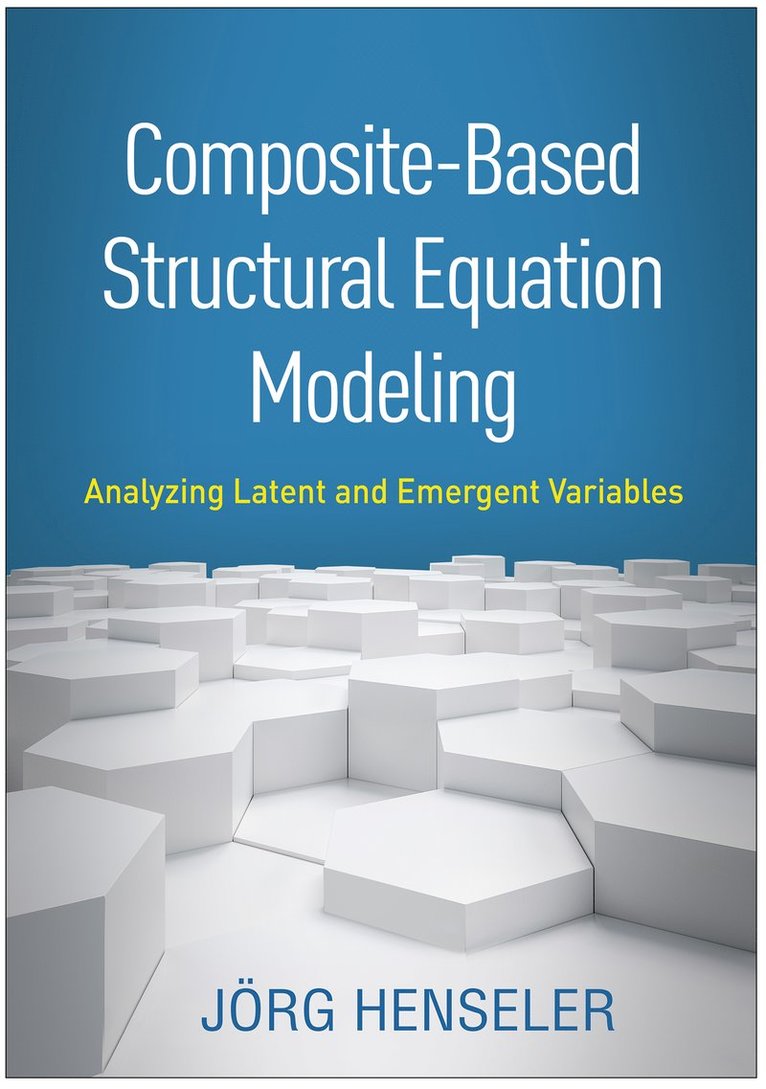
    Composite-Based Structural Equation Modeling

    Analyzing Latent and Emergent Variables

    AvJorg Henseler

    Inbunden, Engelska, 2021

    946 kr

    Beställningsvara. Skickas inom 5-8 vardagar. Fri frakt över 249 kr.

    Beskrivning

    This book presents powerful tools for integrating interrelated composites--such as capabilities, policies, treatments, indices, and systems--into structural equation modeling (SEM). Jörg Henseler introduces the types of research questions that can be addressed with composite-based SEM and explores the differences between composite- and factor-based SEM, variance- and covariance-based SEM, and emergent and latent variables. Using rich illustrations and walked-through data sets, the book covers how to specify, identify, estimate, and assess composite models using partial least squares path modeling, maximum likelihood, and other estimators, as well as how to interpret findings and report the results. Advanced topics include confirmatory composite analysis, mediation analysis, second-order constructs, interaction effects, and importance–performance analysis. Most chapters conclude with software tutorials for ADANCO and the R package cSEM. The companion website includes data files and syntax for the book's examples, along with presentation slides.

    Produktinformation

    • Utgivningsdatum:2021-02-12
    • Mått:178 x 254 x 24 mm
    • Vikt:820 g
    • Format:Inbunden
    • Språk:Engelska
    • Antal sidor:364
    • Förlag:Guilford Publications
    • ISBN:9781462545605

    Utforska kategorier

    • Psykologisk metod inom Psykologi och pedagogik

    Mer om författaren

    Jörg Henseler, PhD, is Full Professor and Chair of Product–Market Relations in the Faculty of Engineering Technology of the University of Twente in The Netherlands. He is also Visiting Professor at NOVA Information Management School, NOVA University of Lisbon, Portugal, and Distinguished Invited Professor in the Department of Business Administration and Marketing at the University of Seville, Spain. His broad-ranging research interests encompass empirical methods of marketing and design research as well as the management of design, products, services, and brands. A highly cited researcher, Dr. Henseler is a leading expert on partial least squares (PLS) path modeling, a composite-based structural equation modeling (SEM) technique that bridges design and behavioral research. He has written dozens of scholarly articles, edited or authored several books, served as guest editor for three special journal issues, and chaired conferences on PLS. He serves on several journal editorial boards and has been an invited speaker on SEM at universities around the world. Dr. Henseler chairs the scientific advisory board for the ADANCO software program and regularly provides seminars on PLS path modeling at the PLS School.

    Recensioner i media

    "This book offers a novel perspective on SEM in which constructs are viewed as composites rather than factors. Explaining the principles and rationales of composite-based SEM, the book provides examples and tutorials using the software ADANCO and the R package cSEM. It will make a great supplementary text for graduate-level courses on SEM, latent variable modeling, and multivariate analysis. It is written in such a way that both beginning doctoral students and experienced researchers can learn a lot from it. Students will get a fresh view of SEM and learn the SEM fundamentals; experienced researchers can use this book as an opportunity to elevate the discussion about SEM."--Ge Jiang, PhD, Department of Educational Psychology, University of Illinois at Urbana–Champaign"Henseler gives an excellent introduction to composite-based SEM, the third member of the SEM family that also includes covariance-based SEM, widely known among researchers in psychology and related fields, and Judea Pearl’s structural causal model, familiar to researchers in epidemiology and medicine. Methods in composite-based SEM offer researchers additional options for modeling, estimating, and testing hypotheses about latent variables, including emergent variables, or proxies for hypothetical constructs analyzed as linear combinations of observed variables. With clear descriptions, numerous examples, and coverage of advanced topics such as moderation, mediation, and importance–performance analysis, Henseler’s book is a great starting point for both students and established researchers seeking to expand their modeling repertoires."--Rex B. Kline, PhD, Department of Psychology, Concordia University, Canada"This extraordinary work on SEM to estimate composite models provides up-to-date explanations illustrated with a range of good examples. The book is 'ambidextrous' in the way it is both student-friendly and rigorous. It will surely make an impact on the SEM community. I plan to use this text in my master's- and doctoral-level SEM courses, as well as in my consulting activities with companies.”--Jose Benitez, PhD, Rennes School of Business, France; and School of Business and Economics, University of Granada, Spain-

    Innehållsförteckning

    • Preface1. Introduction1.1. The Nature of Structural Equation Modeling1.2. What is Composite-Based SEM?1.3. For Which Purpose Should One Use Composite-Based SEM?1.3.1. Using Composite-Based SEM for Confirmatory Research1.3.2. Using Composite-Based SEM for Explanatory Research1.3.3. Using Composite-Based SEM for Exploratory Research1.3.4. Using Composite-Based SEM for Descriptive Research1.3.5. Using Composite-Based SEM for Predictive Research1.3.6. When to Use Composite-Based SEM?1.4. Software Tutorial: Getting Started1.4.1. First Steps in ADANCO1.4.2. First Steps in cSEM2. Auxiliary Theories, with Florian Schuberth2.1. The Need for Auxiliary Theories2.2. Different Types of Science2.3. TheAuxiliaryTheory of Behavioral Science: MeasurementTheory2.4. The Auxiliary Theory of Design Science: Synthesis Theory3. Model Specification3.1. What Is A Structural Equation Model?3.2. The Outer Model3.2.1. Composite Models3.2.2. Reflective Measurement Models3.2.3. Causal-Formative Measurement Models3.2.4. Single-Indicator Measurement Models3.2.5. Categorical Variables3.3. The Inner Model3.4. Software Tutorial: Model Specification3.4.1. Specifying Structural Equation Models in ADANCO3.4.2. Specifying Structural Equation Models in cSEM4. Model Identification4.1. The Necessity of Identification4.2. Ensuring Model Identification in Composite-Based SEM4.3. Ensuring Empirical Identification in Composite-Based SEM4.4 ‘Chance Correlations’4.4.1. The Problem with ‘Chance Correlations’4.4.2. Avoiding ‘Chance Correlations’4.5. The Dominant Indicator Approach As a Solution to Sign Indeterminacy4.6. Identification Rules5. Model Estimation5.1. Composite-Based Estimators for Composite Models5.1.1. Stand-Alone Constructions: Sum Scores, Preset Weights, and Principal Components5.1.2. The Partial Least Squares Path Modeling Algorithm5.1.3. Generalized Structured Component Analysis5.2. Composite-Based Estimators for Reflective Models5.2.1. Consistent Partial Least Squares5.2.2. Sum Scores with Correction for Attenuation5.3. Fitting Functions5.4. Tutorial: Model Estimation5.4.1. Estimating Models Using ADANCO5.4.2. Estimating Models Using cSEM6. Global Model Assessment: Model Fit6.1. The Motivation for Model Fit6.2. Model Fit Tests6.2.1. Non-Parametric Model Fit Tests6.2.2. Parametric Model Fit Tests6.3. Model Fit Indices6.3.1. Standardized Root Mean Squared Residual (SRMR)6.3.2. Root Mean Square Residual Covariance (RMSθ)6.3.3. Fit Measures Provided by Covariance-based SEM6.4. What If Model Fit Is Low?6.5. Beware of Alleged Goodness of Fit Indices6.5.1. Four “Goodness of Fit Indices” That Are Not Model Fit Indices6.5.2. The Different Meanings of Fit6.6. Tutorial: Model Testing6.6.1. Using ADANCO for Model Testing6.6.2. Using cSEM for Model Testing7. Local Model Assessment7.1. The Need for Reliability and Validity7.2. Assessing Composite Models of Emergent Variables7.2.1. Nomological Validity7.2.2. The Reliability of Composites7.2.3. Weights7.3. Assessing Reflective Measurement Models of Latent Variables7.3.1. Construct Validity7.3.2. Unidimensionality7.3.3. Discriminant Validity7.3.4. Reliability of Construct Scores7.4. Assessing Causal-Formative Measurement Models7.5. Assessing Inner Models7.5.1. R2 and Adjusted R27.5.2. Inter-Construct Correlations7.5.3. Path Coefficients7.5.4. Indirect Effects7.5.5. Total Effects7.5.6. Effect Size (Cohen’s f 2)7.6. Inferential Statistics and the Bootstrap7.7. Construct Scores7.8. What If There Is No Output?7.9. Tutorial: Model Assessment7.9.1. Model Assessment Using ADANCO7.9.2. Model Assessment Using cSEM8. Confirmatory Composite Analysis, with Florian Schuberth8.1. Motivation8.2. Confirmatory Composite Analysis: Model Specification8.3. Confirmatory Composite Analysis: Model Identification8.4. Confirmatory Composite Analysis: Model Estimation8.5. Confirmatory Composite Analysis: Model Testing8.6. Tutorial: Confirmatory Composite Analysis8.6.1. Confirmatory Composite Analysis Using ADANCO8.6.2. Confirmatory Composite Analysis Using cSEM9. Mediation Analysis9.1. The Logic of Mediation9.2. Mediation Analysis Using Composite-based SEM9.3. Tutorial: Mediation Analysis9.3.1. Mediation Analysis Using ADANCO9.3.2. Mediation Analysis Using cSEM10. Second-Order Constructs10.1. A Typology of Second-Order Constructs and Their Use10.2. Modeling Type-I Second-Order Constructs: LatentVariablesMeasured by Latent Variables10.3. Modeling Type-II Second-Order Constructs: Emergent Variables Made of Latent Variables10.4. Modeling Type-III Second-Order Constructs: Latent Variables Measured by Emergent Variables10.5. Modeling Type-IV Second-Order Constructs: Emergent Variables Made of Emergent Variables10.6. Modeling Type-V Second-Order Constructs: Latent Variables Measured by Different Types of Variables10.7. Modeling Type-VI Second-Order Constructs: Emergent Variables Made of Different Types of Variables10.8. Tutorial: Second-Order Constructs10.8.1. Modeling Second-Order Constructs with ADANCO10.8.2. Modeling Second-Order Constructs with cSEM11. Analyzing Interaction Effects11.1. The Logic of Interaction Effects11.2. Estimating Interaction Effects with Composite-Based SEM11.2.1. Multigroup Analysis11.2.2. The Two-Stage Approach for Analyzing Interaction Effects11.2.3. The Orthogonalizing Approach for Analyzing Interaction Effects11.3. Visualizing Interaction Effects11.3.1. Surface Analysis11.3.2. Spotlight Analysis11.3.3. Floodlight Analysis11.4. Three-way Interactions11.5. Nonlinear Effects11.6. Tutorial: Interaction Effects11.6.1. Analyzing Interaction Effects Using ADANCO11.6.2. Analyzing Interaction Effects Using cSEM12. Importance–Performance Analysis12.1. Nature and Fields of Application12.2. A Step-by-Step Guide to Conducting IPA Using Composite-Based SEM12.3. Tutorial: Importance–Performance Analysis12.3.1. Using ADANCO for Importance–Performance Analysis12.3.2. Using cSEM for Importance–Performance AnalysisReferencesAuthor IndexSubject IndexAcronymsGlossaryAbout the AuthorDisclosure
    Hoppa över listan

    Mer från samma författare

    Huiwen Wang, Jorg Henseler, Wynne W. Chin, Vincenzo Esposito Vinzi - Handbook of Partial Least Squares, E-bok

    Handbook of Partial Least Squares

    Huiwen Wang, Jorg Henseler, Wynne W. Chin, Vincenzo Esposito Vinzi

    E-bok
    2010

    6 303 kr

    Jorg Henseler - Designing a Control for a Material Fatigue Testing Machine, E-bok

    Designing a Control for a Material Fatigue Testing Machine

    Jorg Henseler

    E-bok
    2002

    467 kr

    Jorg Henseler - Das Wechselverhalten von Konsumenten im Strommarkt, Häftad

    Das Wechselverhalten von Konsumenten im Strommarkt

    Jorg Henseler

    Häftad, 2006

    886 kr

    Jorg Henseler - Das Wechselverhalten von Konsumenten im Strommarkt, E-bok

    Das Wechselverhalten von Konsumenten im Strommarkt

    Jorg Henseler

    E-bok
    2008

    772 kr

    Hoppa över listan

    Du kanske också är intresserad av

    Jorg Henseler - Das Wechselverhalten von Konsumenten im Strommarkt, Häftad

    Das Wechselverhalten von Konsumenten im Strommarkt

    Jorg Henseler

    Häftad, 2006

    886 kr

    Huiwen Wang, Jorg Henseler, Wynne W. Chin, Vincenzo Esposito Vinzi - Handbook of Partial Least Squares, E-bok

    Handbook of Partial Least Squares

    Huiwen Wang, Jorg Henseler, Wynne W. Chin, Vincenzo Esposito Vinzi

    E-bok
    2010

    6 303 kr

    Jorg Henseler - Das Wechselverhalten von Konsumenten im Strommarkt, E-bok

    Das Wechselverhalten von Konsumenten im Strommarkt

    Jorg Henseler

    E-bok
    2008

    772 kr

    Jorg Henseler - Designing a Control for a Material Fatigue Testing Machine, E-bok

    Designing a Control for a Material Fatigue Testing Machine

    Jorg Henseler

    E-bok
    2002

    467 kr

    Helena von Zweigbergk - Huvud klart och hjärta varmt, Inbunden
    • -24%

    Huvud klart och hjärta varmt

    Helena von Zweigbergk

    Inbunden, 2026

    189 kr249 kr

    Kristan Higgins - Bokhandeln vid havet, Pocket
    • -51%

    Bokhandeln vid havet

    Kristan Higgins

    Pocket, 2025

    3,5 utav 5 stjärnor. Totalt antal röster:(11)

    49 kr99 kr

    Klara Ingemyr - SIGNERAD - Klaras husman, Kartonnage
    • Signerad!

    SIGNERAD - Klaras husman

    Klara Ingemyr

    Kartonnage, 2026

    269 kr

    Veronica Henry - Puben vid floden, Pocket
    • -51%

    Puben vid floden

    Veronica Henry

    Pocket, 2023

    4,2 utav 5 stjärnor. Totalt antal röster:(18)

    49 kr99 kr

    Frida Gråsjö - Vatten över huvudet, Pocket
    • -45%
    Del 1

    Vatten över huvudet

    Frida Gråsjö

    Pocket, 2024

    3,4 utav 5 stjärnor. Totalt antal röster:(26)

    49 kr89 kr

    Frida Gråsjö - Beska droppar, Pocket
    • -45%
    Del 2

    Beska droppar

    Frida Gråsjö

    Pocket, 2025

    3,9 utav 5 stjärnor. Totalt antal röster:(7)

    49 kr89 kr