• Fri frakt över 249 kr
  • •
  • Snabba leveranser
  • •
  • Billiga böcker
Kundservice

Du är på sajten för privatpersoner.

Företag, bibliotek eller offentlig verksamhet?

Du handlar på classic.bokus.com, där alla dina funktioner finns intakta.
Till classic.bokus.com
Bokus logotyp. Gå till startsidan.
  • Erbjudanden
  • Nyheter
  • Student
  • Topplistor
  • Barn & ungdom
  • Bokus Play
  • E-böcker
  • Pocketböcker
  • Spel & pussel

10% rabatt på allt med kod: NYSTART10 →

Sidfot

Mina sidor

    Hjälp

    • Kundservice
    • Vanliga frågor och svar
    • Frakt och leverans
    • Retur vid ångerrätt
    • Reklamera vara
    • Betalning
    • Köpvillkor
    • Allmänna villkor
    • Information om webbplatsens tillgänglighet

    Om Bokus

    • Om oss
    • Pressrum
    • För studenter
    • För företag
    • För bibliotek och offentlig verksamhet
    • För leverantörer
    • Hållbarhet

    Populärt

    • Aktuella erbjudanden
    • Presentkort
    • Studentlitteratur
    • Nya böcker
    • Topplistor
    • Signerade böcker
    • Engelska böcker

    Inspiration

    • Boktips
    • BookTok
    • Populära bokserier
    • Barnbokskaraktärer
    • Populära författare
    Logotyp för Bokus
    Följ oss på Facebook (extern länk)Följ oss på Instagram (extern länk)Följ oss på YouTube (extern länk)Följ oss på TikTok (extern länk)
    bokus @ CookiesAnpassa cookiesIntegritetspolicyKöpvillkor
    Till Citymail hemsida (extern länk)Till Budbee hemsida (extern länk)Till Postnord hemsida (extern länk)Till Schenker hemsida (extern länk)Till Early Bird hemsida (extern länk)Till Walleys hemsida (extern länk)
    1. Psykologi och pedagogik
    2. Pedagogik
    3. Pedagogisk metodik

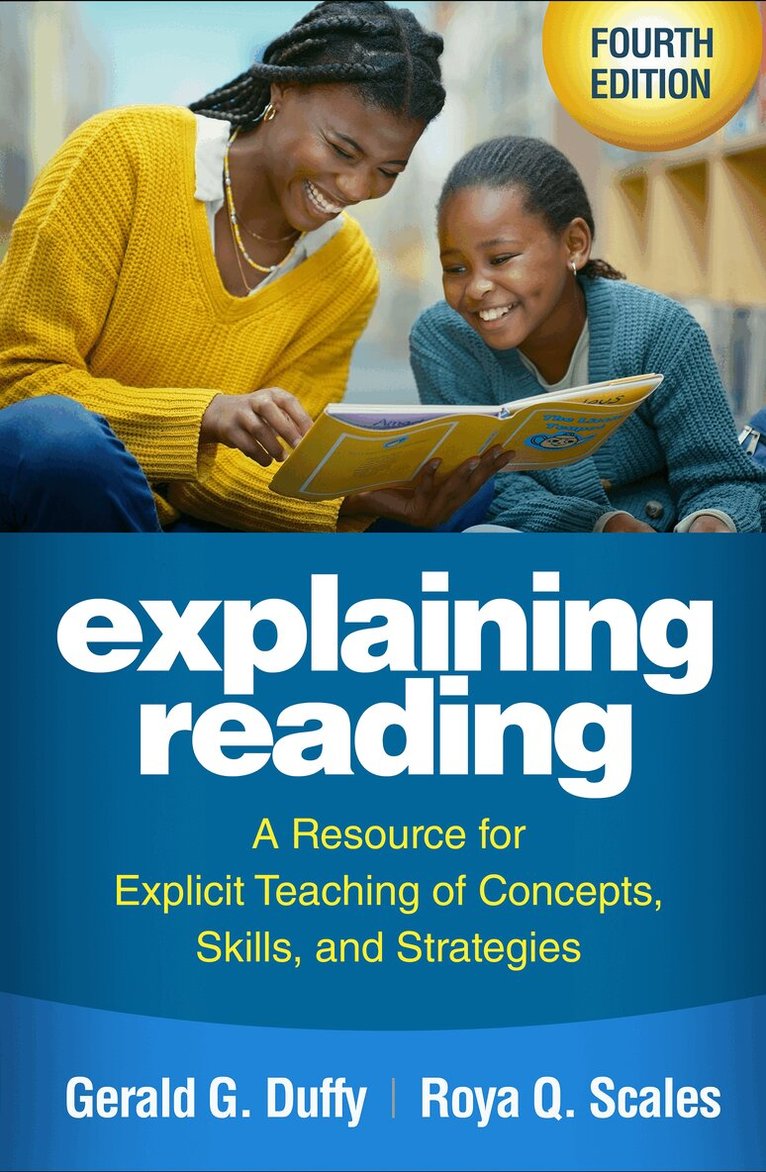
    Explaining Reading, Fourth Edition

    A Resource for Explicit Teaching of Concepts, Skills, and Strategies

    AvGerald G. Duffy,Roya Q. Scales

    Inbunden, Engelska, 2026

    689 kr

    Beställningsvara. Skickas inom 5-8 vardagar. Fri frakt över 249 kr.

    Fler format och utgåvor

    Häftad

    470 kr

    Beskrivning

    Now in a revised and updated fourth edition with 50% new material, this highly practical book guides teachers to demystify the reading process for K–8 students who are struggling. Thirty detailed lesson examples illustrate ways to explain and scaffold skills and strategies as an integral part of purposeful, motivating reading tasks. Teachers can use these examples as starting points for explicit instruction that meets their own students' particular needs. The book shows how to give students the secrets of understanding--and appreciating--both literature and informational texts. Numerous text boxes clarify key concepts and share adaptations for different grade levels.New to This EditionMany of the 30 examples are new or revised, and give increased attention to reading/n-/writing integration.Chapter on classroom experiences that promote reading for meaning.Chapter on organizing and managing differentiated instruction, including for English learners.New discussions of student motivation and agency.

    Produktinformation

    • Utgivningsdatum:2026-06-08
    • Mått:152 x 229 x 18 mm
    • Vikt:540 g
    • Format:Inbunden
    • Språk:Engelska
    • Antal sidor:256
    • Upplaga:4
    • Förlag:Guilford Publications
    • ISBN:9781462562619

    Utforska kategorier

    • Pedagogisk metodik inom Psykologi och pedagogik
    • Undervisning i specifika ämnen inom Psykologi och pedagogik

    Mer om författaren

    Gerald G. Duffy, EdD, is the former William E. Moran Distinguished Professor of Literacy and Reading at the University of North Carolina at Greensboro and Professor Emeritus at Michigan State University. Now retired and living in Bellingham, Washington, he was an elementary and middle school teacher, researcher, and teacher educator for over 50 years. His teaching and research focused on the explicit teaching of reading, on comprehension, and on the development of adaptive teachers. A past president of the Literacy Research Association and a member of the Reading Hall of Fame, Dr. Duffy has worked with teachers and children across the United States and internationally. He has written and edited several books on reading instruction and has published over 150 articles and research studies.Roya Q. Scales, PhD, is Professor of Literacy Education at Western Carolina University. An educator for more than 30 years (11 as a K–2 classroom teacher), she is noted for her research on thoughtfully adaptive teaching, enactment of teachers’ visions, literacy teacher education, and effective teaching of literacy. She is currently Editor of Reading and Writing Quarterly: Overcoming Learning Difficulties. Dr. Scales is the recipient of the 2022 Association of Literacy Educators and Researchers A. B. Herr Award for outstanding contributions to literacy education. With 50 peer-reviewed publications, she has coauthored several books on reading instruction and teachers’ professional development.

    Recensioner i media

    "Duffy and Scales have created a vital resource for teachers who want to teach reading concepts explicitly while aligning their instructional practices to support comprehension. The book guides teachers in the kind of thinking that expert teachers do, using concrete classroom examples. The fourth edition has a heightened focus on student agency and motivation. This book is essential reading for preservice, beginning, and veteran teachers, as well as for professional development providers who want to promote adaptive, visionary, and effective reading teachers."--Margaret Vaughn, PhD, College of Education, Washington State University"This book takes the 'secret' out of reading by showing how to teach comprehension skills and strategies through clear, step-by-step lessons. The 30 sample lessons model what teachers can say and do to guide students toward true understanding. Each lesson includes adaptations for different grade levels and subjects, making it practical and flexible. As an EL teacher, I value the focus on differentiation and supporting English learners."--Monica Kula, MA, Bilingual Teacher, Pennoyer School District #79, Norridge, Illinois"As a teacher of paraprofessionals earning education degrees, I often hear my students express that despite extensive experience in schools, they lack the confidence to try some of the teaching techniques we discuss in class. The fourth edition of Explaining Reading not only provides excellent content, but does so in a way that empowers educators to create authentic and explicit lessons that will foster students' motivation in their classrooms."--Joy Myers, PhD, Executive Director, Grow Your Own Initiatives, James Madison University-

    Innehållsförteckning

    • Foreword, Seth A. ParsonsPrefaceI. Introduction1. Focusing on Meaning2. How Comprehension and Word Identification Work3. How to Use Part II of This Book4. Tips for Managing Differentiated Instruction5. A Final Word: Teachers Make the DifferenceII. The Teaching ExamplesExamples for Comprehension Generally- Example 1. Word Meaning- Example 2. Using Context Clues to Determine Word Meaning- Example 3. Predicting- Example 4. Predicting, Monitoring, and Repredicting- Example 5. InferringExamples for Explaining Literature Strategies- Example 6. Reading for Key Details- Example 7. Theme- Example 8. Character Traits and Motivations- Example 9. Descriptive Words and Phrases- Example 10. Story Structure- Example 11. Point of View- Example 12. Compare–Contrast- Example 13. Illustrations and Text MeaningExamples for Explaining Informational Text Strategies- Example 14. Main Idea- Example 15. Text Features- Example 16. Text Structure- Example 17. Analyzing Positions and Views- Example 18. Evaluating- Example 19. Summarizing- Example 20. Drawing Conclusions- Example 21. SynthesizingExamples for Explaining Word Identification Skills- Example 22. Print Detail- Example 23. Sight-Word Recognition- Example 24. Phonological Awareness: Discriminating among Sounds- Example 25. Letter–Sound Association- Example 26. Vowel Patterns- Example 27. Syllabication- Example 28. Structural AnalysisExamples for Explaining Fluency- Example 29. Reading with Expression- Example 30. Quick Recognition of Easily Confused WordsAppendix: Research Foundations Supporting This BookIndex