• Fri frakt över 249 kr
  • •
  • Snabba leveranser
  • •
  • Billiga böcker
Kundservice

Du är på sajten för privatpersoner.

Företag, bibliotek eller offentlig verksamhet?

Du handlar på classic.bokus.com, där alla dina funktioner finns intakta.
Till classic.bokus.com
Bokus logotyp. Gå till startsidan.
  • Erbjudanden
  • Nyheter
  • Student
  • Topplistor
  • Barn & ungdom
  • Bokus Play
  • E-böcker
  • Pocketböcker
  • Spel & pussel

10% rabatt på allt med kod: NYSTART10 →

Sidfot

Mina sidor

    Hjälp

    • Kundservice
    • Vanliga frågor och svar
    • Frakt och leverans
    • Retur vid ångerrätt
    • Reklamera vara
    • Betalning
    • Köpvillkor
    • Allmänna villkor
    • Information om webbplatsens tillgänglighet

    Om Bokus

    • Om oss
    • Pressrum
    • För studenter
    • För företag
    • För bibliotek och offentlig verksamhet
    • För leverantörer
    • Hållbarhet

    Populärt

    • Aktuella erbjudanden
    • Presentkort
    • Studentlitteratur
    • Nya böcker
    • Topplistor
    • Signerade böcker
    • Engelska böcker

    Inspiration

    • Boktips
    • BookTok
    • Populära bokserier
    • Barnbokskaraktärer
    • Populära författare
    Logotyp för Bokus
    Följ oss på Facebook (extern länk)Följ oss på Instagram (extern länk)Följ oss på YouTube (extern länk)Följ oss på TikTok (extern länk)
    bokus @ CookiesAnpassa cookiesIntegritetspolicyKöpvillkor
    Till Citymail hemsida (extern länk)Till Budbee hemsida (extern länk)Till Postnord hemsida (extern länk)Till Schenker hemsida (extern länk)Till Early Bird hemsida (extern länk)Till Walleys hemsida (extern länk)
    1. Naturvetenskap och teknik
    2. Teknik och industri
    3. Maskinteknik och material

    Vision

    Human and Electronic

    AvAlbert Rose

    Häftad, Engelska, 2012

    Del i serien Optical Physics and Engineering

    1 302 kr

    Beställningsvara. Skickas inom 10-15 vardagar. Fri frakt över 249 kr.

    Fler format och utgåvor

    E-bok

    1 728 kr

    Beskrivning

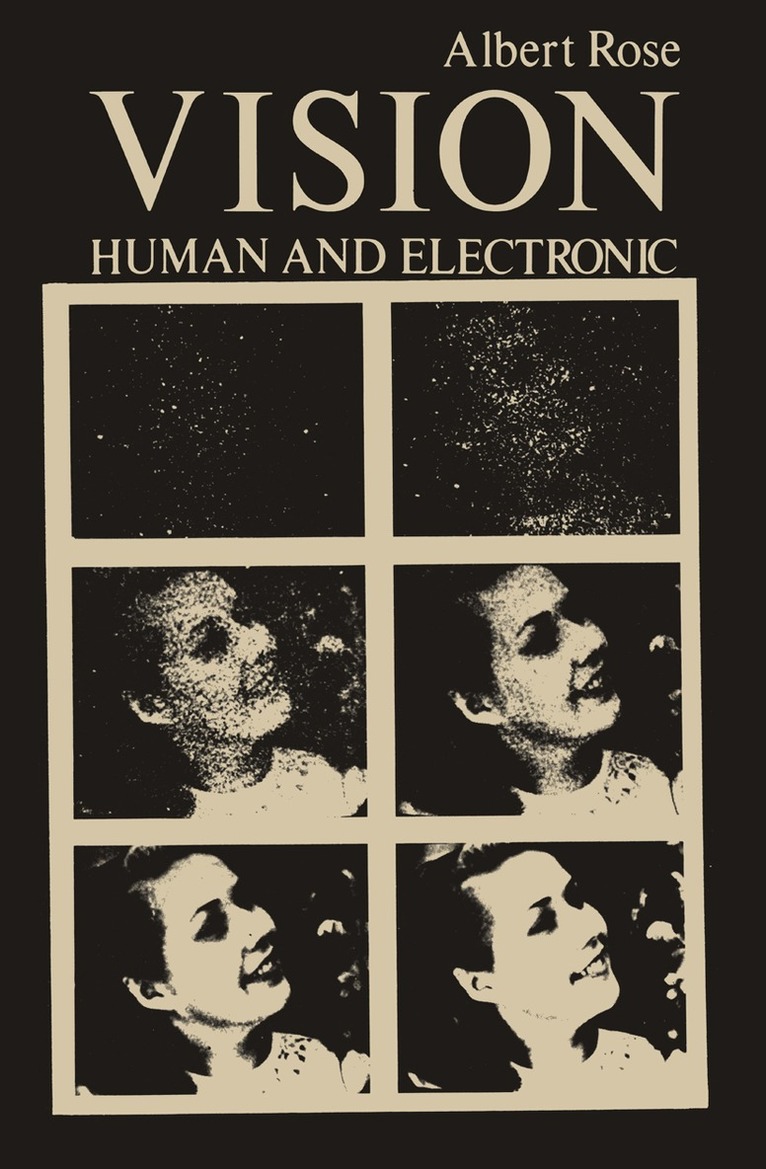
    The content of this monograph stems from the writer's early involvement with the design of a series of television camera tubes: the orthicon, the image orthicon and the vidicon. These tubes and their variations, have, at different times been the "eyes" of the television system almost from its inception in 1939. It was natural, during the course of this work, to have a parallel interest in the human visual system as well as in the silver halide photographic process. The problem facing the television system was the same as that facing the human visual and the photographic systems, namely, to abstract the maximum amount of information out of a limited quantity oflight. The human eye and photographic film both repre­ sented advanced states of development and both surpassed, in their performance, the early efforts on television camera tubes. It was particularly true and "plain to see" that each improvement and refinement of the television camera only served to accentuate the remarkable design of the human eye. A succession of radical advances in camera-tube sensitivity found the eye still operating at levels of illumination too low for the television camera tube. It is only recently that the television camera tube has finally matched and even somewhat exceeded the performance of the human eye at low light levels. It was also clear throughout the work on television camera tubes that the final goal of any visual system-biological, chemical, or electronic-was the ability to detect or count individual photons.

    Produktinformation

    • Utgivningsdatum:2012-11-25
    • Mått:152 x 229 x 12 mm
    • Vikt:321 g
    • Format:Häftad
    • Språk:Engelska
    • Serie:Optical Physics and Engineering
    • Antal sidor:197
    • Förlag:Springer-Verlag New York Inc.
    • ISBN:9781468420395

    Utforska kategorier

    • Maskinteknik och material inom Naturvetenskap och teknik

    Innehållsförteckning

    • 1 · The Visual Process.- 1.1. Introduction.- 1.2. Quantum Limitations on the Visual Process.- 1.3. A Summary Experiment.- 1.4. A Second Experiment.- 1.5. Resolution, Signal-to-Noise Ratio, and Test Patterns.- 1.6. An Absolute Scale of Performance.- 1.7. Geometric versus Noise Limitations to Performance.- 1.8. Beyond the Visible Spectrum.- 1.9. Summary.- 1.10. References.- 2 · Human Vision.- 2.1. Introduction.- 2.2. Optical Parameters.- 2.3. Performance Data.- 2.4. Quantum Efficiency of Human Vision.- 2.5. A Preferred Method for Measuring Quantum Efficiency.- 2.6. A Comparison of Estimates of Quantum Efficiency.- 2.7. Dark Adaptation.- 2.8. Automatic Gain Control.- 2.9. Visual Noise.- 2.10. Afterimages.- 2.11. Visibility of High-Energy Radiations.- 2.12. Vision and Evolution.- 2.13. Summary.- 2.14. References.- 3 · Television Camera Tubes.- 3.1. Introduction.- 3.2. Scanning Discs and Dissector Tubes.- 3.3. Iconoscope.- 3.4. Image Iconoscope.- 3.5. Orthicon.- 3.6. Image Orthicon.- 3.7. Image Isocon.- 3.8. Intensifier Image Orthicon.- 3.9. Bombardment-Induced Conductivity.- 3.10. Vidicons.- 3.11. Solid-State Self-Scanned Arrays.- 3.12. Summary.- 3.13. References.- 4 · Photographic Film.- 4.1. Introduction.- 4.2. Sensitivity and Signal-to-Noise Ratio.- 4.3. Resolution, Signal-to-Noise Ratio, and Effective Passband.- 4.4. Threshold Properties of Photographic Grains.- 4.5. Fog.- 4.6. High-Energy Radiations.- 4.7. Comparative Sensitivities of Film, Television Camera Tubes, and the Human Eye.- 4.8. Summary.- 4.9. References.- 5 · Comparative Noise Properties of Vision, Television, and Photographic Film.- 5.1. Statement of Problem.- 5.2. A Proper Measure of the Signal-to-Noise Ratio in a Television Picture.- 5.3. A Comparison of Arrangements for Noise Reduction.- 5.4.Effect of High Contrast on the Visibility of Noise.- 5.5. Noise in Dark Areas.- 5.6. Noise versus Brightness of Reproduced Pictures.- 5.7. Summary.- 5.8. References.- 6 · Image Multipliers.- 6.1. Introduction.- 6.2. Varieties of Image Multipliers.- 6.3. Typical Performance of a Three-Stage Image Multiplier.- 6.4. Summary.- 6.5. References.- 7 · Solid-State Photon Counters.- 7.1. Introduction.- 7.2. Noise Currents and Charges.- 7.3. Photoconductive Photon Counter.- 7.4. An Analysis of 1/f Noise.- 7.5. Photon Counting by MOS Triodes.- 7.6. Non-Photon-Counters.- 7.7. Summary.- 7.8. References.- 8 · Solid-State Photographic Systems, Light Amplifiers, and Display Systems.- 8.1. Introduction.- 8.2. Blocking Contacts.- 8.3. Sensitivity Aspects of Blocking Contacts.- 8.4. Ohmic Contacts.- 8.5. Sensitivity Aspects of Ohmic Contacts.- 8.6. Special Arrangements.- 8.7. Null Systems.- 8.8. Summary.- 8.9. References.- 9 · Solid-State Photomultipliers.- 9.1. Introduction.- 9.2. Multiplication in Semiconductors.- 9.3. Multiplication in Insulators.- 9.4. Rates of Energy Loss by Hot Electrons.- 9.5. Summary.- 9.6. References.- 10 · Vision: Past, Present, and Future.- 10.1. Introduction.- 10.2. Human Vision.- 10.3. Photographic Vision.- 10.4. Electronic Vision.- 10.5. The Need for High Quantum Efficiencies.- 10.6. Conclusion.- 10.7. References.