Optical Physics and Engineering – serie
Visar alla böcker i serien Optical Physics and Engineering. Handla med fri frakt och snabb leverans.
16 produkter
16 produkter
Inbunden, Engelska, 1975
2 153 kr
Skickas inom 10-15 vardagar
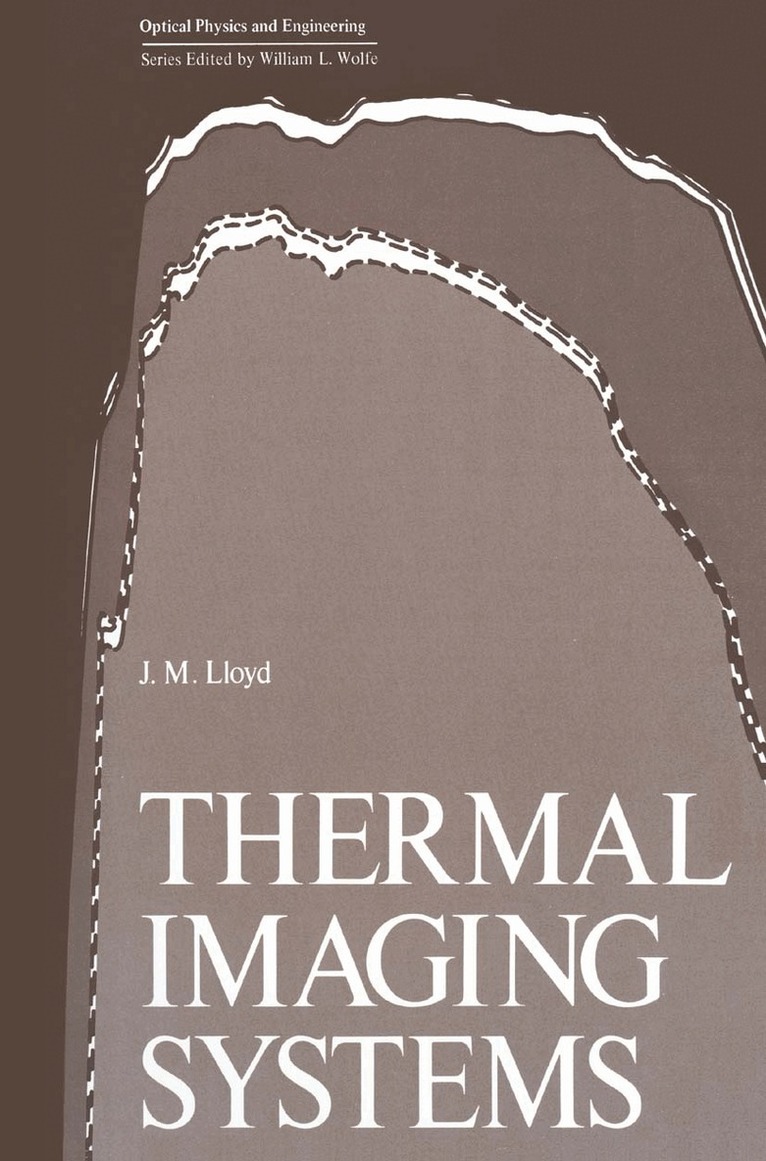
This book is intended to serve as an introduction to the technology of thermal imaging, and as a compendium of the conventions which form the basis of current FUR practice. Those topics in thermal imaging which are covered adequately elsewhere are not treated here, so there is no discussion of detectors, cryogenic coolers, circuit design, or video displays. Useful infor mation which is not readily available because of obscure publication is referenced as originating from personal communications. Virtually everyone with whom I have worked in the thermal imaging business has contributed to the book through the effects of conversations and ideas. I gratefully proffer blanket appreciation to all those who have helped in that way to make this book possible. The contributions of five people, however, bear special mention: Bob Sendall, Luke Biberman, Pete Laakmann, George Hopper, and Norm Stetson. They, more than any others, have positively influenced my thinking.
Häftad, Engelska, 2012
556 kr
Skickas inom 10-15 vardagar
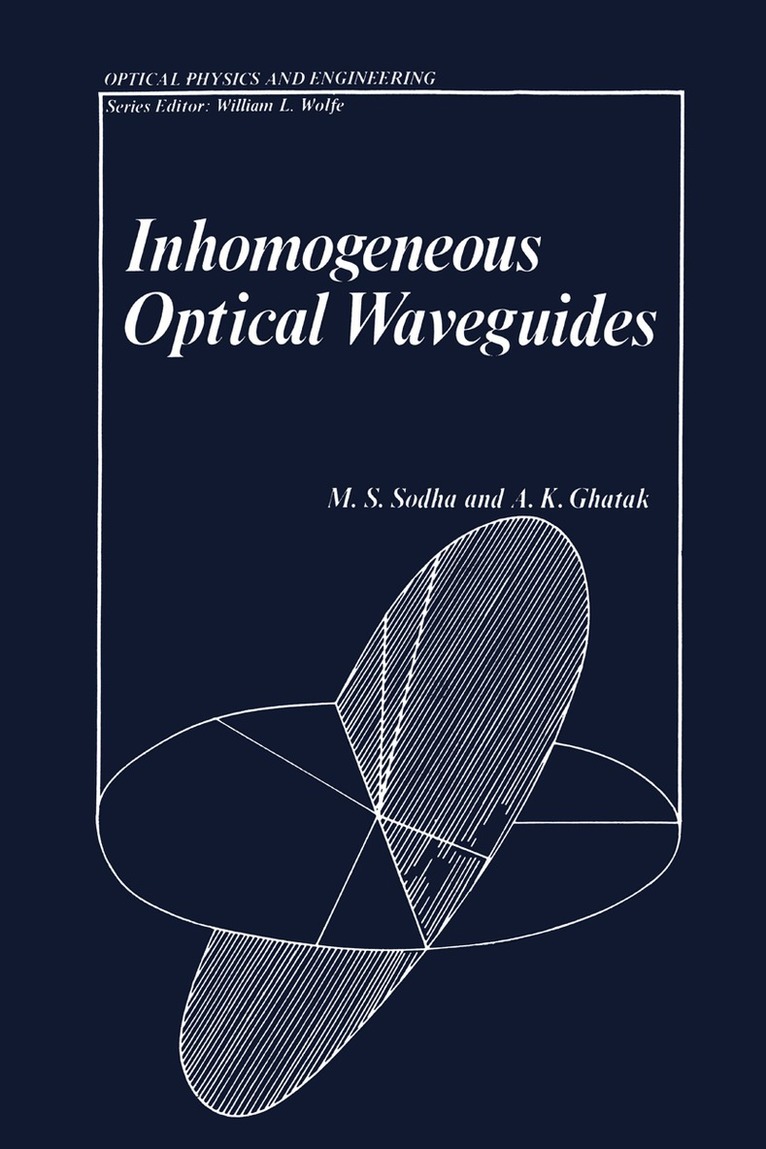
The propagation of electromagnetic waves in "square-law" media, i.e., media characterized by a quadratic spatial variation of the dielectric constant, has been a favorite subject of investigation in electromagnetic theory. However, with the recent fabrication of glass fibers with a quadratic radial variation of the dielectric constant and the application of such fibers to optical imaging and communications, this subject has also assumed practical importance. Comparison of experimental results on propagation, resolu tion, and pulse distortion in such inhomogeneous waveguides with theory has put the field on a sound base and spurred further work. The present book aims at presenting a unified view of important aspects of our knowledge of inhomogeneous optical waveguides. A brief discussion of homogeneous dielectric waveguides is unavoidable, since itforms a basis for the appreciation of inhomogeneous waveguides. A short course based on some chapters of this book was offered to graduate students at IIT Delhi and was well received. We consider that despite the unavoidable mathemati cal nature of the present book, the comparison of experimental results with theory throughout and the description of fabrication technology (Appen dixes A and B) should make its appeal universal. The authors are grateful to Dr. K. Thyagarajan for writing most of Chapter 9 and to their colleagues Dr. I. C. Goyal, Dr. B. P. Pal, and Dr. A.
Häftad, Engelska, 2012
1 104 kr
Skickas inom 10-15 vardagar
This book provides an account of modern aspects relating far infrared radiation to properties of solids; it encompasses both theoretical and experimental considerations. Written at the gradu ate level, it attempts a threefold purpose; an indication of the breadth of the subject, an in-depth examination of important areas, and reference material to complement a text for a course. The treatment and organization of material here is compatible with a preceding volume of this series on "Optical Properties of Solids." Chapters 1-6 present material concerned principally with experimental considerations necessary to the carrying out of meas urements in the far infrared spectral region. They also serve to provide considerable introductory material for the remaining chap ters which deal with various areas that offer theoretical treat ments utilizing and understanding far infrared properties of solids. Several lectures presented at the Institute could not be in cluded in this book for two reasons: (i) Final versions of the lecture notes suitable for publication never arrived from several lecturers; (ii) Some materials were deliberately left out fro~ this book as they were also presented at an earlier NATO Institute and form part of a preceding volume edited by us in this series. In particular, it is recommended that Chapters 14 and 15, viz., in frared and Raman spectra due to lattice vibrations by S. S. Mitra and impurity induced lattice absorption by L. Genzel in "Optical Properties of Solids'· be read concurrently with the present volume.
Häftad, Engelska, 2013
540 kr
Skickas inom 10-15 vardagar
During the decade there were many developments in laser research and numerous applications of the laser were made in fields of science and engineering. Many theoretical and experimental ad vances were made in the Soviet Union; often they paralleled those taking place in the United States and elsewhere but started from different points, proceeded along different paths, and yielded dif ferent insights into the physical processes taking place in the la ser. The present book offers a unified theory of lasers by which the operating characteristics of the laser are described and re lated to the details of the radiation emitted. Extensive emenda tions to the original, Soviet edition were supplied by the author and incorporated into the text, and references to the English literature were added to the translation to permit the reader to readily ex plore topics in greater detail. Since the Soviet edition's appearance in 1968 one very impor tant area has developed-that of mode locking and picosecond pulse production. This area is so important that no comprehensive work on the laser published in 1972 could neglect it. Accordingly, Chap ter XII was added to round off the treatment. I am indebted to my colleague, Professor A. J. Carruthers of the University of Min nesota for many illuminating discussions on mode locking.
Häftad, Engelska, 2012
532 kr
Skickas inom 10-15 vardagar
As this book took form, its contents furnished the material for a graduate course at the University of Rhode Island. Toward the end of that course, the class reviewed the literature on display characteristics and design. The universal criticism voiced in those reviews was that there was lots of hardware information but no criteria upon which one could base a sound design. Though one could learn all about the size and brightness of various displays, one could not form any judgment about how ef fectively the display transferred information to an observer. As I reviewed our nearly completed text, an announcement crossed my desk stating that one of the professional societies in a seminar was to consider if one should not attempt to formulate a theory concerning information transfer from displays to an observer. That was the first title chosen for our book, before our publisher told us that "that was a paragraph, not a title. " The group of contributors to this book have labored long in the conviction that there was a real need to develop and present a consolidated theory based upon the work of a number of pioneers, including Barnes and Czerny, de Vries, Rose, Coltman and Anderson, Schade, Johnson, van Meeteren, and others, who established the various parts of a substantial theoretical and experimental back ground that seemed ripe for consolidation.
Häftad, Engelska, 2012
1 285 kr
Skickas inom 10-15 vardagar
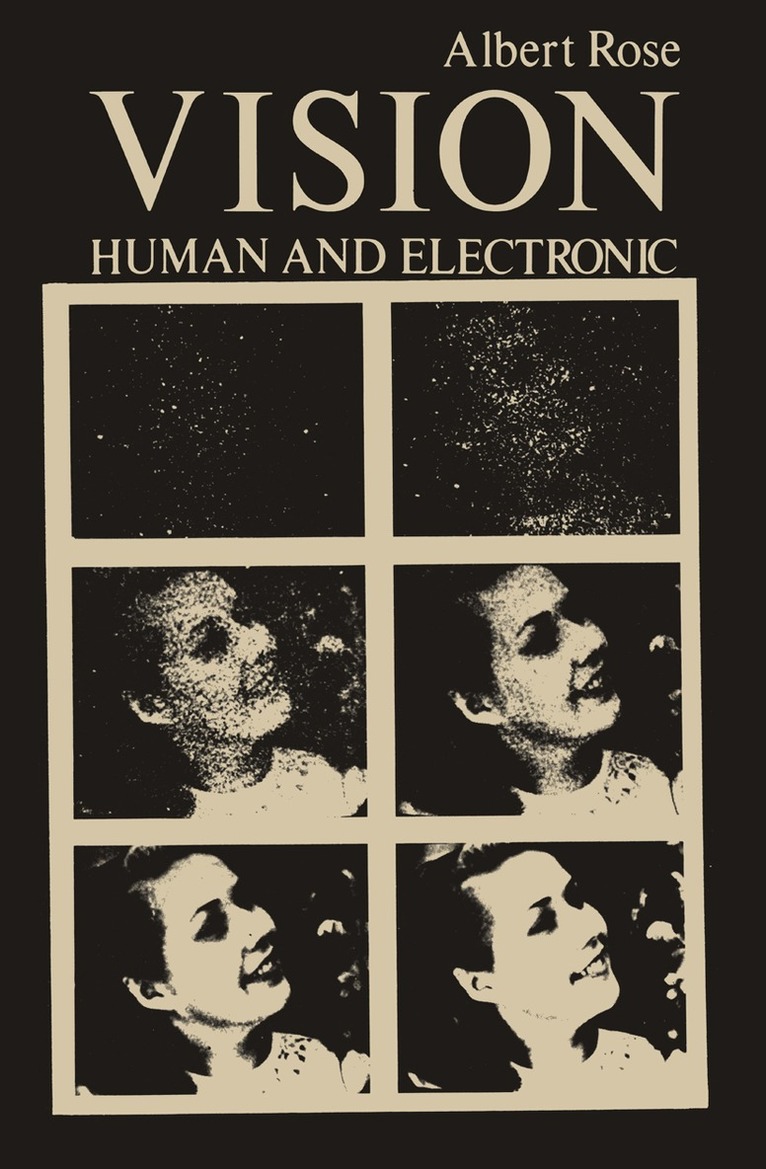
The content of this monograph stems from the writer's early involvement with the design of a series of television camera tubes: the orthicon, the image orthicon and the vidicon. These tubes and their variations, have, at different times been the "eyes" of the television system almost from its inception in 1939. It was natural, during the course of this work, to have a parallel interest in the human visual system as well as in the silver halide photographic process. The problem facing the television system was the same as that facing the human visual and the photographic systems, namely, to abstract the maximum amount of information out of a limited quantity oflight. The human eye and photographic film both repre sented advanced states of development and both surpassed, in their performance, the early efforts on television camera tubes. It was particularly true and "plain to see" that each improvement and refinement of the television camera only served to accentuate the remarkable design of the human eye. A succession of radical advances in camera-tube sensitivity found the eye still operating at levels of illumination too low for the television camera tube. It is only recently that the television camera tube has finally matched and even somewhat exceeded the performance of the human eye at low light levels. It was also clear throughout the work on television camera tubes that the final goal of any visual system-biological, chemical, or electronic-was the ability to detect or count individual photons.
Häftad, Engelska, 2012
556 kr
Skickas inom 10-15 vardagar
The emergence of fibre optics as a commercially viable technology oc curred barely ten years ago; in this time it has become an established field with a variety of applications. This book has been written in an attempt to review the entire field with an emphasis on the practical applications of the technology. This approach has been adopted since it was felt that there was a need for a work which could be referred to by non -specialists in the field who were interested in, or who wished to make use of, fibre optics. With this readership in mind, the theory has been presented in as simple a manner as possible and emphasis has been placed on the description of typical applications and the manufacturing techniques of the technology. It is hoped that this mode of presentation will en able the reader to form an appreciation of both its advantages and its limitations.
Häftad, Engelska, 2012
532 kr
Skickas inom 10-15 vardagar
This book is intended for upperclass college students as an introduction to the growing field of coherent optics and to the increasing number of its applications, and also for those versed in other fields who wish to gain per spective and insight without detailed calculations. It is an outgrowth of the author's Science Study Series book Lasers and HolographY. * Besides being an updated and expanded version of that book, it includes discussions of numerous recent applications. It differs in its slightly higher analytical level and in the inclusion oflarge numbers of references, which enable the reader to obtain further information on subjects of interest to him. The level was selected to match the capabilities of students in their middle college years so as to permit them to make an early assessment of possible career interests in any of the many interdisciplinary fields now embracing the technologies of modern optics. It is hoped that the book can be used (as has occurred rather extensively with another of the author's Science Study Series books, Sound Waves and Light Wavest) as an auxiliary reading assignment for students in various disciplines. The author strongly believes that the promise of continued growth in this field, as evidenced by the extensive participation in technology develop ments by industry, both within the U. S. and abroad, identifies the subject as * Doubleday, 1969 (hard cover and paperback).
Häftad, Engelska, 2012
556 kr
Skickas inom 10-15 vardagar
Although much work has been performed on measure ments and interpretation of light absorption by opaque or nearly opaque solids, it is surprising to note that until recently relatively little reliable experimental data, and much less theoretical work was available on the nature of transparent solids. This, in spite of the fact that a vast majority of engineering and device ap plications of a solid depend on its optical transparency. Needless to say, all solids are both transparent and opa que depending on the spectral region of consideration. The absorption processes that limit the transparency of a solid are either due to lattice vibrations, as in ionic or partially ionic solids, or due to electronic transi tions, both intrinsic and impurity-induced. For most materials, a sufficiently wide spectral window exists be tween these two limits, where the material is transpar ent. In general, the absorption coefficient, in the long wavelength side of, but sufficiently away from, the fun damental absorption edge, is relatively structureless and has an exponential dependence on frequency. Recent evi dence suggests that in the short wavelength side of the one-phonon region, but beyond two- or three-phonon sin gularities, the absorption coefficient of both polar and nonpolar solids is also relatively structureless and de pends exponentially on frequency.
Häftad, Engelska, 2012
1 104 kr
Skickas inom 10-15 vardagar
With the advent of lasers, numerous applications of it such as optical information processing, holography, and optical communication have evolved. These applications have made the study of optics essential for scientists and engineers. The present volume, intended for senior under graduate and first-year graduate students, introduces basic concepts neces sary for an understanding of many of these applications. The book has grown out of lectures given at the Master's level to students of applied optics at the Indian Institute of Technology, New Delhi. Chapters 1-3 deal with geometrical optics, where we develop the theory behind the tracing of rays and calculation of aberrations. The formulas for aberrations are derived from first principles. We use the method in volving Luneburg's treatment starting from Hamilton's equations since we believe that this method is easy to understand. Chapters 4--8 discuss the more important aspects of contemporary physical optics, namely, diffraction, coherence, Fourier optics, and holog raphy. The basis for discussion is the scalar wave equation. A number of applications of spatial frequency filtering and holography are also discussed. With the availability of high-power laser beams, a large number of nonlinear optical phenomena have been studied. Of the various nonlinear phenomena, the self-focusing (or defocusing) of light beams due to the nonlinear dependence of the dielectric constant on intensity has received considerable attention. In Chapter 9 we discuss in detail the steady-state self-focusing of light beams.
Del 1 - Optical Physics and Engineering
Photoelectronic Imaging Devices
Physical Processes and Methods of Analysis
Häftad, Engelska, 2012
540 kr
Skickas inom 10-15 vardagar
The past decade has seen a major resurgence in optical research and the teaching of optics in the major universities both in this country and abroad. Electrooptical devices have become achallenging subject of study that has penetrated both the electrical engineering and the physics departments of most major schools. There seems to be something about the laser that has appealed to both the practical electrical engineer with a hankering for fundamental research and to the fundamental physicist with a hankering to be practical. Somehow or other, this same form of enthusiasm has not previously existed in the study of photoelectronic devices that form images. This field of endeavor is becoming more and more sophisticated as newer forms of solid-state devices enter the field, not only in the data-processing end, but in the conversion of radiant energy into electrical charge patterns that are stored, manipulated, and read out in a way that a decade ago would have been considered beyond some fundamental limit or other.
Häftad, Engelska, 2013
540 kr
Skickas inom 10-15 vardagar
The past decade has seen a major resurgence in optics research and the teaching of optics throughout the major universities both in this country and abroad. Electrooptical devices have become a challenging form of study that has penetrated both the electrical engineering and the physics departments of most major schools. There seems to be something challeng ing about a laser that appeals to both the practical electrical engineer with a hankering for fundamental research and to the fundamental physicist with a hankering to be practical. Somehow or other this same form of enthusiasm has not previously existed in the study of photoelectronic devices that form images. This field of, endeavor is becoming more and more so phisticated as newer forms of solid state devices enter the field not only in the data processing end but in the conversion of radiant energy into electrical charge patterns that are stored, manipulated, and read out in a way that a decade ago would have been considered beyond some fundamental limit or other. It is unfortunate, however, that this kind of material has heretofore been learned only by the process of becoming an apprentice in one or more of the major development laboratories concerned with the manufacture of image intensifiers or television tubes or the production of systems employing these devices.
Häftad, Engelska, 2013
556 kr
Skickas inom 10-15 vardagar
Häftad, Engelska, 2013
1 072 kr
Skickas inom 10-15 vardagar
Optics is reborn. There is fresh new vitality in applying old techniques to new prob lems and fully exploring novel phenomena. Lasers, holography, stellar navigation, nonlinear phenomena, and remote sensing are subjects of the seventies, and their further development will increase our understanding of nature and the development of technology. This Series is devoted to provid ing ideas and data to nourish the growth of these scientific and engineering en deavors' for we feel strongly that science and engineering flourish best when they grow together. Some of the volumes in the Series will be devoted to the optical properties of materials, theories of the detailed mechanisms of absorption, reflection, and nonlinea r phenomena, and electro-optical coefficients. The understanding of such things leads to further engineering applications. Companions to such theoretical books will be compendia of property data; the triad is completed by monographs on the use of the materials in op tical and electro-optical systems. Laser materials, lasers, and laser sys tems form one of the groups which will comprise the full set of ready-reference material for the entire field. The Series will be intentionally international, including a fair sampling of Russian work. There are important benefits to be obtained in the alternate approaches often taken by our Soviet and other foreign colleagues (just as they can gain from studying ours).
Häftad, Engelska, 2012
556 kr
Skickas inom 10-15 vardagar
This book is an account of the manner in which the optical phenomena observed from solids relate to their fundamental properties. Written at the graduate level, it attempts a threefold purpose: an indication of the breadth of the subject, an in-depth examination of important areas, and a text for a two-semester course. The first two chapters present introductory theory as a foundation for subsequent reading. The following ten chapters broadly concern electronic properties associated with semiconductors ranging from narrow to wide energy gap materials. Lattice properties are examined in the remaining chap ters, in which effects governed by phonons in perfect crystals, point defects, their vibrational and electronic spectra, and electron-phonon interactions are stressed. Fun and hard work, both in considerable measure, have gone into the preparation of this volume. At the University of Freiburg, W. Germany, from August 7-20, 1966, the occasion of a NATO Advanced Study Institute on "The Optical Properties of Solids," the authors of these various chapters lectured for the Institute; this volume provides essentially the "Proceed ings" of that meeting. Many major revisions of original lectures (contrac tions and enlargements) were required for better organization and presentation of the subject matter. Several abbreviated chapters appear mainly to indicate the importance of their contents in optical properties research and to indicate recently published books that provide ample coverage. We are indebted to many people: the authors for their efforts and patience; our host at the University of Freiburg, the late Professor Dr.
Häftad, Engelska, 2013
2 350 kr
Skickas inom 10-15 vardagar
This book is intended to serve as an introduction to the technology of thermal imaging, and as a compendium of the conventions which form the basis of current FUR practice. Those topics in thermal imaging which are covered adequately elsewhere are not treated here, so there is no discussion of detectors, cryogenic coolers, circuit design, or video displays. Useful infor mation which is not readily available because of obscure publication is referenced as originating from personal communications. Virtually everyone with whom I have worked in the thermal imaging business has contributed to the book through the effects of conversations and ideas. I gratefully proffer blanket appreciation to all those who have helped in that way to make this book possible. The contributions of five people, however, bear special mention: Bob Sendall, Luke Biberman, Pete Laakmann, George Hopper, and Norm Stetson. They, more than any others, have positively influenced my thinking.