E-bok, Engelska, 2013
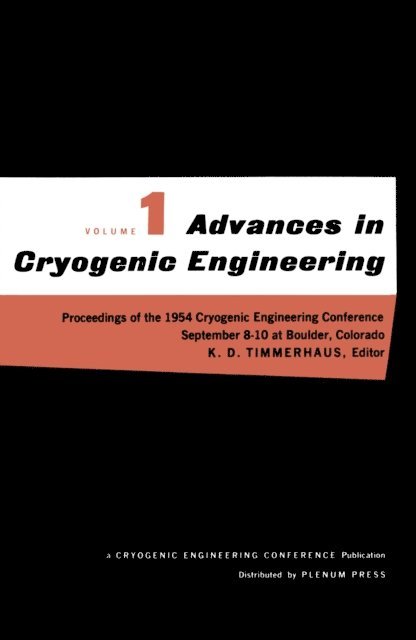
Advances in Cryogenic Engineering
1392 kr
Läs direkt i Bokus Reader – eller ladda ned till din enhet (PDF kräver ofta zoom och scroll på små skärmar).
Beskrivning
More than sixty years have elapsed since Linde first liquefied air on a commercial scale and prepared the way for separating of other gaseous mixtures. His work, however, was not of an isolated nature. It was conceived eighteen years after air had, for the first time, been liquefied in the laboratory by Pictet in Geneva and Caillete in Paris. Linde''s liquefaction of air was followed by Dewar''s work on hydrogen liquefaction in London and by the setting up at Leiden of Kamerlingh Onnes''s famous low temperature laboratory. These advances in low temperature or cryogenic technology have resulted in the establishment of a completely new and thriving industry. Cryogenic engineering is concerned with developing and improving low temperature processes, techniques, and equipment; determining the physical properties of structural and related materials used in producing, maintaining, and using low temperatures; and the practical application of low temperature techniques and processes. These low tempera tures are below those usually encountered in refrigerating engineering. It is rather difficult to assign a definite temperature which serves to divide refrigerating engineering from cryogenic engineering. A temperature below _lSOoC, however, is generally associated with cryogenic engineering.
Produktinformation
- Utgivningsdatum: 2013-03-08
- Språk: Engelska
- Filformat: PDF
- Kopieringsskydd: LCP
- ISBN: 9781468430998
- Förlag: Springer US
Utforska kategorier
Betyg & recensioner
0 recensioner
Inga recensioner tillgängliga.