• Fri frakt över 249 kr
  • •
  • Snabba leveranser
  • •
  • Billiga böcker
Kundservice

Du är på sajten för privatpersoner.

Företag, bibliotek eller offentlig verksamhet?

Du handlar på classic.bokus.com, där alla dina funktioner finns intakta.
Till classic.bokus.com
Bokus logotyp. Gå till startsidan.
  • Erbjudanden
  • Nyheter
  • Student
  • Topplistor
  • Barn & ungdom
  • Bokus Play
  • E-böcker
  • Pocketböcker
  • Spel & pussel

10% rabatt på allt med kod: NYSTART10 →

Sidfot

Mina sidor

    Hjälp

    • Kundservice
    • Vanliga frågor och svar
    • Frakt och leverans
    • Retur vid ångerrätt
    • Reklamera vara
    • Betalning
    • Köpvillkor
    • Allmänna villkor
    • Information om webbplatsens tillgänglighet

    Om Bokus

    • Om oss
    • Pressrum
    • För studenter
    • För företag
    • För bibliotek och offentlig verksamhet
    • För leverantörer
    • Hållbarhet

    Populärt

    • Aktuella erbjudanden
    • Presentkort
    • Studentlitteratur
    • Nya böcker
    • Topplistor
    • Signerade böcker
    • Engelska böcker

    Inspiration

    • Boktips
    • BookTok
    • Populära bokserier
    • Barnbokskaraktärer
    • Populära författare
    Logotyp för Bokus
    Följ oss på Facebook (extern länk)Följ oss på Instagram (extern länk)Följ oss på YouTube (extern länk)Följ oss på TikTok (extern länk)
    bokus @ CookiesAnpassa cookiesIntegritetspolicyKöpvillkor
    Till Citymail hemsida (extern länk)Till Budbee hemsida (extern länk)Till Postnord hemsida (extern länk)Till Schenker hemsida (extern länk)Till Early Bird hemsida (extern länk)Till Walleys hemsida (extern länk)
    1. Djur och Natur
    2. Naturböcker
    3. Växtböcker

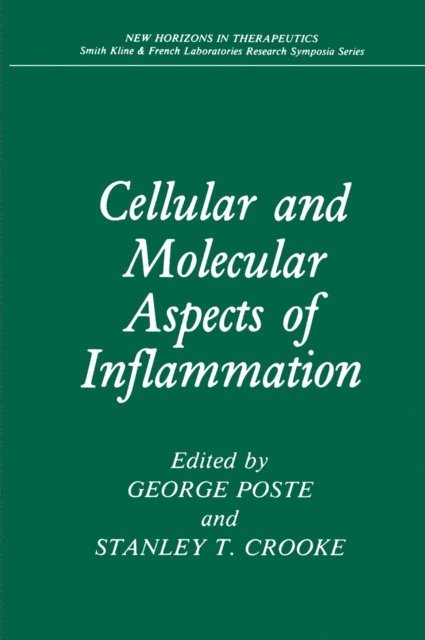
    Cellular and Molecular Aspects of Inflammation

    AvGeorge Poste,Stanley T. Crooke

    Häftad, Engelska, 2012

    Del i serien New Horizons in Therapeutics

    1 119 kr

    Beställningsvara. Skickas inom 10-15 vardagar. Fri frakt över 249 kr.

    Beskrivning

    The characterization of the cellular and molecular mechanisms that mediate inflammation provides a foundation that supports future studies that will de­ fine mechanisms more intimately. It encourages substantial optimism about the opportunities to understand the inflammatory process and to use that information to develop novel therapeutic approaches. Recent progress has defined the cells that mediate the inflammatory response, many of the inter­ cellular transmitters, the receptors, signal transduction processes and regula­ tory mechanisms. Thus, we now have the opportunity to understand inflammation in pharmacologic terms and to attack the key molecular targets to develop new therapeutics. Among the cells involved in the inflammatory response are the lympho­ cytes, neutrophils and endothelial cells. Maintenance of homeostasis, re­ sponse to proinflammatory stimuli and pathophysiologic responses are products of complex interactions between these and other elements of the immune systems. Each of these cells displays a variety of receptors to define the stimuli to which they respond. The receptors displayed that the signal transduction processes and cellular responses are regulated genetically and epigenetic ally . The critical role of membranes and particularly the phospho­ lipid components of the membranes is emphasized by recent studies.

    Produktinformation

    • Utgivningsdatum:2012-03-26
    • Mått:152 x 229 x 27 mm
    • Vikt:717 g
    • Format:Häftad
    • Språk:Engelska
    • Serie:New Horizons in Therapeutics
    • Antal sidor:496
    • Förlag:Springer-Verlag New York Inc.
    • ISBN:9781468454895

    Utforska kategorier

    • Växtböcker inom Djur och Natur
    • Biokemi inom Naturvetenskap och teknik
    • Onkologi inom Medicin

    Innehållsförteckning

    • I. Cellular Interactions in Inflammatory Processes.- 1 Cellular Interactions Regulating Inflammation: Activation of T Lymphocytes at Inflammatory Sites and Their Role in Perpetuating Chronic Inflammation.- 2 Triggering and Activation of Human Neutrophils: Two Aspects of the Response to Transmembrane Signals.- 3 Neutrophil Emigration: Quantitation, Kinetics, and the Role of Mediators.- 4 The Role of Endothelium in Chronic Inflammation.- II. Peptide Mediators of Inflammation.- 5 Peptide Mediators of Inflammation: An Overview.- 6 Interleukin-1: Biology and Molecular Biology.- 7 Structure—Function Relations for the Interleukin-2 Receptor.- 8 Cachectin (Tumor Necrosis Factor): A Macrophage Protein that Induces a Catabolic State and Septic Shock in Infected Animals.- III. Biosynthesis and Release of Lipid Mediators of Inflammation.- 9 Arachidonic Acid Metabolism in Tissue Injury.- 10 Lipoxygenase Metabolites: Chemistry and Biochemistry.- IV. Molecular Intermediates in Signal Transductions.- 11 Guanine Nucleotide Regulatory Proteins in Inflammatory and Immune Responses.- 12 Regulation of Phosphoinositide Breakdown.- 13 Regulation of Protein Kinase C by Sphingosine/Lysosphingolipids.- 14 Regulation of Inositol Trisphosphate Formation and Action.- V. Receptors and Signal Transduction Processes Involved in Inflammation.- 15 Molecular Properties of Leukocyte Receptors for Leukotrienes.- 16 LTD4 Receptors and Signal Transduction Processes.- 17 Characterization of Thromboxane A2/Prostaglandin H2 Receptors.- 18 Chemoattractant Receptors and Signal Transduction Processes.- 19 The Molecular Biology of the Human Interleukin-2 Receptor.- VI. The Role of Phospholipases in Inflammation.- 20 Some Novel Phospholipase C Activities: Actions on Phosphatidylcholine and onPhosphatidylinositol—Glycans as Anchors for Membrane Proteins and as Precursors for Possible Insulin Mediators.- 21 Enzymatic Mechanisms and Inhibition of Phospholipase A2: From Manoalide to the Lipocortins.- 22 Molecular Mechanism of Regulation of Cellular Phospholipases.- 23 The Metabolism of Inositol Phosphates.