• Fri frakt över 249 kr
  • •
  • Snabba leveranser
  • •
  • Billiga böcker
Kundservice

Du är på sajten för privatpersoner.

Företag, bibliotek eller offentlig verksamhet?

Du handlar på classic.bokus.com, där alla dina funktioner finns intakta.
Till classic.bokus.com
Bokus logotyp. Gå till startsidan.
  • Erbjudanden
  • Nyheter
  • Student
  • Topplistor
  • Barn & ungdom
  • Bokus Play
  • E-böcker
  • Pocketböcker
  • Spel & pussel

Må bättre, för mindre! Upp till 50% rabatt på hälsoböcker

Sidfot

Mina sidor

    Hjälp

    • Kundservice
    • Vanliga frågor och svar
    • Frakt och leverans
    • Retur vid ångerrätt
    • Reklamera vara
    • Betalning
    • Köpvillkor
    • Allmänna villkor
    • Information om webbplatsens tillgänglighet

    Om Bokus

    • Om oss
    • Pressrum
    • För studenter
    • För företag
    • För bibliotek och offentlig verksamhet
    • För leverantörer
    • Hållbarhet

    Populärt

    • Aktuella erbjudanden
    • Presentkort
    • Studentlitteratur
    • Nya böcker
    • Topplistor
    • Signerade böcker
    • Engelska böcker

    Inspiration

    • Boktips
    • BookTok
    • Populära bokserier
    • Barnbokskaraktärer
    • Populära författare
    Logotyp för Bokus
    Följ oss på Facebook (extern länk)Följ oss på Instagram (extern länk)Följ oss på YouTube (extern länk)Följ oss på TikTok (extern länk)
    bokus @ CookiesAnpassa cookiesIntegritetspolicyKöpvillkor
    Till Citymail hemsida (extern länk)Till Budbee hemsida (extern länk)Till Postnord hemsida (extern länk)Till Schenker hemsida (extern länk)Till Early Bird hemsida (extern länk)Till Walleys hemsida (extern länk)
    1. Naturvetenskap och teknik
    2. Matematik och naturvetenskap
    3. Naturvetenskap:allmänt
    4. Populärvetenskap

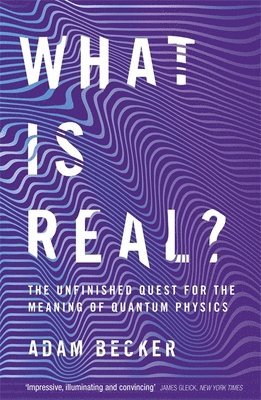
    What is Real?

    The Unfinished Quest for the Meaning of Quantum Physics

    AvAdam Becker

    Häftad, Engelska, 2019

    165 kr

    Beställningsvara. Skickas inom 5-8 vardagar. Fri frakt över 249 kr.

    Fler format och utgåvor

    E-bok

    44 kr

    Beskrivning

    Every physicist agrees quantum mechanics is among humanity's finest scientific achievements. But ask what it means, and the result will be a brawl. For a century, most physicists have followed Niels Bohr's Copenhagen interpretation and dismissed questions about the reality underlying quantum physics as meaningless. A mishmash of solipsism and poor reasoning, Copenhagen endured, as Bohr's students vigorously protected his legacy, and the physics community favoured practical experiments over philosophical arguments. As a result, questioning the status quo long meant professional ruin. And yet, from the 1920s to today, physicists like John Bell, David Bohm, and Hugh Everett persisted in seeking the true meaning of quantum mechanics. What is Real? is the gripping story of this battle of ideas and the courageous scientists who dared to stand up for truth.

    Produktinformation

    • Utgivningsdatum:2019-06-27
    • Mått:190 x 20 x 130 mm
    • Vikt:305 g
    • Format:Häftad
    • Språk:Engelska
    • Antal sidor:384
    • Förlag:John Murray Press
    • ISBN:9781473661363

    Utforska kategorier

    • Populärvetenskap inom Naturvetenskap och teknik
    • Kvantfysik inom Naturvetenskap och teknik

    Mer om författaren

    Adam Becker is a science journalist with a PhD in astrophysics. He has written for the New York Times, BBC, NPR, Scientific American, New Scientist, Quanta and many other publications. His first book, What Is Real?, was a New York Times Book Review Editor's Choice and was longlisted for the PEN Literary Science Writing Award. He has been a science journalism fellow at the Santa Fe Institute and a science communicator in residence at the Simons Institute for the Theory of Computing. He lives in California.

    Recensioner i media

    A thorough, illuminating exploration of the most consequential controversy raging in modern science . . . Becker leads us through an impressive account of the rise of competing interpretations, grounding them in the human stories, which are naturally messy and full of contingencies. He makes a convincing case that it's wrong to imagine the Copenhagen interpretation as a single official or even coherent statement