• Fri frakt över 249 kr
  • •
  • Snabba leveranser
  • •
  • Billiga böcker
Kundservice

Du är på sajten för privatpersoner.

Företag, bibliotek eller offentlig verksamhet?

Du handlar på classic.bokus.com, där alla dina funktioner finns intakta.
Till classic.bokus.com
Bokus logotyp. Gå till startsidan.
  • Erbjudanden
  • Nyheter
  • Student
  • Topplistor
  • Barn & ungdom
  • Bokus Play
  • E-böcker
  • Pocketböcker
  • Spel & pussel

10% rabatt på allt med kod NYSTART10 →

Sidfot

Mina sidor

    Hjälp

    • Kundservice
    • Vanliga frågor och svar
    • Frakt och leverans
    • Retur vid ångerrätt
    • Reklamera vara
    • Betalning
    • Köpvillkor
    • Allmänna villkor
    • Information om webbplatsens tillgänglighet

    Om Bokus

    • Om oss
    • Pressrum
    • För studenter
    • För företag
    • För bibliotek och offentlig verksamhet
    • För leverantörer
    • Hållbarhet

    Populärt

    • Aktuella erbjudanden
    • Presentkort
    • Studentlitteratur
    • Nya böcker
    • Topplistor
    • Signerade böcker
    • Engelska böcker

    Inspiration

    • Boktips
    • BookTok
    • Populära bokserier
    • Barnbokskaraktärer
    • Populära författare
    Logotyp för Bokus
    Följ oss på Facebook (extern länk)Följ oss på Instagram (extern länk)Följ oss på YouTube (extern länk)Följ oss på TikTok (extern länk)
    bokus @ CookiesAnpassa cookiesIntegritetspolicyKöpvillkor
    Till Citymail hemsida (extern länk)Till Budbee hemsida (extern länk)Till Postnord hemsida (extern länk)Till Schenker hemsida (extern länk)Till Early Bird hemsida (extern länk)Till Walleys hemsida (extern länk)
    1. Kultur
    2. Arkitektur
    3. Arkitekturhistoria

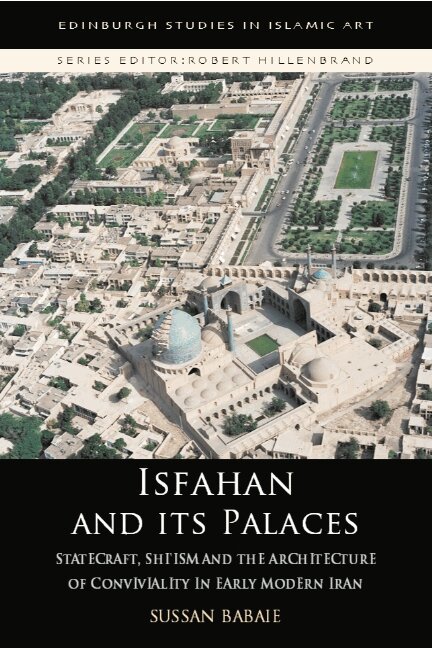
    Isfahan and its Palaces

    Statecraft, Shi`ism and the Architecture of Conviviality in Early Modern Iran

    AvSussan Babaie

    Häftad, Engelska, 2018

    Del i serien Edinburgh Studies in Islamic Art

    588 kr

    Beställningsvara. Skickas inom 7-10 vardagar. Fri frakt över 249 kr.

    Beskrivning

    This beautifully illustrated history of Safavid Isfahan (1501–1722) explores the architectural and urban forms and networks of socio-cultural action that reflected a distinctly early-modern and Perso-Shi‘i practice of kingship.An immense building campaign, initiated in 1590-91, transformed Isfahan from a provincial, medieval, and largely Sunni city into an urban-centered representation of the first Imami Shi‘i empire in the history of Islam. The historical process of Shi‘ification of Safavid Iran and the deployment of the arts in situating the shifts in the politico-religious agenda of the imperial household informs Sussan Babaie’s study of palatial architecture and urban environments of Isfahan and the earlier capitals of Tabriz and Qazvin.Babaie argues that since the Safavid claim presumed the inheritance both of the charisma of the Shi‘i Imams and of the aura of royal splendor integral to ancient Persian notions of kingship, a ceremonial regime was gradually devised in which access and proximity to the shah assumed the contours of an institutionalized form of feasting. Talar-palaces, a new typology in Islamic palatial designs, and the urban-spatial articulation of access and proximity are the architectural anchors of this argument. Cast in the comparative light of urban spaces and palace complexes elsewhere and earlier—in the Timurid, Ottoman, and Mughal realms as well as in the early modern European capitals—Safavid Isfahan emerges as the epitome of a new architectural-urban paradigm in the early modern age.

    Produktinformation

    • Utgivningsdatum:2018-04-05
    • Mått:172 x 244 x 21 mm
    • Vikt:856 g
    • Format:Häftad
    • Språk:Engelska
    • Serie:Edinburgh Studies in Islamic Art
    • Antal sidor:344
    • Förlag:Edinburgh University Press
    • ISBN:9781474437196

    Utforska kategorier

    • Arkitekturhistoria inom Kultur
    • Mellanösterns historia inom Historia och arkeologi

    Mer om författaren

    Sussan Babaie is currently teaching at The Courtauld Institute of Art in London, where her research focuses on imperialism and artistic patronage in Persianate West, Central and South Asia where high culture derived from the literary corpus of the Persian language. She has previously taught in the Department of the History of Art at the University of Michigan, Smith College, and New York University. Sussan is co-author of Slaves of the Shah: New Elites of Safavid Iran (2004) and Persian Drawings in the Metropolitan Museum of Art (1989).

    Innehållsförteckning

    • 1. Introduction: Conviviality, Charismatic Absolutism, and the Persianizing of Shi‘ism2. Peripatetic Kings and Palaces: From Tabriz to Qazvin in the Sixteenth Century3. Dwelling in Paradise, or Isfahan “Half the World”4. Architectural (Re)Persianization of Muslim Kingship: The Daulatkhane (The Abode of Felicity) Royal Precinct5. Inventing the Spatial Choreography of Feasting: the Talar Palaces of Isfahan6. Feasting and the Perso-Shi‘i Etiquette of Kingship7. Safavid Dynastic Chart8. A Buildings’ ChartBibliography