• Fri frakt över 249 kr
  • •
  • Snabba leveranser
  • •
  • Billiga böcker
Kundservice

Du är på sajten för privatpersoner.

Företag, bibliotek eller offentlig verksamhet?

Du handlar på classic.bokus.com, där alla dina funktioner finns intakta.
Till classic.bokus.com
Bokus logotyp. Gå till startsidan.
  • Erbjudanden
  • Nyheter
  • Student
  • Topplistor
  • Barn & ungdom
  • Bokus Play
  • E-böcker
  • Pocketböcker
  • Spel & pussel

10% rabatt på allt med kod: NYSTART10 →

Sidfot

Mina sidor

    Hjälp

    • Kundservice
    • Vanliga frågor och svar
    • Frakt och leverans
    • Retur vid ångerrätt
    • Reklamera vara
    • Betalning
    • Köpvillkor
    • Allmänna villkor
    • Information om webbplatsens tillgänglighet

    Om Bokus

    • Om oss
    • Pressrum
    • För studenter
    • För företag
    • För bibliotek och offentlig verksamhet
    • För leverantörer
    • Hållbarhet

    Populärt

    • Aktuella erbjudanden
    • Presentkort
    • Studentlitteratur
    • Nya böcker
    • Topplistor
    • Signerade böcker
    • Engelska böcker

    Inspiration

    • Boktips
    • BookTok
    • Populära bokserier
    • Barnbokskaraktärer
    • Populära författare
    Logotyp för Bokus
    Följ oss på Facebook (extern länk)Följ oss på Instagram (extern länk)Följ oss på YouTube (extern länk)Följ oss på TikTok (extern länk)
    bokus @ CookiesAnpassa cookiesIntegritetspolicyKöpvillkor
    Till Citymail hemsida (extern länk)Till Budbee hemsida (extern länk)Till Postnord hemsida (extern länk)Till Schenker hemsida (extern länk)Till Early Bird hemsida (extern länk)Till Walleys hemsida (extern länk)
    1. Filosofi och religion
    2. Filosofi
    3. Filosofiska discipliner

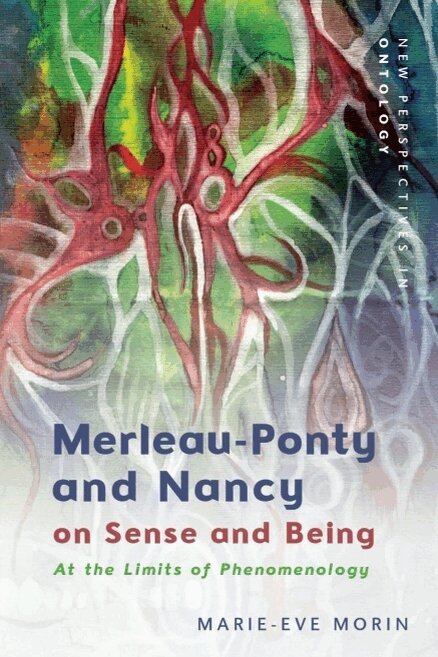
    Merleau-Ponty and Nancy on Sense and Being

    At the Limits of Phenomenology

    AvMarie-Eve Morin

    Inbunden, Engelska, 2022

    Del i serien New Perspectives in Ontology

    1 895 kr

    Beställningsvara. Skickas inom 3-6 vardagar. Fri frakt över 249 kr.

    Fler format och utgåvor

    Häftad

    471 kr

    E-bok

    314 kr

    E-bok

    314 kr

    Beskrivning

    Marie-Eve Morin proposes a reinterpretation of the philosophy of Merleau-Ponty and Nancy from the perspective of realist and object-oriented tendencies in contemporary philosophy. The realist critique of subject-centred anthropocentric thinking indicates the danger, inherent in the phenomenological approach, of reducing being to sense. Morin demonstrates how Merleau-Ponty and Nancy avoid this pitfall through the development of ontologies that respect the materiality and exteriority of what exists without reaffirming the Cartesian divide between mind and world.Morin lays out the parameters of this philosophical approach which operates outside of Cartesian dualism. She orients her analysis around three ideas where Merleau-Ponty's and Nancy's thinking intersect: Body, Thing, Being. Each time, she tracks the role of difference or spacing within sensing and sense-making and concludes that their respective conceptions as encroachment and promiscuity or as unpassable limit may provide counterweights to each other.

    Produktinformation

    • Utgivningsdatum:2022-06-17
    • Mått:156 x 234 x 20 mm
    • Vikt:478 g
    • Format:Inbunden
    • Språk:Engelska
    • Serie:New Perspectives in Ontology
    • Antal sidor:216
    • Förlag:Edinburgh University Press
    • ISBN:9781474492423

    Utforska kategorier

    • Filosofiska discipliner inom Filosofi och religion

    Mer om författaren

    Marie-Eve Morin is Professor of Philosophy at the University of Alberta in Edmonton, Canada. She is the author of many articles on Derrida, Heidegger, Nancy, Sartre, Latour, and Sloterdijk. She is also the author of Jean-Luc Nancy (Polity, 2012) and is the co-editor, with Peter Gratton, of The Nancy Dictionary (Edinburgh University Press, 2015) and Jean-Luc Nancy and Plural Thinking: Expositions of World, Politics, Art, and Sense (SUNY, 2012). She is editor of Continental Realism and its Discontents (Edinburgh University Press, 2017).

    Recensioner i media

    This book performs work that has not yet been done and that is really very important in understanding French phenomenology, its legacy, and its relation to Nancy, a key contemporary thinker. Written with extraordinary rigour, it is a major contribution to thinking about philosophical materialism and realism in the wake of phenomenology and deconstruction.

    Innehållsförteckning

    • Introductioni. The Context: The Speculative Realist Challengeii. The Limits of Phenomenology: Being and Senseiii. Merleau-Ponty and Nancy: Influence and Resonancesiv. BreakdownPart I – Body1. Merleau-Ponty, Descartes and the Unreflected Life of the Bodyi. Reading Descartes: The Relation Between Reflection and the Unreflectedii. Sensing and Self-Sensing Body of the Phenomenology of Perceptioniii. The Problem of the Phenomenology of Perception: Tacit Versus Operative Cogito2. Nancy, Descartes, the Exposition of Bodies and the Extension of the Souli. Nancy’s Reading of Descartes: The Unum Quid Against the Modern Subjectii. Nancy’s Bodies: Skin, Sense, Touch3. Divergences: Unity Versus Dislocationi. Synthesis of the Body Schema or Partes extra Partes?ii. Synaesthesia or Dislocation of the Senses? Self-Touching or Touching the Outside?Part II – Thing4. Things in the Phenomenology of Perception: The Paradox of an In-Itself-for-Usi. The Order of the Phenomena: Between Being and Appearanceii. Answering the Accusation of Correlationismiii. The Limit of the Answer in the Phenomenology and the Move to Ontology5. Things After the Phenomenology: Merleau-Ponty’s Cautious Anthropomorphismi. Sartre’s Thingsii. Merleau-Ponty’s Thingsiii. Anthropomorphism as Defamiliarization6. Nancy’s Materialism and the Stonei. The Freedom of the Stone and the Creation of the Worldii. The Existence of the Stone and Its Feeling Hardiii. Materialism, Materiality, Matteriv. Thinking and ThingsPart III – Being7. Merleau-Ponty’s and Nancy’s Engagement with Heideggeri. Is Merleau-Ponty’s Late Ontology Heideggerian?ii. Merleau-Ponty Between Husserl’s Wesenschau and Heidegger’s Weseniii. Merleau-Ponty Between the Negativism of Doubt and the Positivism of Essencesiv. Merleau-Ponty’s Indirect Ontologyv. Nancy and Heidegger’s Withdrawal of Being8. Two Ontologies of Sensei. Merleau-Ponty, Écart, and the Fleshii. Narcissism and the Reversibility of the Chiasmiii. Écart as Encroachment or Separationiv. Conclusion: Two Ontologies of Sense for Our TimeNotesBibliography