• Fri frakt över 249 kr
  • •
  • Snabba leveranser
  • •
  • Billiga böcker
Kundservice

Du är på sajten för privatpersoner.

Företag, bibliotek eller offentlig verksamhet?

Du handlar på classic.bokus.com, där alla dina funktioner finns intakta.
Till classic.bokus.com
Bokus logotyp. Gå till startsidan.
  • Erbjudanden
  • Nyheter
  • Student
  • Topplistor
  • Barn & ungdom
  • Bokus Play
  • E-böcker
  • Pocketböcker
  • Spel & pussel

10% studentrabatt med kod TERM26

Sidfot

Mina sidor

    Hjälp

    • Kundservice
    • Vanliga frågor och svar
    • Frakt och leverans
    • Retur vid ångerrätt
    • Reklamera vara
    • Betalning
    • Köpvillkor
    • Allmänna villkor
    • Information om webbplatsens tillgänglighet

    Om Bokus

    • Om oss
    • Pressrum
    • För studenter
    • För företag
    • För bibliotek och offentlig verksamhet
    • För leverantörer
    • Hållbarhet

    Populärt

    • Aktuella erbjudanden
    • Presentkort
    • Studentlitteratur
    • Nya böcker
    • Topplistor
    • Signerade böcker
    • Engelska böcker

    Inspiration

    • Boktips
    • BookTok
    • Populära bokserier
    • Barnbokskaraktärer
    • Populära författare
    Logotyp för Bokus
    Följ oss på Facebook (extern länk)Följ oss på Instagram (extern länk)Följ oss på YouTube (extern länk)Följ oss på TikTok (extern länk)
    bokus @ CookiesAnpassa cookiesIntegritetspolicyKöpvillkor
    Till Citymail hemsida (extern länk)Till Budbee hemsida (extern länk)Till Postnord hemsida (extern länk)Till Schenker hemsida (extern länk)Till Early Bird hemsida (extern länk)Till Walleys hemsida (extern länk)
    1. Kultur
    2. Konstböcker
    3. Konsthistoria

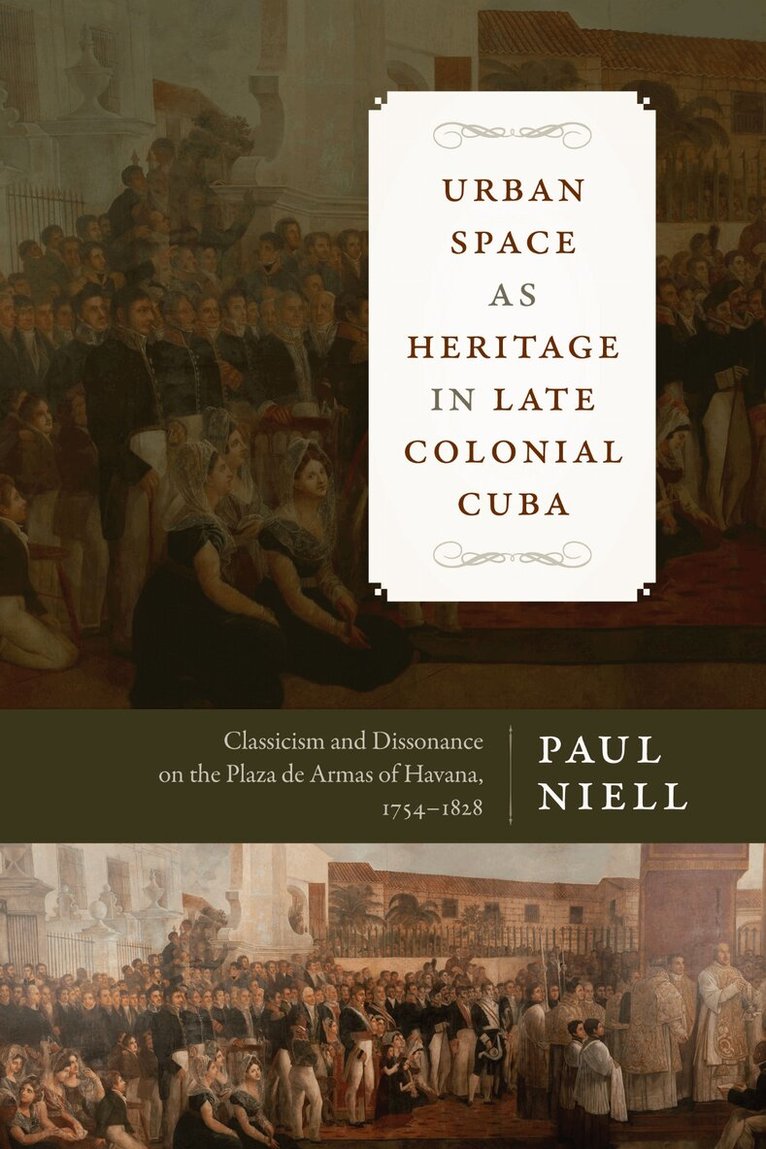
    Urban Space As Heritage in Late Colonial Cuba

    Classicism and Dissonance on the Plaza De Armas of Havana, 1754-1828

    AvPaul Niell

    Häftad, Engelska, 2015

    Del i serien Latin American and Caribbean Arts and Culture Publication Initiative, Mellon Foundation

    393 kr

    Beställningsvara. Skickas inom 10-15 vardagar. Fri frakt över 249 kr.

    Beskrivning

    According to national legend, Havana, Cuba, was founded under the shade of a ceiba tree whose branches sheltered the island’s first Catholic mass and meeting of the town council (cabildo) in 1519. The founding site was first memorialized in 1754 by the erection of a baroque monument in Havana’s central Plaza de Armas, which was reconfigured in 1828 by the addition of a neoclassical work, El Templete. Viewing the transformation of the Plaza de Armas from the new perspective of heritage studies, this book investigates how late colonial Cuban society narrated Havana’s founding to valorize Spanish imperial power and used the monuments to underpin a local sense of place and cultural authenticity, civic achievement, and social order.Paul Niell analyzes how Cubans produced heritage at the site of the symbolic ceiba tree by endowing the collective urban space of the plaza with a cultural authority that used the past to validate various place identities in the present. Niell’s close examination of the extant forms of the 1754 and 1828 civic monuments, which include academic history paintings, neoclassical architecture, and idealized sculpture in tandem with period documents and printed texts, reveals a “dissonance of heritage”-in other words, a lack of agreement as to the works’ significance and use. He considers the implications of this dissonance with respect to a wide array of interests in late colonial Havana, showing how heritage as a dominant cultural discourse was used to manage and even disinherit certain sectors of the colonial population.

    Produktinformation

    • Utgivningsdatum:2015-05-15
    • Mått:152 x 229 x 23 mm
    • Vikt:426 g
    • Format:Häftad
    • Språk:Engelska
    • Serie:Latin American and Caribbean Arts and Culture Publication Initiative, Mellon Foundation
    • Antal sidor:344
    • Förlag:University of Texas Press
    • ISBN:9781477311301

    Utforska kategorier

    • Konsthistoria inom Kultur
    • Landskapsarkitektur inom Kultur
    • Amerikas historia inom Historia och arkeologi

    Mer om författaren

    Paul Niell is Assistant Professor of Art History at Florida State University. He is the coeditor, with Stacie Widdifield, of Buen Gusto and Classicism in the Visual Cultures of Latin America, 1780–1910.

    Recensioner i media

    "[T]his book offers a sweeping and carefully researched volume that will appear to scholars in art history, Latin American Studies, cultural studies, urban studies and related fields. It reflects the efforts of a determined scholar who aims to link the local, plaza, city, colony, and ultimately (Spanish) empire scales of analysis. This work will force veteran scholars to rethink their assessment of Spanish colonial spaces, and will guide younger scholars too." (European Review of Latin American and Caribbean Studies) Niell addresses an important gap in the research on Cuba’s heritage and promising interpretations will emerge from his work. Scholars and students interested on Latin American cultural, art and urban history, heritage studies, and those looking at the transition from the former Iberian colonialism to the modern colonial episteme will find this work enlightening and useful.(International Journal of Heritage Studies) Niell’s text makes an important contribution to the Hispanic American discourse as he provides analysis and coverage of a grossly understudied area in Latin American and Caribbean studies: the art and architecture of colonial Cuba . . . His text will not only enliven the current discourse in Hispanic American studies but it is also timely and sure to be of interest to both area specialists and nonacademics alike as we attempt to decipher this moment of renewed cultural exchange.(Winterthur Portfolio) Intellectual exchange across the Straits of Florida is now so common that Paul Niell’s excellent new book, Urban Space as Heritage in Late Colonial Cuba: Classicism and Dissonance on the Plaza de Armas of Havana, 1754–1828, comes as a very welcome relief from all things related to Cuba’s here and now . . . More than anything, Niell’s absorbing book reminds us that urban space as heritage is a potent vehicle for negotiating the here and now.(Colonial Latin American Review) Paul Niell’s book is an important addition to the history of colonial architecture in Latin America, and in particular, a welcome addition to the genre of heritage studies . . . [Urban Space as Heritage in Late Colonial Cuba] will be of interest to social and cultural historians, preservationists, public historians, and art and architectural historians.  Neill has deftly explained the process of constructing public memory, a process full of complexities that requires careful navigation among competing constituencies.(The Journal of the Southeast Chapter of the Society of Architectural Historians) As an effort to understand Cuban architecture as both a component of the larger Spanish Empire and a product of its immediate political condition, the book is an important contribution to the history of architecture in Cuba.(Choice) Like El Templete that emerges through Niell’s dense scholarly enquiry, his book is a carefully constructed mosaic. It should be read by students of heritage, historians and architects, art and architectural historians of the colonial Spanish Americas, and Havana’s inquisitive citizens.(Hispanic American Historical Review) Paul Niell’s book is an important addition to the growing literature on Bourbon urban reforms, presenting a fruitful combination of art history, urban history, and heritage studies . . . The strength of the book lies in its sophisticated analysis of the urban dimension of the Bourbon reforms in Havana, and for that alone it is worth a read.(The Americas) This study makes important contributions to the burgeoning new scholarship on the eighteenth century, as well as to rethinking the Hispanic Enlightenment . . . Given the careful documentation and innovative methodology of this comprehensive study, I expect it will remain relevant for years to come . . . Niell’s work fits into a large, newer body of scholarship that updates understanding of the Hispanic Enlightenment and the emergence of global modernity.(American Historical Review) Urban Space as Heritage in Late Colonial Cuba is a wonderful contribution to the small amount of existing literature that examines the cultural history of the Enlightenment in Cuba. It is also one of the few books that analyzes the art and architectural history of the Cuban colonial period in depth, while placing it in useful dialogue with works produced in other areas of the Spanish viceroyalties . . . Niell effectively connects important iconographic sources from around the Atlantic world to the typology of the Templete and its visual program in a way that should further inspire similarly compelling studies of the political ramifications of visual culture produced under late colonialism.(caa.reviews) This book offers a sweeping and carefully researched volume that will appeal to scholars in art history, Latin American Studies, cultural studies, urban studies, and related fields. It reflects the efforts of a determined scholar who aims to link the local, plaza, city, colony, and ultimately (Spanish) empire scales of analysis. The work will force veteran scholars to rethink their assessments of Spanish colonial spaces, and will guide younger scholars too. (European Review of Latin American and Caribbean Studies)

    Innehållsförteckning

    • List of IllustrationsAcknowledgmentsIntroductionChapter 1. The Plaza de Armas and Spatial ReformChapter 2. Classicism and Reformed SubjectivityChapter 3. Fashioning Heritage on the Colonial Plaza de ArmasChapter 4. The Dissonance of Colonial HeritageChapter 5. Sugar, Slavery, and DisinheritanceEpilogueNotesBibliographyIndex