• Fri frakt över 249 kr
  • •
  • Snabba leveranser
  • •
  • Billiga böcker
Kundservice

Du är på sajten för privatpersoner.

Företag, bibliotek eller offentlig verksamhet?

Du handlar på classic.bokus.com, där alla dina funktioner finns intakta.
Till classic.bokus.com
Bokus logotyp. Gå till startsidan.
  • Erbjudanden
  • Student
  • Topplistor
  • Barn & ungdom
  • Bokus Play
  • E-böcker
  • Ljudböcker
  • Pocketböcker
  • Spel & pussel

10% rabatt på allt med kod NYSTART10 →

Sidfot

Mina sidor

    Hjälp

    • Kundservice
    • Vanliga frågor och svar
    • Frakt och leverans
    • Retur vid ångerrätt
    • Reklamera vara
    • Betalning
    • Köpvillkor
    • Allmänna villkor
    • Information om webbplatsens tillgänglighet

    Om Bokus

    • Om oss
    • Pressrum
    • För studenter
    • För företag
    • För bibliotek och offentlig verksamhet
    • För leverantörer
    • Hållbarhet

    Populärt

    • Aktuella erbjudanden
    • Presentkort
    • Studentlitteratur
    • Nya böcker
    • Topplistor
    • Signerade böcker
    • Engelska böcker

    Inspiration

    • Boktips
    • BookTok
    • Populära bokserier
    • Barnbokskaraktärer
    • Populära författare
    Logotyp för Bokus
    Följ oss på Facebook (extern länk)Följ oss på Instagram (extern länk)Följ oss på YouTube (extern länk)Följ oss på TikTok (extern länk)
    bokus @ CookiesAnpassa cookiesIntegritetspolicyKöpvillkor
    Till Citymail hemsida (extern länk)Till Budbee hemsida (extern länk)Till Postnord hemsida (extern länk)Till Schenker hemsida (extern länk)Till Early Bird hemsida (extern länk)Till Walleys hemsida (extern länk)
    1. Samhälle och politik
    2. Sociologi och antropologi
    3. Sociologi

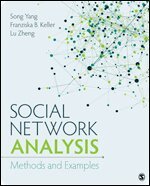
    Social Network Analysis

    Methods and Examples

    AvSong Yang,Franziska B Keller

    Häftad, Engelska, 2017

    1 199 kr

    Beställningsvara. Skickas inom 5-8 vardagar. Fri frakt över 249 kr.

    Fler format och utgåvor

    E-bok

    458 kr

    Beskrivning

    Social Network Analysis: Methods and Examples prepares social science students to conduct their own social network analysis (SNA) by covering basic methodological tools along with illustrative examples from various fields. This innovative book takes a conceptual rather than a mathematical approach as it discusses the connection between what SNA methods have to offer and how those methods are used in research design, data collection, and analysis. Four substantive applications chapters provide examples from politics, work and organizations, mental and physical health, and crime and terrorism studies.

    Produktinformation

    • Utgivningsdatum:2017-01-11
    • Mått:187 x 231 x 13 mm
    • Vikt:430 g
    • Format:Häftad
    • Språk:Engelska
    • Antal sidor:248
    • Upplaga:1
    • Förlag:SAGE Publications
    • ISBN:9781483325217

    Utforska kategorier

    • Sociologi inom Samhälle och politik

    Mer om författaren

    Song Yang (Ph.D., University of Minnesota, 2002) is a professor of sociology and criminology at the University of Arkansas. His teaching and research areas are social network analysis, including business, economic, and organizational networks, work and organization studies, and social statistics. He published many articles and chapters, with the most recent ones on Journal of Business Research and Nonprofit and Voluntary Sector Quarterly. He has written several books, including Social Network Analysis (2008, with David Knoke), The Invisible Hands of Political Parties in Presidential Elections: Party Activists and Political Aggregation from 2004 to 2012 (2013, with Andrew Dowdle, Scott Limbocker, Patrick Stewart, and Karen Sebold), and Social Network Analysis: Methods and Examples (2016, with Franziska Keller, and Lu Zheng).  Franziska Barbara Keller has received her PhD degree from New York University’s Department of Politics, and is currently Assistant Professor at the Division of Social Science at the Hong Kong University of Science and Technology. Her work uses Social Network Analysis to examine informal politics in authoritarian regimes. Her research has been supported by organizations such as the Chiang Ching-Kuo Foundation, and has received the John Sprague Award by the Political Network Section of the American Political Science Association. Her most recent publication, “Moving Beyond Factions: Using Social Network Analysis to Uncover Patronage Networks Among Chinese Elites”, has appeared in the Journal of East Asian Studies.Lu Zheng is Associate Professor of Sociology in Tsinghua University, China and Adjunct Professor of Sociology in Texas A&M University, USA. His research projects focus on corporate social responsibility (CSR), social governance, and China’s ongoing urbanization process. His publications appear in Social Forces, British Journal of Sociology, Social Science Research, and China Quarterly, etc. His paper on listed firms in China’s stock market won the Best Paper Award from the International Association of Chinese Management Research (IACMR) Biennial Conference in 2012. His most recent coauthored book is Data you need to know about China: Research Report of China Household Finance Survey (2014).

    Recensioner i media

    "In the growing literature on social networks, Social Network Analysis: Methods and Examples stands out for the authors′ ability to introduce readers to key network theoretical concepts, methodology, and applications in a variety of fields in a very accessible and clear fashion."

    Innehållsförteckning

    • PrefaceAbout the AuthorsChapter 1: Basics of Social Network Analysis1.1 Introduction1.2 The Social Network and How to Represent It1.3 Types of Networks1.4 Network Parts and Levels of Analysis1.5 Networks as Social Structure and Institution1.6 Theoretical Assumptions1.7 Causality in Social Network Studies1.8 A Brief History of Social Network AnalysisChapter 2: Data Collection2.1 Boundary Specification2.2 Data Collection Process2.3 Informant Bias and Issue of Reliability2.4 Archival DataChapter 3: Descriptive Methods in Social Network Analysis3.1 Graph and Matrix–Social Network Representation3.2 Density3.3 Centrality, Centralization, and Prestige3.4 Cliques3.5 Multidimensional Scaling (MDS) and Dendogram3.6 Structural Equivalence3.7 Two-Mode Networks and Bipartite MatrixChapter 4: Inferential Methods in Social Network Analysis4.1 Permutation and QAP (Quadratic Assignment Procedure) Correlation4.2 P* or Exponential Random Graph Model (ERGM)Chapter 5: Social Network Analysis of Work and Organizations5.1 Personal Connections and Labor Market Processes5.2 Intra-Organizational Networks5.3 Inter-Organizational RelationsChapter 6: Social Network Analysis in Crime and Terrorism6.1 Personal Networks, Delinquency, and Crime6.2 Neighborhood Networks6.3 Criminal Networks6.4 Analyzing Social Networks of TerrorChapter 7: Social Network Analysis in Emotional and Physical Health7.1 Social Network Analysis and Emotional Health7.2 Social Network Analysis in Physical Fitness7.3 Social Network Analysis and Illicit Drug Use7.4 Social Network Analysis and Sexually Transmitted DiseaseChapter 8: Political Networks8.1 American Politics8.2 Networks in International RelationsGlossaryReferencesIndex